

Reducing the environmental footprint of beauty products at home starts with a less glamorous decision than buying a new natural skincare range: using fewer resources and wasting fewer products. Packaging, ingredient production, transportation and disposal all contribute to a cosmetic product’s environmental impact. A plant-based formula, recyclable bottle or refillable dispenser cannot independently guarantee a lower footprint across that entire lifecycle.
The most practical improvements are usually behavioural. Finish products already in the bathroom, avoid unnecessary replacements, choose packaging that fits local recycling or refill infrastructure, and pay attention to how frequently everyday essentials are purchased. These decisions can make a meaningful difference without requiring an entirely new beauty routine.
For eco-conscious consumers, the objective is not to achieve a perfectly waste-free bathroom. It is to identify which purchases and habits create avoidable environmental pressure, then change them using evidence rather than marketing claims. That means distinguishing genuinely useful sustainability measures from attractive but poorly substantiated green credentials.
The practical essentials of lower-waste beauty
- Use existing cosmetics before buying replacements, even when newer products have more sustainable packaging.
- Evaluate the entire product lifecycle, including formulation, packaging, transportation and disposal.
- Choose refills, reusable containers and botanical ingredients only when their real-world use and supply chains justify the environmental claims.
- Why Doesn’t a Plant-Based Skincare Label Guarantee a Low Environmental Footprint?
- How to Reduce Bathroom Beauty Waste Without Throwing Away Usable Products?
- Refill Pouches or Reusable Jars: Which Makes More Sense for Daily Body Care?
- Why Glass Cosmetic Packaging Is Not Automatically Greener Than Plastic
- When to Switch to Refillable Cosmetics Without Increasing Unnecessary Purchases?
- Wild Harvesting or Regenerative Farming: Which Better Supports Botanical Supply?
- Why Natural Ingredient Claims Can Mislead Even When the Plant Is Genuine
- How Can Beauty Brands Source Botanical Ingredients Without Harming Ecosystems?
Why Doesn’t a Plant-Based Skincare Label Guarantee a Low Environmental Footprint?
A plant-based skincare label does not guarantee a low environmental footprint because it describes something about the formulation, not necessarily the product’s complete environmental performance. Agricultural production, ingredient processing, packaging and distribution can all create significant impacts. A cosmetic containing botanical extracts may therefore have a substantial footprint even when its ingredient story sounds environmentally responsible.
Three distinct areas deserve attention:
- Formulation: The cultivation or extraction of ingredients, water and energy consumption, processing methods and potential environmental effects of their use.
- Packaging: The materials, manufacturing processes, weight, components, recyclability and actual disposal options for bottles, tubes, pumps and boxes.
- Logistics: Transportation of raw materials and finished products, distribution distances, storage requirements and delivery packaging.
A label highlighting plant-derived ingredients reveals little about the other two categories. Even within the formulation, natural origin does not automatically mean low impact. Intensive cultivation, irrigation, land conversion, fertilisation and energy-intensive extraction can create environmental pressures. Conversely, a synthetic ingredient may sometimes offer a more resource-efficient alternative. The comparison requires evidence about the actual ingredient and manufacturing process.
This distinction matters when evaluating environmental marketing. The UK’s Competition and Markets Authority (CMA), in its Green Claims Code checklist, explains that environmental claims should be supported by credible evidence and tell the whole story of the product. A favourable characteristic should not create a misleading impression about overall environmental performance.
Consumers should also distinguish voluntary certification from self-declared branding. A third-party certification can provide structured requirements and verification, but its meaning depends on the standard, product and certification scope. A botanical illustration, a green-coloured logo or the word natural is not equivalent to independent assessment.
For US consumers, the FDA‘s ingredient-listing rules provide another useful starting point. Ingredients are generally listed in descending order of predominance, with exceptions for ingredients present at concentrations of 1% or less and certain other categories. However, ingredient position does not reveal exact percentages, environmental impacts or the effectiveness of an ingredient.
The practical priority is to assess high-frequency purchases first. Cleansers, toothpaste, deodorants and shampoo are used repeatedly and can generate recurring packaging and consumption impacts. Investigating a serum used in tiny quantities while ignoring several regularly replaced products may divert attention from more consequential purchasing habits.
A useful purchasing hierarchy is therefore: reduce unnecessary consumption, assess packaging and distribution, and then investigate ingredient sourcing and processing. This does not make formulation irrelevant; it places it within the complete product lifecycle.
Plant-derived ingredients can be valuable, but their origin is only one part of the environmental equation. The next step is to apply the same evidence-based approach to products already sitting in the bathroom, where avoiding premature disposal can prevent unnecessary replacement purchases.
How to Reduce Bathroom Beauty Waste Without Throwing Away Usable Products?
The most effective way to reduce bathroom beauty waste is to use suitable products already owned before purchasing alternatives. Replacing a half-full conventional bottle with a supposedly greener product creates additional consumption rather than eliminating waste. A simple inventory, followed by sensible sorting, helps distinguish products worth finishing from those that should be given away, recycled or discarded.
Start by emptying bathroom shelves and grouping products into four categories:
- Products to finish: Opened, suitable products that remain usable and are compatible with the user’s skin and routine.
- Products to give away: Unopened, suitable products with sufficient remaining shelf life, provided the recipient wants them and local donation rules permit them.
- Products to discard: Items that are expired, contaminated, damaged, unsuitable or associated with an adverse reaction.
- Containers to recover: Empty packaging that can be recycled, returned through a take-back programme or reused appropriately.
Product condition matters more than appearance alone. Changes in smell, colour, consistency or texture can indicate degradation. Separation of phases, unexpected contamination or damaged packaging may also make a product unsuitable. Conversely, an old-looking label or a desire to adopt a new routine does not automatically mean an existing product needs replacing.
In markets where cosmetics display a Period After Opening (PAO) symbol, such as an open jar marked 6M or 12M, that indication communicates the period during which the product is expected to remain suitable after opening under the relevant conditions. It is not interchangeable with an unopened product’s expiry date or best-before indication. Applicable labelling requirements also differ by market and product category.
Do not extend product use simply to avoid waste. Cosmetics that have deteriorated, become contaminated or triggered an allergic reaction should not be applied to the body again. Avoid mixing leftovers, adding water to extend a formula’s life or transferring products into unclean containers.
Unopened products may be suitable for donation, but acceptance rules vary. Charities, shelters and community organisations frequently have restrictions concerning hygiene, product types and remaining shelf life. Confirm acceptance before transporting items. Opened cosmetics should not be donated unless the receiving organisation explicitly accepts them.
For unusable products, check whether the retailer operates a take-back programme and whether the packaging is accepted by local recycling services. Some empty containers can be repurposed for non-cosmetic household tasks, but only where their material and previous contents make that use appropriate. Recycling instructions should take precedence over assumptions based on packaging appearance.
A five-step bathroom waste audit
- Collect every cosmetic and personal care product in one place. Deliverable: a complete bathroom inventory.
- Record which products are opened, unopened and regularly used. Deliverable: a usage-status list.
- Check PAO information, expiry indications, smell, texture and packaging condition. Deliverable: a list of products that remain suitable for use.
- Separate suitable unopened products for potential donation and verify the recipient’s acceptance conditions. Deliverable: a confirmed donation box.
- Identify empty containers and check local recycling or retailer take-back instructions. Deliverable: a packaging disposal list.
The result should be a smaller, more manageable bathroom stock rather than a collection of replacement products purchased to complete an idealised sustainable routine.
Once existing products are under control, packaging choices become easier to evaluate. Refillable systems can reduce repeated container purchases, but their benefits depend on how frequently they are used and what materials are involved.
Refill Pouches or Reusable Jars: Which Makes More Sense for Daily Body Care?
Refill pouches and reusable jars can both reduce packaging waste, but neither is automatically the better choice. A pouch may require less material and weigh less during transport, while a durable container can avoid repeated purchases of complete dispensers. The better option depends on the number of actual refills, material composition, hygiene requirements and local availability.
Three variables are particularly important.
First, consider material efficiency. A lightweight refill pouch may use less packaging material than repeatedly buying rigid bottles. However, a flexible pouch may combine different plastics or incorporate components that make recycling difficult. A reusable container also has an initial manufacturing impact that must be considered rather than ignored.
Second, consider actual reuse. A dispenser only provides a meaningful reuse benefit if it remains functional and is refilled repeatedly. A decorative bottle used once before being replaced by another attractive container creates little advantage. The same applies to refill systems purchased without a reliable commitment to use them.
Third, consider the product itself. Frequent-use liquid products such as shampoo and shower gel are often practical candidates for refill systems. Their regular consumption creates repeated opportunities to avoid buying a complete new bottle. Thick creams, sensitive formulations and products requiring specialised packaging may present additional hygiene, dispensing or stability challenges.
A comparison should include the complete packaging system rather than just the refill container. The initial bottle, pouch, cap, pump, labels, protective packaging and transport all matter. A pouch sold individually with substantial secondary packaging may reduce less waste than expected.
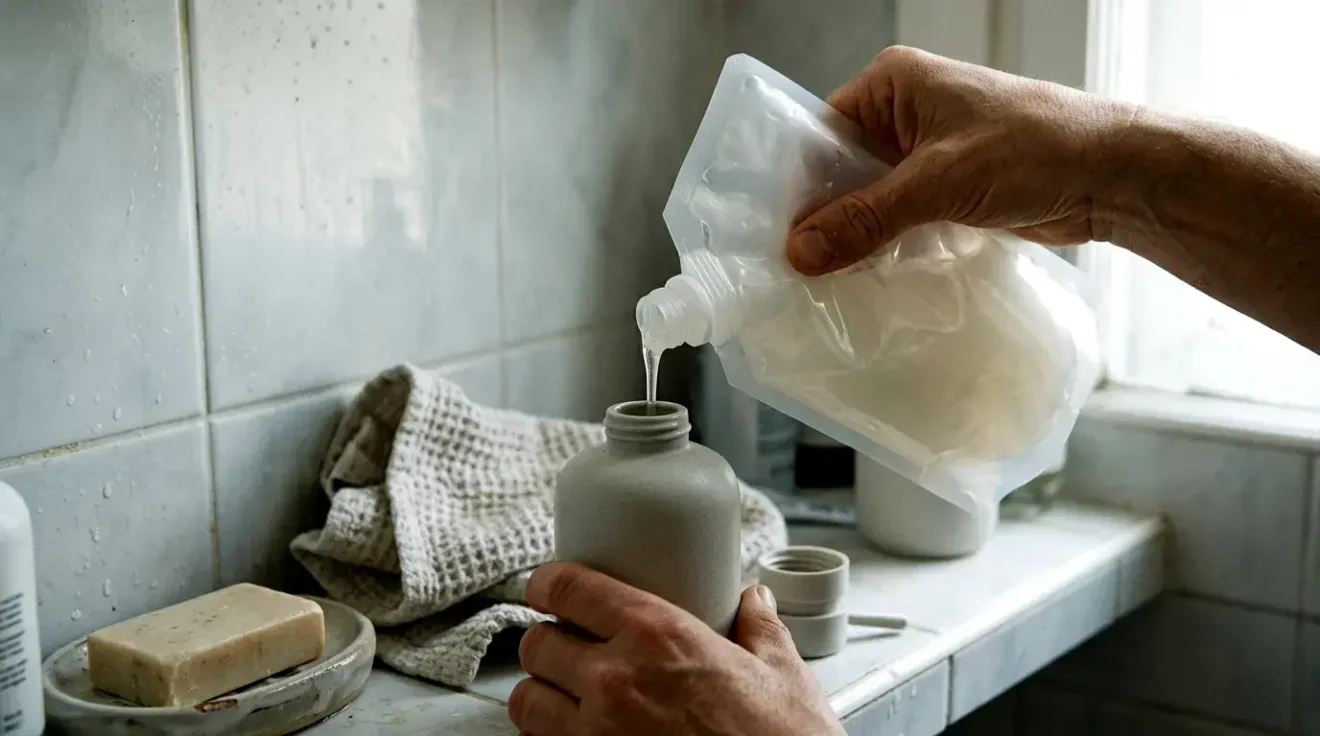
A simple household calculation can clarify whether a refill system makes sense. Compare the total packaging purchased under each option over the same period, including the reusable dispenser and all replacement refills. Also consider the amount of product consumed, so that a smaller package is not mistakenly treated as a more efficient option when it requires more frequent purchases.
Local infrastructure is another deciding factor. Refill stations and compatible products may be readily available in some urban areas but difficult to access elsewhere. Ordering individual refill pouches online can introduce additional delivery packaging and transportation. A refill system that is inconvenient to maintain is less likely to deliver consistent benefits.
The following comparison highlights the main trade-offs.
| Decision criterion | Refill pouches | Reusable jars or dispensers |
|---|---|---|
| Initial packaging | Usually flexible and lightweight | Requires a more durable initial container |
| Transport | Potentially lower weight and volume | Rigid containers can add transport weight |
| Reuse potential | Requires an existing compatible container | Can be refilled repeatedly if maintained |
| Hygiene | Depends on transfer method and refill handling | Requires cleaning and proper drying where appropriate |
| Recycling | Depends on pouch material and local facilities | Depends on material, components and collection systems |
| Practical suitability | Often convenient for frequently used liquids | Useful for long-term dispensing and storage |
Neither format should be selected solely because it looks more sustainable. The useful question is how much packaging the household avoids over time, without introducing unnecessary accessories or additional purchases.
Even when a reusable system is appropriate, the material of the permanent container still matters. Glass is often marketed as a premium sustainable option, but its weight, production and recycling conditions complicate the comparison with plastic.
Why Glass Cosmetic Packaging Is Not Automatically Greener Than Plastic
Glass cosmetic packaging is not automatically greener than plastic because its environmental performance depends on manufacturing energy, container weight, transportation distance, recycled content and actual recycling rates. Glass can be recycled repeatedly without the same material degradation associated with many plastics, but producing and transporting heavy glass containers can increase environmental burdens.
The comparison starts with the difference between material properties and real-world outcomes.
Glass is durable, chemically stable and widely accepted in some recycling systems. It can also retain material value when properly collected and processed. However, producing glass requires high-temperature manufacturing, and heavier containers can increase the weight transported through distribution networks.
Plastic packaging often requires less material for a comparable function. A lightweight, single-material plastic bottle may therefore be more efficient in certain transport and manufacturing scenarios. Yet plastic has its own limitations, including dependence on fossil feedstocks for many conventional polymers, material degradation in some recycling processes and the possibility that small or contaminated items are not recovered.
The thickness of a glass container is particularly relevant. A heavy cosmetic jar with a metal pump, decorative coating and multiple inserts may contain several materials that are difficult to separate. A simpler bottle may perform better in practical recycling systems, even if its material is less visually associated with sustainability.
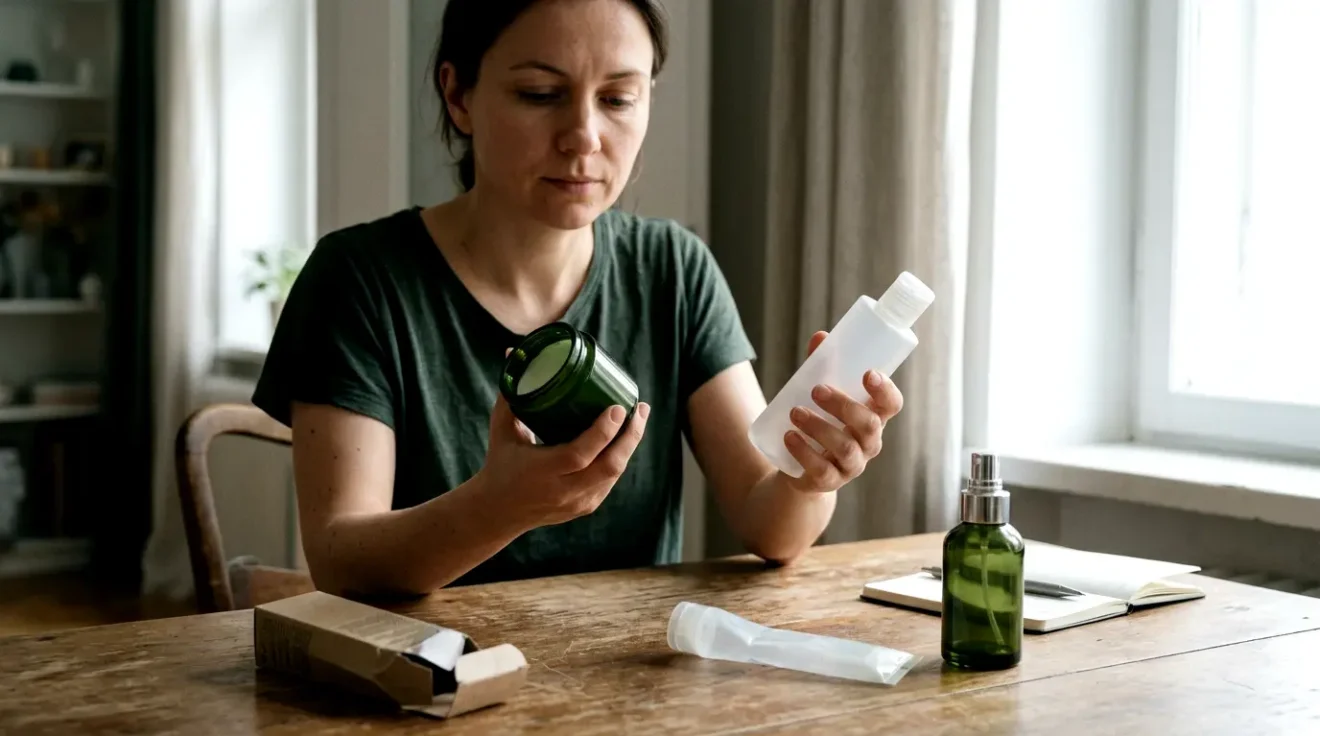
One important distinction is the difference between recyclable and recycled. A package labelled recyclable is not necessarily collected, sorted and reprocessed in the consumer’s area. Small cosmetic containers can be particularly challenging because their size, material combinations or residual contents may prevent them from entering standard municipal recycling streams.
Before choosing a package, check the local waste authority’s instructions. In some locations, glass bottles and jars are accepted through household recycling, while pumps, lids and mixed-material components require separation. Other systems impose restrictions on small formats or particular colours of glass. These details vary by municipality and should not be assumed from a generic recycling symbol.
Compostable and bio-based packaging also deserves careful examination. Bio-based describes the origin of a material, not necessarily its biodegradability. Compostable packaging may require industrial composting conditions that are unavailable in domestic gardens or local waste systems. The actual disposal instructions matter more than the material’s marketing name.
A useful comparison considers:
- The weight of the empty container relative to the quantity of product it holds.
- Whether the packaging is made from one material or several difficult-to-separate components.
- Whether recycled content is specified rather than merely claimed as recyclable.
- Whether the local collection system accepts the complete packaging format.
- Whether a refill or reuse option can avoid manufacturing another complete container.
There is no universal rule that glass should replace plastic or that plastic should always be preferred. The most appropriate choice depends on the product, packaging design, distribution route and end-of-life infrastructure.
Material comparisons are valuable, but they become less important if a household repeatedly replaces products and containers before they are needed. The timing of a transition to refillable cosmetics is therefore just as important as the packaging itself.
When to Switch to Refillable Cosmetics Without Increasing Unnecessary Purchases?
The best time to switch to refillable cosmetics is when an existing product or container reaches the end of its useful life, not when a new sustainability trend appears. Buying a replacement system prematurely can create additional manufacturing demand and waste. A refillable option makes sense when it matches regular consumption, is reliably available and will actually replace repeated purchases of complete packaging.
This principle prevents a common form of sustainable consumption paradox: purchasing new objects to avoid waste from objects that are still perfectly usable.
For example, someone with a functioning shampoo dispenser does not need to replace it with a newly marketed reusable glass bottle. If the existing container can be cleaned and refilled safely with a compatible product, continuing to use it is generally a more rational first step.
Before investing in a new system, evaluate three practical conditions:
- Regular consumption: Is the product used frequently enough to justify a refill system?
- Reliable availability: Can compatible refills be purchased locally or through an established supply route without excessive additional packaging?
- Cost and convenience: Is the refill option practical enough to become the normal purchasing behaviour rather than an occasional experiment?
Compatibility also matters. Not every formula is suitable for transfer into every container. Some products require specific dispensing systems or packaging characteristics to preserve their stability and hygiene. Reusing a container without following the manufacturer’s cleaning and handling instructions can compromise product quality.
Reusable accessories create another potential source of unnecessary waste. Buying several washable cotton pads, travel bottles, soap containers and cosmetic organisers does not automatically reduce environmental impact. If these accessories remain unused or fail to replace disposable alternatives, their production and eventual disposal add to the overall footprint.
A practical approach is to introduce one replacement at a time. Finish the existing product, identify a recurring consumption pattern, and only then consider a reusable alternative. Avoid buying a complete collection of accessories before understanding which ones will genuinely be used.
Household purchasing habits can be monitored through a simple monthly record. Track products purchased, products finished and any packaging avoided through reuse. The relationship between purchases and finished products is a useful indicator of whether consumption is becoming more controlled.
For example, a household may discover that it regularly purchases new skincare products while existing products remain partially used. The first improvement is not necessarily a new refill system; it may be reducing the number of simultaneous products in use.
The distinction between visible and effective sustainability is important. A newly purchased reusable bottle makes a visible statement, but finishing an existing product without replacing it unnecessarily can be the more meaningful action.
Reducing unnecessary purchases also influences the demand for raw materials. Botanical ingredients are not exempt from this principle: their environmental performance depends on the ecosystems, farming practices and harvesting arrangements that supply them.
Key considerations before choosing botanical ingredients
- Wild harvesting needs documented ecological limits to prevent excessive pressure on natural plant populations.
- Regenerative farming offers potential soil and ecosystem benefits, but its effectiveness depends on measurable agricultural practices.
- Traceability and independent supply-chain verification provide stronger evidence than attractive ingredient-origin stories.
Wild Harvesting or Regenerative Farming: Which Better Supports Botanical Supply?
Neither wild harvesting nor regenerative farming is automatically the more sustainable way to source botanical ingredients. Wild collection can preserve access to plants that are difficult to cultivate, but uncontrolled harvesting may deplete natural populations. Regenerative farming can improve soil management and agricultural resilience, although its benefits depend on actual practices, land-use decisions and long-term monitoring.
The two approaches address different supply-chain conditions.
Wild harvesting collects plants from their natural environments. When carefully managed, it can provide livelihoods for collectors and support the use of botanical resources that are not readily cultivated. However, harvesting intensity, seasonality, collection methods and the ecological status of the species all influence whether collection remains sustainable.
Removing too much plant material can affect regeneration and reproduction. Harvesting roots, bark or whole plants may have different ecological consequences from collecting renewable leaves or fruits. The impact also depends on the size and condition of the population and the frequency of collection.
Regenerative agriculture, meanwhile, seeks to improve the condition and functioning of agricultural land through practices such as crop rotation, soil cover, reduced soil disturbance and diversified production systems. These practices can support soil health and biodiversity, but the label regenerative does not guarantee that every farm follows the same standards or achieves identical results.
The key is to distinguish agricultural intentions from verified outcomes. A brand claiming regenerative sourcing should ideally explain which practices are used, where ingredients are grown and how progress is monitored.
For wild ingredients, independent standards provide a useful framework. The FairWild Standard 3.0 addresses sustainable collection through ecological, socio-cultural and business criteria. Its framework considers harvested species, collection-area impacts, collectors’ rights and responsible trade practices.
The standard’s structure includes seven principles and 24 criteria. This describes its assessment framework rather than proving a quantified improvement in biodiversity or the environmental performance of every certified cosmetic ingredient. Its relevance must be checked against the actual ingredient, operator and certification scope.
Consumers can look for several practical indicators when assessing botanical sourcing:
- Named geographical origins for important botanical ingredients.
- Identifiable partnerships with growers, collectors or producer cooperatives.
- Documented harvesting limits and monitoring arrangements for wild species.
- Evidence of agricultural practices for cultivated ingredients.
- Independent certification or verification with a clearly defined scope.
Claims about rare or exotic plants deserve particular scrutiny. Marketing that emphasises scarcity, remote habitats or unusual botanical origins does not establish ecological responsibility. In some circumstances, increased commercial attention to a rare plant may increase pressure on its natural populations.
It is also important not to assume that all wild-harvested ingredients are threatened or that all cultivated botanicals are environmentally beneficial. Some species can be collected responsibly, while some agricultural systems can create significant pressure through land conversion, water use or intensive production.
The most defensible choice depends on the plant, its ecological requirements and the governance of its supply chain. Cultivation may be appropriate for ingredients needed in large volumes, while carefully regulated collection may remain relevant for species that are difficult to domesticate.
Assessing how a plant is harvested or cultivated is only one part of responsible botanical sourcing. Brands also need to demonstrate traceability, fair supply arrangements and oversight across the wider ingredient supply chain.
Why Natural Ingredient Claims Can Mislead Even When the Plant Is Genuine
A natural ingredient claim can be misleading even when the named plant is genuinely present because marketing prominence does not necessarily reflect its concentration, function or environmental significance. A botanical oil featured on the front label may appear in a small quantity, while the rest of the formula consists of ingredients with very different origins and processing requirements.
This distinction separates ingredient authenticity from the overall truthfulness of a marketing message.
A cosmetic may genuinely contain aloe vera, lavender oil or a botanical extract without those ingredients being the main components of its formulation. Their presence alone does not demonstrate that the product is predominantly plant-based, organically produced or environmentally preferable.
Ingredient lists can help, but they need to be interpreted carefully. In the United States, the FDA generally requires cosmetic ingredients to be declared in descending order of predominance. However, ingredients present at concentrations of 1% or less may appear in any order after ingredients present above that threshold. Exact ingredient percentages are not generally required on cosmetic labels.
This means that the position of a botanical ingredient can provide an initial indication of its relative prominence, but it cannot establish its precise concentration. A position near the beginning of the list is not proof that the ingredient is the main active component or that it delivers a particular benefit.
Ingredient processing introduces another layer of complexity. Natural raw materials can be extracted, refined, chemically modified, esterified or otherwise processed to make them suitable for cosmetic formulations. Processing does not automatically make an ingredient environmentally harmful, nor does a synthetic-sounding name prove that an ingredient is petroleum-derived.
For example, coco-caprylate and cetearyl alcohol can have plant-derived feedstocks depending on their manufacturing route. Their INCI names alone do not establish the precise origin, environmental footprint or processing history of a particular supplier’s ingredient.
The COSMOS Standard version 4.2, effective from 1 September 2025, illustrates why a more detailed approach is needed. Its certification criteria distinguish ingredient categories and address agricultural origin, processing methods, product composition, packaging, environmental management and labelling.
COSMOS is a voluntary certification standard, not a universal legal definition of natural cosmetics. Certification also needs to be interpreted according to the specific signature and scope of the certified product or raw material. It does not establish that every certified product has zero environmental impact, or that every uncertified product is environmentally inferior.
There is also a practical reason not to treat the absence of a certification as proof of misconduct. Independent certification can involve financial and administrative requirements. A manufacturer may have a credible formulation and supply chain without holding a particular voluntary label. The appropriate response is to evaluate the evidence available rather than make assumptions based on the presence or absence of a logo.
A useful three-question assessment is:
- Does the highlighted botanical ingredient appear prominently in the ingredient declaration, taking applicable ordering exceptions into account?
- Does the manufacturer provide reliable information about ingredient concentration, formulation or sourcing where relevant?
- Does the brand distinguish independently verified certification from its own marketing descriptions?
These questions help separate verifiable product information from the impression created by botanical imagery, ingredient storytelling and broad natural claims.
For consumers, the lesson is to assess ingredients without treating them as isolated environmental guarantees. The strongest evidence comes from manufacturers that can explain both the materials they use and the systems through which those materials are produced.
How Can Beauty Brands Source Botanical Ingredients Without Harming Ecosystems?
Beauty brands can reduce the ecological risks of botanical sourcing through traceable supply chains, responsible harvesting or farming practices, long-term producer relationships and independent verification. No certification or sourcing statement eliminates every environmental risk. The most credible brands explain where important ingredients originate, how they are produced and what safeguards apply to the ecosystems and communities involved.
Responsible sourcing begins before a botanical ingredient reaches a cosmetic manufacturer. Its environmental footprint is influenced by land management, water availability, harvesting intensity, processing energy, transportation and the economic arrangements supporting producers.
A robust supply chain should therefore address several connected requirements.
Traceability: Brands should be able to identify the geographical origin of important botanical ingredients and, where appropriate, the farms, collection areas or producer organisations involved. Country-of-origin information alone may be insufficient when an ingredient comes from ecologically sensitive regions.
Responsible harvesting: Wild-collected plants require appropriate collection methods, documented limits and consideration of natural regeneration. Harvesting arrangements should reflect the biology and conservation status of the species rather than simply the commercial demand for an ingredient.
Responsible cultivation: Agricultural sourcing should consider soil management, crop diversity, water consumption, chemical inputs and land-use change. A regenerative farming claim is more meaningful when supported by descriptions of actual practices and monitoring.
Long-term producer relationships: Stable purchasing arrangements can support better planning and reduce pressure for short-term extraction. Fair commercial conditions and recognition of local rights are also important parts of responsible botanical supply chains.
Transparent verification: Third-party standards can help establish structured requirements and independent oversight, but their scope must be examined. A certification may cover a particular ingredient, operator, production site or product rather than an entire brand’s portfolio.
Several voluntary standards serve different purposes. COSMOS addresses natural and organic cosmetics, including ingredient origin and processing, formulation, packaging and environmental management. FairWild focuses on wild-harvested products and their ecological, social and business requirements. Fair for Life is another relevant certification framework for responsible trade and supply-chain relationships.
These schemes should not be treated as interchangeable. A standard focused on wild harvesting does not automatically verify regenerative farming, and a cosmetic certification does not necessarily establish that every ingredient comes from an ecologically responsible source.
Consumers can evaluate sourcing claims by looking for concrete information rather than general promises:
- Which botanical ingredients are considered environmentally sensitive by the brand?
- Where are those ingredients cultivated or collected?
- Does the company identify its suppliers or producer partnerships?
- Are harvesting practices, agricultural methods or collection limits documented?
- What does the cited certification actually cover?
A brand that publishes a sourcing policy but provides no geographical information, supplier details or verification may be offering a useful statement of intent, but not sufficient evidence of ecological performance.
It is also reasonable for consumers to ask manufacturers direct questions. Customer-service channels can be used to request information about ingredient origin, wild harvesting, agricultural practices and the scope of certifications. Responses that identify specific suppliers, standards and limitations are generally more useful than broad assurances about sustainability.
However, sourcing improvements should not distract from the overall quantity of beauty products consumed. Even a well-managed botanical ingredient still requires land, water, labour and processing. Reducing unnecessary purchases can therefore lower demand for raw materials before any individual sourcing claim is considered.
The most effective household strategy combines restraint with informed selection: purchase fewer products, use them appropriately, avoid unnecessary packaging and support manufacturers that provide credible evidence about their supply chains.
For a practical next step, review the products already used every day, identify the purchases that can be avoided and investigate the sourcing and packaging claims of products that genuinely need replacing. This approach makes environmental improvement measurable without turning sustainability into another reason to consume more.
What is the most effective way to make a beauty routine more sustainable?
Start by reducing unnecessary purchases and finishing suitable products already owned. Then prioritise frequently used essentials, choose packaging that can realistically be reused or recycled locally, and assess ingredient and sourcing claims using verifiable information. Avoid replacing functioning products simply to adopt a more sustainable-looking routine.
Are natural cosmetics always better for the environment than conventional cosmetics?
No. Natural origin does not automatically mean lower environmental impact. Botanical ingredients can involve intensive agriculture, land use, water consumption and energy-intensive extraction. Synthetic alternatives may sometimes require fewer resources. A meaningful comparison considers the complete formulation, manufacturing process, packaging, transport and disposal rather than ingredient origin alone.
Should glass or plastic containers be preferred for sustainable skincare?
Neither material is universally preferable. Glass offers durability and established recycling pathways in many locations, but it is heavier and energy-intensive to manufacture. Lightweight plastic can reduce transport weight but may be difficult to recycle depending on its composition and local facilities. Packaging weight, material combinations, recycled content and actual collection infrastructure should determine the decision.
Do refillable beauty products always reduce packaging waste?
No. Their benefits depend on repeated use of the original container, the material and packaging of the refills, and the availability of compatible products. A refill system that is used only once or requires heavily packaged individual replacements may deliver limited benefits. Refill frequently used products when the system is practical and genuinely replaces complete new containers.
How can consumers identify genuinely responsible botanical sourcing?
Look for geographical traceability, named producer partnerships, documented harvesting or farming practices and clearly scoped independent certifications. COSMOS, FairWild and Fair for Life address different aspects of responsible production and sourcing. Check what each certification covers rather than assuming that one label verifies every ingredient, supplier or environmental impact across an entire product range.