
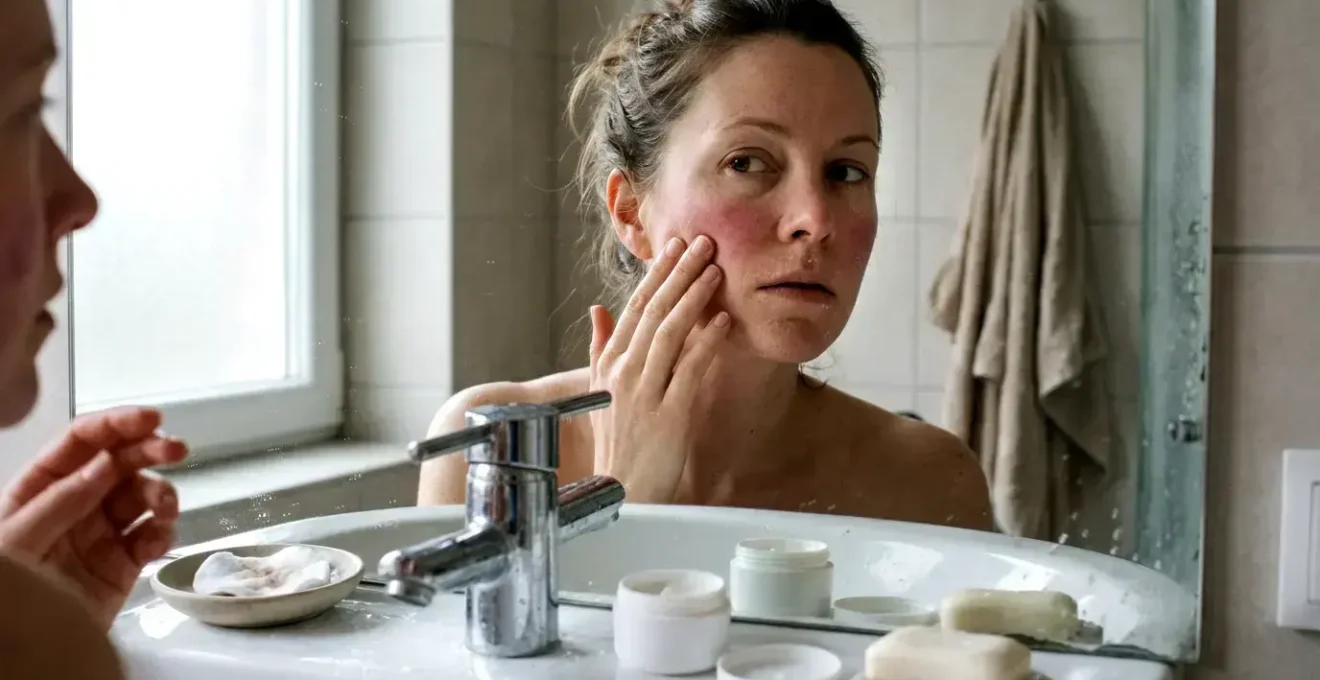
Dryness, tightness, redness and unexpected sensitivity can develop when an otherwise familiar skincare routine becomes too aggressive. Frequent exfoliation, strong cleansing products and overlapping active ingredients may interfere with the skin’s protective barrier, making everyday products uncomfortable. Restoring skin health requires more than applying another moisturiser: it means reducing the factors responsible for irritation while giving the skin a consistent, well-tolerated environment in which to recover.
A practical approach starts with a simplified routine built around gentle cleansing, barrier-supporting moisturisation and appropriate sun protection. Botanical ingredients can contribute useful lipids and soothing compounds, but natural origin does not automatically guarantee compatibility with reactive skin. Formulation, concentration and individual tolerance remain important. Understanding the difference between temporary dehydration and more significant barrier disruption also helps determine which products to pause and when to consider professional advice.
The objective is to restore everyday comfort without repeatedly introducing new treatments. A gradual, evidence-informed approach makes it easier to recognise improvement, avoid unnecessary exfoliation and choose products that support rather than challenge the skin.
How to Restore Skin Health After Product Overuse
- Pause unnecessary exfoliants, strong actives and potentially irritating products while reducing cleansing intensity.
- Use a minimal routine with a gentle cleanser, a compatible moisturiser containing barrier-supporting ingredients and daily sun protection.
- Prioritise consistency, monitor changes in sensitivity and reintroduce optional treatments only when the skin is comfortable and stable.
- Why Does Your Face Feel Tight After Washing Even When You Use Moisturiser?
- How to Reset an Overloaded Skincare Routine Without Triggering More Irritation?
- Dehydrated or Barrier-Damaged Skin: Which Signs Matter After Product Overuse?
- The Skincare Layering Mistakes That Can Make Already Irritated Skin Worse
- When Should Your Skin Start Feeling Better After Stopping Harsh Products?
- Why Do Ceramides, Cholesterol, and Fatty Acids Work Together in Skin Creams?
- Why Fruit Enzyme Exfoliants Can Still Trigger Skin Reactions
- Which Barrier Repair Complex Ingredients Matter Most for Dry, Stressed Skin?
Why Does Your Face Feel Tight After Washing Even When You Use Moisturiser?
Facial tightness after washing can indicate that cleansing has removed more than surface impurities. When a cleanser disrupts protective skin lipids and natural moisturising factors, water escapes more easily from the outer skin layers. Applying moisturiser afterwards may temporarily soften the sensation, but it cannot necessarily compensate for repeated exposure to an overly aggressive cleansing formula.
The outermost skin layer, known as the stratum corneum, works as a protective barrier. It contains flattened skin cells surrounded by an organised matrix of lipids. These components help retain moisture and limit exposure to external irritants. Cleansing surfactants remove oil and debris by interacting with surface substances, but their effects depend on the formulation, concentration, contact time and cleansing conditions.
Harsh alkaline soaps and poorly tolerated cleansing practices can disturb the proteins and lipids that maintain barrier integrity. A scientific review of soaps, syndets and skin barrier integrity explains why cleanser selection matters when maintaining the protective function of the stratum corneum. Appropriately formulated synthetic detergent cleansers, known as syndets, may be better tolerated than traditional alkaline soaps.
A useful way to assess post-cleansing discomfort is to observe how the skin behaves rather than relying on one sensation. Consider these patterns:
- Temporary dryness: Tightness improves relatively quickly after applying a compatible moisturiser and does not consistently return.
- Persistent discomfort: Tightness continues despite moisturising or appears after nearly every cleansing session.
- Increased reactivity: Water, previously tolerated skincare products or ordinary environmental exposure causes stinging or burning.
These observations are practical indicators, not a validated diagnostic test. Persistent discomfort deserves more attention than occasional dryness, particularly when accompanied by redness or roughness.
Three major lipid families
Ceramides, cholesterol and free fatty acids form the principal lipid groups in the stratum corneum. Their organisation contributes to the skin’s protective structure and moisture-retention function.
Evidence: scientific review of soaps, syndets and skin barrier integrity.
One particularly misleading habit is treating a squeaky-clean sensation as evidence of effective cleansing. Skin does not need to feel stripped to be clean. Repeatedly pursuing that sensation can reinforce a cycle in which cleansing removes protective components, moisturiser briefly reduces discomfort and the next aggressive wash recreates the problem.
When tightness becomes a recurring experience, the most useful next step is to reconsider the entire routine rather than compensate with increasingly rich products. Reducing unnecessary cleansing and treatment exposure provides a more practical starting point for recovery.
How to Reset an Overloaded Skincare Routine Without Triggering More Irritation?
Resetting an overloaded skincare routine means temporarily removing unnecessary treatments while keeping a small number of well-tolerated essentials. The priority is to stop repeated irritation without introducing several unfamiliar products at once. A gentle cleanser, a suitable barrier-supporting moisturiser and sun protection usually provide a sensible foundation while the skin’s comfort and tolerance are monitored.
The first step is identifying which products contribute the greatest potential for irritation. Frequent exfoliation, retinoids, strong acid treatments and combinations of multiple active ingredients deserve particular attention when discomfort begins after an intensive routine. Fragranced products and essential oils may also be problematic for some individuals, especially when the skin is already reactive.
Rather than immediately replacing everything, create a temporary pause list. Remove non-essential treatments and avoid combining several potentially irritating products. If a prescribed treatment is involved, consult the prescribing healthcare professional before changing its use.
The maintenance routine should remain deliberately uncomplicated:
- Cleanser: Choose a mild, appropriately formulated product that removes everyday impurities without leaving the skin feeling stripped.
- Moisturiser: Select a compatible formulation that combines hydration with barrier-supporting ingredients.
- Sun protection: Maintain daily broad-spectrum sun protection, selecting a formulation that the skin tolerates comfortably.
Consistency is more important than the number of products. A complicated routine makes it harder to identify individual triggers, whereas a small maintenance set provides a clearer picture of how the skin responds.
Botanical skincare can fit into this approach through carefully selected plant-derived oils, lipid-supporting ingredients and soothing compounds. However, replacing synthetic actives with several botanical products simultaneously can recreate the original problem. Essential oils and botanical extracts can also cause irritation or allergic contact reactions.
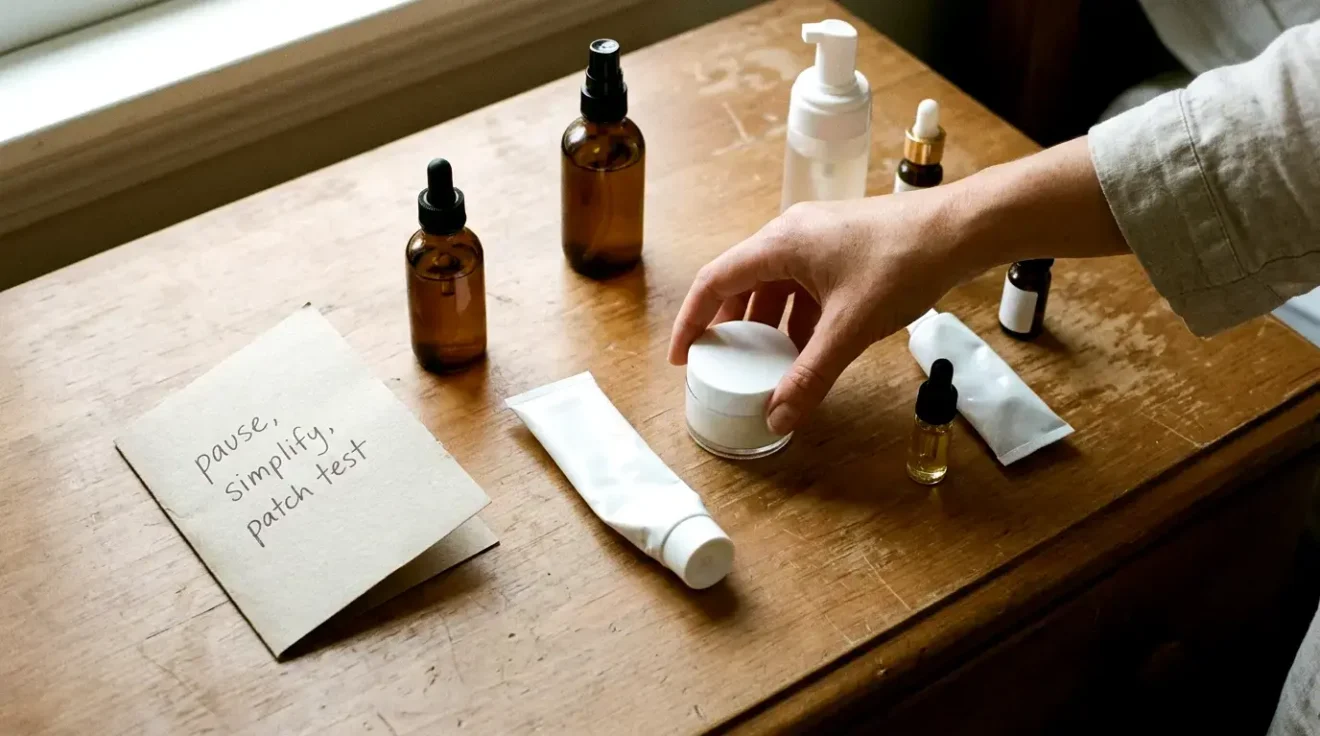
Another common concern is the idea of a detox breakout. Skin does not need to undergo a cleansing or detoxification phase to recover from product overuse. Changes in breakouts after stopping active ingredients may reflect the loss of their previous effects, while a new reaction may indicate intolerance to a replacement product. These possibilities should not be treated as interchangeable.
Introduce any replacement product individually, preferably when the skin is relatively settled. A small-area test can help identify obvious intolerance before wider application, although it cannot guarantee that a product will never cause a reaction.
Your Five-Step Skincare Reset Checklist
- Review every current product and create a written inventory showing its main active ingredients.
- Identify and pause non-essential exfoliants and potentially irritating treatments, recording the products removed.
- Select one gentle cleanser and document its name and how the skin feels after use.
- Choose one compatible moisturiser and one tolerated sun protection product, recording their ingredients and application schedule.
- Introduce any optional botanical product individually and maintain a simple daily record of redness, tightness, stinging and comfort.
The German clinical guideline on contact dermatitis emphasises reducing exposure to relevant irritants and allergens while allowing sufficient time for barrier restoration. It also highlights the importance of selecting topical skincare according to individual skin condition and tolerance.
Once unnecessary exposure has been reduced, observing the skin becomes more meaningful. The next challenge is determining whether the remaining symptoms reflect a lack of water, a disrupted protective barrier or a combination of both.
Dehydrated or Barrier-Damaged Skin: Which Signs Matter After Product Overuse?
Dehydrated skin lacks sufficient water in its upper layers, whereas barrier-damaged skin has impaired protective function and may lose water more readily while becoming unusually reactive. Both conditions can produce tightness and roughness, but persistent stinging, redness and intolerance to familiar products suggest that simple dehydration may not explain the entire problem.
Dehydration is a condition that can affect different skin types, including naturally oily skin. Its visible signs may include dullness, fine dehydration lines and a temporary feeling of tightness. These symptoms can fluctuate with environmental conditions, cleansing habits and the consistency of moisturising.
Barrier disruption involves a broader problem. When the lipid organisation and protective function of the outer skin layer are compromised, the skin may become more vulnerable to external irritants and experience increased transepidermal water loss. This can contribute to dryness, redness, roughness and discomfort.
The two conditions can occur together. A person who has repeatedly used strong exfoliants and aggressive cleansers may experience both insufficient surface hydration and impaired barrier function.
Several observations can help clarify the pattern:
- Reaction to water: Does ordinary water produce unexpected stinging or burning?
- Reaction to familiar moisturiser: Has a previously tolerated product started to cause discomfort?
- Redness: Does flushing appear after cleansing, application of products or exposure to environmental conditions?
- Texture: Are there persistent rough areas, flaking or a visibly uneven surface?
- Symptom progression: Are symptoms becoming less frequent, remaining unchanged or worsening?

These observations should be recorded over several days rather than interpreted from a single morning. However, deliberately exposing uncomfortable skin to water or a suspected trigger is unnecessary. Stop an application that causes significant discomfort rather than repeating it to test the reaction.
The distinction matters because the recovery priorities differ. Dehydration may respond to humectant ingredients such as glycerin, combined with moisturising products that reduce water loss. A compromised barrier needs a broader reduction in irritating exposure, supported by appropriately formulated moisturisers and time for recovery.
It is also important not to confuse cosmetic irritation with a confirmed diagnosis. Persistent burning, swelling, itching or recurring eczema-like symptoms may indicate irritant or allergic contact dermatitis. The German clinical guideline on contact dermatitis explains the importance of identifying relevant triggers and adapting skincare to individual tolerance.
When symptoms suggest increased reactivity, the safest approach is to reduce unnecessary exposure before experimenting with additional hydration or botanical treatments. That distinction also makes it easier to avoid application habits that can intensify discomfort.
The Skincare Layering Mistakes That Can Make Already Irritated Skin Worse
Skincare layering can make irritation worse when too many products introduce overlapping actives, fragrances or potentially irritating ingredients. Even individually well-tolerated formulations may become problematic when combined with frequent cleansing, exfoliation and repeated applications. A simpler routine with compatible textures and fewer active ingredients is generally easier to manage while skin comfort is being restored.
One frequent mistake is applying multiple watery products because the skin feels dehydrated. Serums containing humectants such as glycerin can attract and hold water, but adding several layers does not automatically improve hydration. The final result also depends on the moisturiser, surrounding humidity, formulation and condition of the skin.
In dry environmental conditions, relying on numerous lightweight hydration layers without an appropriate moisturising product may leave the skin feeling uncomfortable. A cream containing suitable emollient and occlusive components can help reduce water loss and improve the overall feel of the skin.
Another problem is applying too many products without allowing the skin to tolerate each formulation independently. Combining a supposedly gentle moisturiser with a strong active ingredient does not neutralise the active’s potential to irritate.
For a simplified routine, the general application logic is:
- Begin with a gentle cleanser when cleansing is needed.
- Apply an optional, well-tolerated lightweight hydrating product.
- Follow with a barrier-supporting moisturiser.
- Use an appropriate occlusive product only when needed and tolerated.
- Apply sun protection as the final step of the morning skincare routine.
This is a practical framework rather than a universal rule for every formulation. Product instructions, texture and compatibility can change the appropriate order. More importantly, a compromised barrier is not a reason to maximise the number of layers.
Botanical formulations deserve the same scrutiny as conventional products. Essential oils, fragrant plant extracts and complex blends can contain substances that trigger irritation or allergic contact reactions. A natural label does not guarantee that a formula will be suitable for skin experiencing increased sensitivity.
Fragrance is particularly important when evaluating a replacement routine. A product tolerated before irritation developed may no longer feel comfortable when the skin is reactive. However, this does not mean every botanical extract is unsuitable or that every essential oil causes a reaction.
Another avoidable mistake is layering exfoliating treatments with other active ingredients. Acid-based products, retinoids and enzyme exfoliants can collectively increase treatment intensity, particularly when used frequently. During an active recovery phase, the priority should be removing unnecessary irritation rather than optimising exfoliation.
Once the number of products has been reduced, consistency becomes the main focus. The skin’s response over time is more informative than the immediate sensation produced by applying several products together.
When Should Your Skin Start Feeling Better After Stopping Harsh Products?
Skin may begin feeling more comfortable within days of removing an irritating product, but complete barrier recovery can take longer. The timeline depends on the severity and duration of irritation, the products involved, individual skin characteristics and whether exposure to the original triggers continues. There is no universal recovery schedule that applies to every person.
Superficial discomfort may settle relatively quickly when the main irritant is removed and the routine becomes gentler. However, persistent dryness, sensitivity or redness can take longer to improve, particularly after prolonged or repeated exposure to aggressive treatments.
Rather than relying on an arbitrary deadline, monitor the order in which symptoms change. A useful progression to look for includes:
- Reduced stinging: Everyday cleansing and moisturising become more comfortable.
- Less flushing: Redness becomes less frequent or less pronounced.
- Improved tightness: The skin feels more comfortable between cleansing and moisturising.
- Better texture: Roughness and visible flaking gradually become less noticeable.
- Greater product tolerance: Previously uncomfortable basic skincare steps become easier to maintain.
Improvement does not necessarily happen in a perfectly linear sequence. Environmental conditions, stress, weather, existing skin disorders and accidental exposure to irritating ingredients can all influence symptoms. A short period of improvement followed by renewed discomfort does not automatically mean that recovery has failed.
Consistency is especially important at this stage. Introducing a new serum or exfoliant as soon as the skin looks slightly better can make it difficult to identify what is helping. Continue with the minimal routine rather than attempting to accelerate recovery with additional treatments.
Professional assessment is appropriate if symptoms worsen, remain persistent or appear inconsistent with ordinary cosmetic dryness. Warning signs include significant swelling, increasing redness, blistering, oozing, spreading irritation or severe discomfort. Symptoms around the eyes or signs of infection also warrant medical attention. Breathing difficulty or swelling of the lips or tongue requires emergency medical care.
Persistent symptoms may also indicate allergic contact dermatitis or another underlying skin condition rather than product overuse alone. A dermatologist can assess the pattern of symptoms and determine whether further investigation, including contact allergy testing, is appropriate.
Once everyday sensitivity has settled, attention can shift towards the composition of the moisturiser itself. Understanding how skin lipids work together makes it easier to select products that support the barrier without relying on isolated ingredient claims.
Key Points Before Choosing a Barrier Repair Cream
- Reducing exposure to irritating products remains the foundation of recovery.
- Barrier-supporting moisturisers should combine appropriate hydration and lipid support rather than relying on a single headline ingredient.
- Individual tolerance matters more than whether an ingredient is described as natural, advanced or intensive.
Why Do Ceramides, Cholesterol, and Fatty Acids Work Together in Skin Creams?
Ceramides, cholesterol and free fatty acids work together because they form the principal lipid families in the skin’s outer protective layer. Their organisation into structured lamellar arrangements helps limit water loss and protects against external substances. A moisturiser containing several complementary barrier lipids may therefore offer a more comprehensive approach than one relying on a single fashionable ingredient.
The stratum corneum is often described through a brick-and-mortar model. Corneocytes, the flattened cells at the surface, represent the bricks, while the surrounding lipid matrix acts as the mortar. This arrangement helps maintain the physical organisation and protective function of the outer skin layer.
The three principal lipid families have complementary roles:
- Ceramides: These specialised lipids contribute to the organised structure of the intercellular lipid matrix.
- Cholesterol: This lipid participates in the organisation and physical properties of the barrier’s lipid structures.
- Free fatty acids: These contribute to the lipid matrix and help maintain its organisation and protective characteristics.
These lipids do not function as three independent moisturising ingredients. Their proportions and organisation influence the physical properties of the lipid matrix, including its ability to restrict water diffusion.
Approximately 1:1:1
An approximate molar ratio of ceramides, cholesterol and free fatty acids is described for the principal intercellular lipid classes in the stratum corneum. This refers to endogenous skin lipids, not a mandatory ingredient ratio for every commercial moisturiser.
Evidence: The scientific review of ceramides and skin barrier formulation discussed in the International Journal of Cosmetic Science.
Formulation is as important as ingredient presence. A product can list ceramides without necessarily providing them in a formulation that supports their intended function. The way lipids are incorporated, their compatibility and their physical organisation influence the potential performance of the finished product.
The scientific review of ceramides and skin barrier formulation discusses how lipid organisation affects barrier function and why the formulation of topical ceramides deserves attention. The review also reports in vitro findings concerning improperly dissolved ceramides, although these findings should not be treated as direct evidence of clinical outcomes for every commercial cream.
For consumers, the practical lesson is to look beyond one highlighted ingredient. A moisturiser that combines several relevant lipid families may provide a more comprehensive formulation approach than one promoted exclusively around a single ceramide or plant oil.
Botanical oils can contribute useful fatty acids, including linoleic acid, depending on their composition. However, a plant oil is not automatically equivalent to a complete barrier-repair formulation. It may provide lipid support without supplying the full range of components found in more comprehensive moisturisers.
Topical lipids can support skin comfort and contribute to the restoration of the outer barrier, but they should not be understood as permanently replacing the skin’s own lipid production. Continued exposure to irritating cleansers or excessive exfoliation can undermine the benefits of an otherwise appropriate moisturiser.
The most useful formulation is one that combines appropriate lipid support with good individual tolerance. This becomes particularly important when deciding whether seemingly gentler exfoliation methods are suitable during or after recovery.
Why Fruit Enzyme Exfoliants Can Still Trigger Skin Reactions
Fruit enzyme exfoliants can still trigger skin reactions because their exfoliating action involves breaking down proteins associated with the outer skin layer. Although enzymes such as papain and bromelain are often marketed as gentler alternatives to exfoliating acids, they remain active exfoliating ingredients. On recently irritated skin, even enzymatic exfoliation may increase discomfort or aggravate existing sensitivity.
Proteolytic enzymes act on proteins and can help loosen material associated with the skin’s natural desquamation process. Papain, commonly associated with papaya, and bromelain, associated with pineapple, are examples used in cosmetic exfoliating formulations.
The distinction between chemical acids and fruit enzymes is therefore not simply a distinction between aggressive and gentle treatments. Both approaches are intended to influence the removal of surface skin material, and both require appropriate formulation and use.
This matters particularly after repeated product overuse. If the skin is already experiencing redness, persistent tightness or unexpected stinging, introducing another exfoliating treatment may create additional irritation. Replacing an acid with an enzyme does not automatically solve the underlying problem.
Scientific evidence also deserves careful interpretation. A review of proteolytic enzymes used as exfoliating agents identified papain, bromelain and other enzymes as cosmetic exfoliation ingredients. It discussed formulation variables such as pH, temperature and enzyme stabilisation, while highlighting the limited number of clinical studies specifically evaluating enzymatic exfoliation.
Only 11 relevant articles were identified in the review, and relatively few involved clinical trials assessing enzymes as exfoliants. The available evidence therefore does not establish that every fruit enzyme exfoliant is irritating or that all formulations have the same safety profile.
Several formulation characteristics can influence how an enzyme product performs:
- Concentration: The amount of active enzyme influences the formulation’s intended activity.
- pH: Enzyme performance and stability can depend on the acidity or alkalinity of the formula.
- Temperature: Storage and formulation conditions can influence enzyme stability.
- Supporting ingredients: The presence of moisturising or soothing compounds may influence the overall user experience.
- Fragrance: Added fragrance or aromatic botanical extracts may introduce additional potential triggers.
The PubMed review of proteolytic enzyme exfoliants highlights the need for further robust in vivo research before enzymatic exfoliation can be confidently recommended as a treatment modality under the conditions reviewed.
For someone recovering from an overloaded routine, the immediate priority should be avoiding exfoliation altogether while symptoms remain active. Reintroduction should be considered only when everyday skincare is comfortable and signs such as persistent redness, stinging and roughness have settled.
If an exfoliant is eventually reintroduced, a cautious approach is preferable:
- Choose a formulation with transparent ingredient information and clear usage instructions.
- Check whether it contains additional exfoliating actives or fragrance.
- Test a small area according to appropriate product instructions before wider application.
- Begin with less frequent use than the previous routine, following the manufacturer’s directions.
- Stop immediately if stinging, persistent redness or renewed irritation develops.
A small-area test can reduce uncertainty but cannot rule out every delayed or cumulative reaction. Anyone with persistent dermatitis or significant sensitivity should seek professional advice before resuming exfoliation.
Exfoliation should remain optional rather than becoming a compulsory step in a recovery routine. A comfortable, stable skin barrier is a more useful priority than achieving an immediately smoother surface.
Which Barrier Repair Complex Ingredients Matter Most for Dry, Stressed Skin?
The most useful barrier repair complexes combine ingredients that replenish or support skin lipids, bind water and improve comfort. Ceramides, cholesterol, fatty acids, suitable plant oils and glycerin can contribute to these different functions. However, no single ingredient guarantees recovery. The most appropriate formula is one that provides balanced support while remaining comfortable and well tolerated with consistent use.
Rather than choosing a cream based on a long list of fashionable ingredients, evaluate its components according to their intended functions. A practical ingredient framework includes three main groups.
1. Lipid-supporting ingredients
Ceramides, cholesterol and free fatty acids contribute to the organisation of the skin’s protective lipid matrix. Plant-derived oils may also provide fatty acids that contribute to the emollient properties of a formulation.
Some botanical oils are particularly relevant because of their fatty acid composition. Oils containing linoleic acid can contribute to lipid replenishment, although the complete composition and formulation determine their suitability for individual skin types.
2. Water-binding ingredients
Humectants attract and retain water in the outer skin layers. Glycerin is a well-established example used in moisturising formulations. It can help improve hydration and reduce the uncomfortable feeling associated with surface dryness.
Humectants work best as part of a complete moisturising approach. Their presence does not automatically replace the need for emollient or occlusive components that help reduce water loss.
3. Soothing and comfort-supporting ingredients
Some formulations include ingredients intended to improve the feel of dry or uncomfortable skin. Examples may include carefully selected botanical extracts and other soothing compounds. Their suitability depends on the individual ingredient, concentration, formulation and potential for irritation or allergy.
A botanical ingredient should never be assumed to be universally calming. Fragrant extracts and essential oils may be unsuitable for reactive skin, even when they are derived from plants.
For consumers comparing barrier creams, a practical selection framework is more useful than chasing the highest number of ingredients:
- Check lipid diversity: Look for complementary barrier-supporting lipids rather than relying exclusively on one headline ingredient.
- Review the full ingredient list: Identify the presence of ceramides, cholesterol, fatty acids, glycerin and other relevant components.
- Consider ingredient placement: The order of ingredients can provide context, although it does not disclose exact concentrations or guarantee performance.
- Screen for personal triggers: Pay attention to fragrance, essential oils and ingredients previously associated with discomfort.
- Prioritise suitable formulations: A simpler cream designed for dry or sensitive skin may be more appropriate than a complex product making numerous treatment claims.
The word natural should not be used as a substitute for ingredient assessment. Plant oils and extracts can be valuable components of a moisturising formulation, but their origin does not establish their safety or suitability for every individual.
Another consideration is the condition of the skin when the product is introduced. A formula that was comfortable before aggressive exfoliation may feel different when the protective barrier is compromised. Introducing new products individually makes it easier to identify possible reactions and avoid unnecessary changes.
Consistency also matters. A moisturiser that is comfortable enough to use regularly is generally a more practical choice than an elaborate formulation that causes stinging or is difficult to tolerate. Twice-daily use may be suitable for many moisturisers when consistent with the product instructions and individual needs, but it is not a universal medical requirement.
For a botanical-focused routine, the most sensible approach is to combine a well-tolerated moisturising formula with a gentle cleanser and daily sun protection. Additional oils, serums and exfoliants should remain optional and should not be introduced simply because they are marketed as natural or restorative.
The central principle is straightforward: restore comfort by reducing unnecessary irritation, supporting the skin’s protective structure and maintaining a routine that can be tolerated consistently. If dryness, redness or sensitivity persists despite these adjustments, professional assessment can help identify whether another skin condition or contact allergy requires attention.
Can skin recover naturally after using too many active skincare products?
Skin can often regain comfort and improve barrier function after unnecessary irritants are removed. Recovery depends on the extent of disruption, individual skin characteristics and whether other conditions are present. A gentle routine with appropriate moisturisation and sun protection supports this process. Persistent or worsening symptoms should be assessed by a healthcare professional.
Should you stop using all skincare products when your face becomes irritated?
Not necessarily. Stopping every product can remove useful basic skincare steps, including moisturisation and sun protection. A more practical approach is to pause non-essential actives and exfoliants while retaining a small number of products that are already well tolerated. Prescribed treatments should not be discontinued without appropriate medical advice.
Are natural oils suitable for skin with a damaged moisture barrier?
Some plant oils can provide emollient and lipid-supporting benefits, depending on their fatty acid composition and formulation. However, natural oils are not universally suitable. Fragrance, botanical extracts and individual sensitivities can influence tolerance. Introduce any unfamiliar product cautiously and prioritise formulations designed for dry or sensitive skin.
Can you use hyaluronic acid while recovering from skincare irritation?
Hyaluronic acid is a humectant used to attract and retain water in skincare formulations. It may be suitable for some people during recovery, provided the complete product is comfortable and well tolerated. It does not replace barrier-supporting lipids or eliminate the need to reduce irritating products. If an application causes stinging, discontinue it and reassess the formula.
When can you safely restart exfoliation after damaging your skin barrier?
There is no universal restart date. Exfoliation should remain paused while the skin experiences persistent redness, stinging, tightness or unusual sensitivity. Once basic skincare is consistently comfortable and the visible signs of irritation have settled, a suitable exfoliant may be cautiously reintroduced according to its instructions. Stop if symptoms return, and seek professional advice if irritation persists.