

High-performance skincare is not about using the largest number of products or choosing the richest formula. It is about matching ingredients, textures and application methods to the needs of each skin area. Facial skin, hands, forearms and lower legs differ in their anatomical characteristics, lipid content and exposure to environmental stress. Consequently, one moisturiser may feel comfortable on the face but leave the shins insufficiently protected, or feel unnecessarily heavy on frequently washed hands.
A practical routine should therefore be assessed through observable outcomes: reduced tightness, less visible flaking, comfortable absorption and fewer episodes of irritation. These indicators are more useful than fragrance, immediate softness or the sensation of a product sitting on the skin. Natural skincare can support this approach, provided that formulations are evaluated by their actual functions rather than their marketing claims.
The objective is to establish a small collection of complementary products, adjust quantities by anatomical zone and monitor results over time. This makes it possible to simplify daily care without compromising the different requirements of facial and body skin.
What Makes a Face and Body Routine Perform Better?
- Match product textures to regional skin characteristics and measurable hydration needs rather than assuming one formula works equally everywhere.
- Combine humectants, emollients and occlusives according to skin condition, especially on dry areas such as the shins and hands.
- Measure results through comfort, reduced flaking, manageable residue and barrier tolerance instead of relying exclusively on immediate sensory impressions.
- Why Does a Face Cream Feel Different When Applied to Arms and Legs?
- How to Match Skincare Textures to Your Face, Hands, and Body Without Waste?
- Body Lotion or Body Balm: Which Works Better for Very Dry Shins?
- Why Strong Facial Exfoliants Can Cause Problems When Used Across the Body
- How to Adjust Face and Body Care After Swimming or Frequent Showering?
- How to Layer a Hydrating Serum and Light Cream Without Sticky Residue?
- When to Apply Carrier Oil After Bathing for Better Skin Comfort?
- Which Barrier Repair Complex Ingredients Matter Most for Dry, Stressed Skin?
Why Does a Face Cream Feel Different When Applied to Arms and Legs?
A face cream can feel lighter, heavier or less effective on the arms and legs because skin physiology varies across anatomical regions. Facial skin generally belongs to sebaceous regions with greater sebaceous gland activity, whereas the extremities are commonly classified as dry regions with lower surface lipid content. These differences influence how a moisturiser feels and how well its formulation meets local skin requirements. The same product therefore does not necessarily deliver equivalent comfort or barrier support everywhere.
A scientific review of regional skin barrier differences published in the Journal of the European Academy of Dermatology and Venereology describes anatomical variations in skin lipid content and barrier characteristics. It distinguishes sebaceous, moist and dry regions rather than treating human skin as a uniform surface. Importantly, these categories form a continuum, and the findings do not establish that every body area has thinner skin than the face.
These physiological differences explain why a cream rich in lipids may feel comfortable on the cheeks but leave a persistent film on the forearms. Conversely, a lightweight facial moisturiser may provide insufficient emollience for dry shins. High lipid content alone does not guarantee effective hydration: the balance between water-binding ingredients, emollients, occlusives and the formulation’s overall characteristics also matters.
Efficiency should consequently be evaluated by anatomical zone. Relevant observations include how quickly the product settles, whether residue remains after application and whether tightness returns later in the day. These are practical indicators, not laboratory measurements of absorption or proven penetration rates.
A simple comparison can identify mismatches. Apply the same cream to a cheek, the back of one hand and a shin. Use comparable amounts relative to the treated areas, then observe the finish immediately and again after 30 minutes. Note which area feels comfortable, which remains greasy and where dryness persists. The result provides a useful indication of whether the formulation suits multiple zones.
The key distinction is between a product that feels nourishing and one that addresses a particular area’s needs. A richer formula is not automatically more effective on the body, particularly when its formulation is primarily designed for facial use.
Once these differences are recognised, texture selection becomes a practical decision rather than an exercise in choosing the richest available cream.
How to Match Skincare Textures to Your Face, Hands, and Body Without Waste?
The most efficient skincare texture depends on the area being treated, its condition and the finish required. A lightweight gel can suit facial skin that dislikes heavy residue, a fast-absorbing lotion can work well on hands during the day, and a richer balm can provide additional lipid protection to dry shins. Carrier oils offer another option for reducing moisture loss. No single texture is universally superior: its performance depends on the formulation and the skin’s requirements.
Each format has a different functional profile. Gels often provide lightweight hydration, particularly when formulated with humectants. Lotions distribute easily across larger areas and can combine water, emollients and occlusives. Balms generally contain a higher proportion of lipids and provide a more substantial protective film. Oils primarily contribute emollient and occlusive effects, depending on their composition.
| Skin area | Potentially suitable texture | Performance objective |
|---|---|---|
| Face | Light gel or cream | Hydration with a comfortable, manageable finish |
| Hands | Fast-absorbing lotion or cream | Comfort without interfering with daytime activities |
| Forearms | Light lotion or cream | Even application over a relatively large surface |
| Very dry shins | Rich cream or balm | Emollience and reduced moisture loss |
| Dry elbows | Rich cream, balm or suitable oil | Additional lipid support for rough areas |
Application quantity also influences performance. A useful starting point is to use the product’s recommended facial dose, such as an appropriate fingertip-based measure, and adjust body application according to the area covered. One pump per limb segment can serve as a practical starting estimate when the dispenser and formula allow it, but it is not a universal dermatological dosage.
Applying too little can leave dry areas untreated. Applying too much can produce persistent residue, transfer onto clothing and unnecessary product consumption. The better approach is to distribute a modest amount evenly, assess coverage and add product only where dryness or discomfort remains.
There is also a cost-efficiency trade-off. A versatile natural moisturiser can simplify a routine when its formulation genuinely suits several areas. However, using one product everywhere may create hidden costs if it repeatedly underperforms on particularly dry or sensitive zones. A separate body balm may be more economical than repeatedly applying a facial cream that does not provide sufficient comfort.
Texture should never become the only measure of effectiveness. A product can absorb quickly yet leave the skin tight two hours later. Equally, a slightly richer cream may provide better sustained comfort without feeling excessively greasy.
Five Steps to Audit Your Face and Body Skincare Routine
- List the areas requiring care and record their main concerns, such as facial tightness, hand dryness or shin flaking.
- Identify the texture and principal functional ingredients of each current product. Create a simple product-to-zone inventory.
- Apply a consistent starting quantity to each relevant area and record immediate absorption and residue observations.
- Check each treated area again after two hours. Record persistent tightness, dryness or discomfort in a short assessment log.
- Remove unnecessary overlapping products and retain the smallest combination that consistently meets the identified needs.
This approach makes the next decision easier: when dryness becomes pronounced, the distinction between a lotion and a balm becomes particularly important.
Body Lotion or Body Balm: Which Works Better for Very Dry Shins?
For very dry shins, a body balm or a rich cream will often provide more sustained comfort than a lightweight lotion, particularly when the skin has low surface lipid content and visible flaking. However, the best choice depends on the formulation and the severity of dryness. A lotion containing effective humectants can help increase water content, while a balm can reduce moisture loss through a more substantial lipid layer. Combining the two may be useful when dryness involves both dehydration and barrier impairment.
The difference begins with their composition. A conventional body lotion contains a relatively substantial water phase and may include humectants such as glycerin. These ingredients help attract and retain water in the outer skin layers. A balm generally contains a higher proportion of oils, waxes or other lipid-based ingredients, creating an emollient and potentially occlusive layer.
Very dry shins often need more than a lightweight hydrating product. When the surface barrier lacks sufficient lipids, water can escape more readily and the skin may become rough, tight or flaky. A richer balm can therefore provide useful protection, particularly when applied after bathing while the skin remains slightly damp.
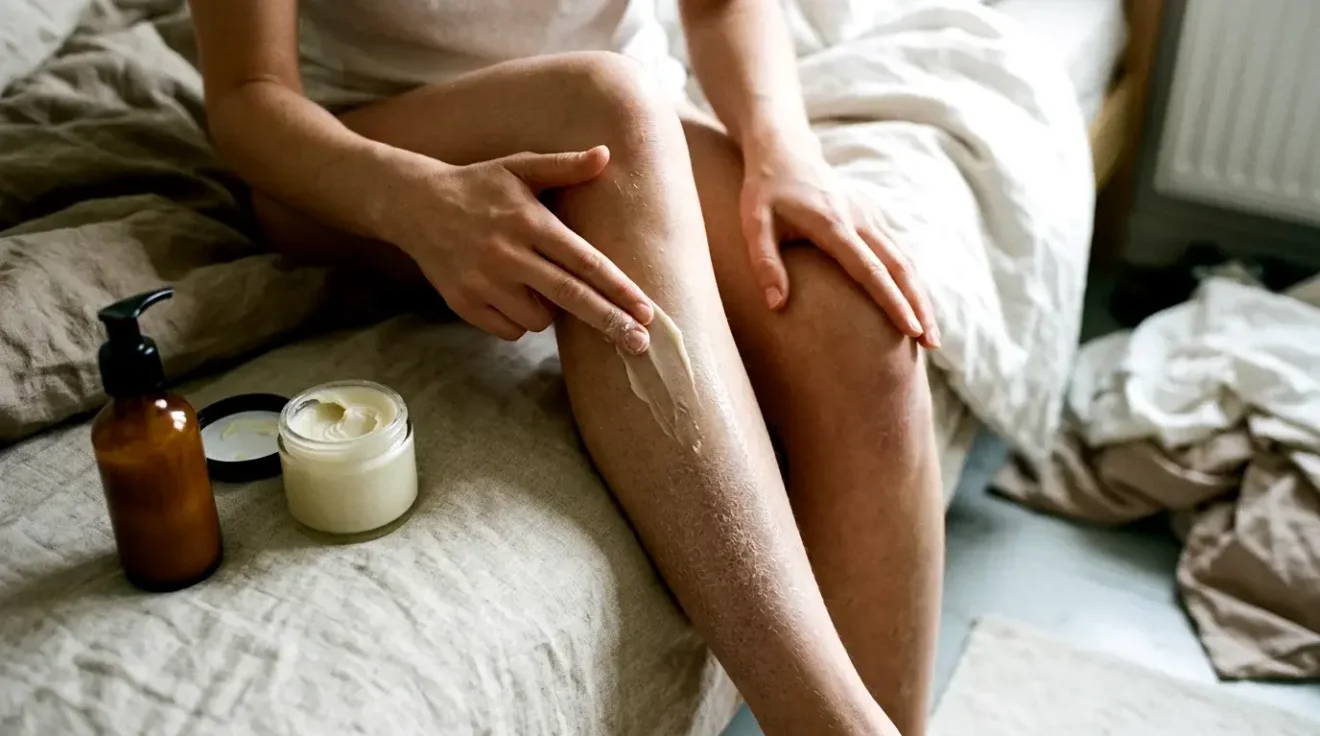
There is an important limitation: occlusion does not create water. A balm applied to completely dry skin can help reduce subsequent water loss, but it does not replace the hydration supplied by a water-based product. This explains why application timing can influence comfort as much as the choice between lotion and balm.
A simple assessment helps identify the appropriate format. Consider three observations: tightness after showering, visible flaking and itching. Mild tightness without persistent flaking may respond to a suitable moisturising lotion. Pronounced roughness and recurring dryness may justify a richer cream or balm. When both dehydration and significant surface dryness are present, a hydrating lotion followed by a thin layer of balm can offer complementary functions.
Formulation quality matters as well. Fragrance or potentially irritating ingredients may be poorly tolerated by stressed skin. Some lotions also contain ingredients that do not suit an individual’s skin condition. If neither format improves persistent dryness, simply increasing the amount of product may not solve the underlying problem. A formulation with complementary barrier-supporting ingredients may be more appropriate. Persistent itching, cracking, inflammation or discomfort warrants professional assessment rather than endless product experimentation.
Once the shin routine is better matched to its needs, another source of unnecessary dryness deserves attention: excessive exfoliation across different body areas.
Why Strong Facial Exfoliants Can Cause Problems When Used Across the Body
Strong facial exfoliants can cause irritation when used over larger body areas because exfoliation intensity, frequency and formulation are not automatically suitable for every anatomical zone. Applying the same active product to a much larger surface can increase overall exposure, while sensitive areas may tolerate less frequent exfoliation. The assumption that all body skin is tougher than facial skin is therefore unreliable. Safe use depends on the active ingredient, concentration, application instructions and individual skin tolerance.
Chemical exfoliants, including alpha-hydroxy acids and beta-hydroxy acids, act differently from mechanical exfoliants. Their effects depend on formulation, concentration, pH and contact time. A product designed for facial use may contain an exfoliating system that is unnecessary or poorly tolerated on the chest, neck or inner arms.
Some body areas, including elbows and knees, frequently develop thicker, rougher surface skin and may tolerate certain exfoliation methods differently. However, this does not mean that every other body area can tolerate aggressive treatment. The neck, chest and inner arms can be particularly uncomfortable when exposed to unsuitable active products.
The American Academy of Dermatology‘s exfoliation safety guidance emphasises adapting exfoliation to skin type and method. More aggressive approaches generally require less frequent use, and excessive exfoliation can result in redness and irritation. This is especially relevant when multiple active products are already part of a routine.
Over-exfoliation may not become obvious immediately. Early warning signs include unusual tightness, stinging when applying moisturiser, increased sensitivity after showering and persistent irritation. When the barrier becomes stressed, even previously comfortable products may begin to cause discomfort.
The correction is to stop escalating exfoliation. Pause the exfoliating products responsible for irritation, return to gentle cleansing and moisturisation, and avoid adding other potentially irritating treatments until the skin has recovered. If symptoms are severe, persistent or worsening, seek dermatological advice.
When exfoliation is reintroduced, use the product only according to its instructions and begin conservatively on the intended area. Evaluate each zone independently rather than applying a single schedule to the entire body. Avoid exfoliating already irritated, cracked or inflamed skin.
Exfoliation should support skin smoothness without creating a cycle in which additional moisturiser is needed to compensate for irritation caused by excessive treatment.
Managing exfoliation is only one part of barrier protection; bathing habits and repeated water exposure also influence how comfortable skin remains throughout the day.
How to Adjust Face and Body Care After Swimming or Frequent Showering?
After swimming or frequent showering, the priority is to reduce avoidable barrier stress and restore skin comfort without adding unnecessary products. Hot water and prolonged washing can contribute to dryness by removing surface lipids, while swimming introduces additional exposure to pool water and its treatment chemicals. The practical response is to rinse when appropriate, dry gently and moisturise while the skin is still slightly damp. The same core products can often be used with adjusted timing and quantities.
Repeated exposure to water does not automatically improve hydration. During long or hot showers, cleansing and prolonged contact with water can contribute to the removal of protective surface lipids. After drying, the skin may feel tight because water has evaporated and the outer barrier is less comfortable.
Swimming introduces a different context. Chlorinated pool water and repeated immersion can leave some people experiencing dryness or irritation. Rinsing after swimming helps remove residual pool water from the skin, while appropriate moisturisation supports comfort. The exact response depends on exposure frequency, individual sensitivity and the products used.
The American Academy of Dermatology recommends limiting baths and showers to 5–10 minutes, using warm rather than hot water and applying moisturiser immediately after bathing while the skin is still damp.
5–10 minutes
The American Academy of Dermatology’s recommended shower or bath duration for people experiencing dry skin. This is general self-care guidance, not a universal exposure threshold for every individual.
American Academy of Dermatology dry-skin guidance.
A simple sequence helps maintain consistency:
- Rinse the body after swimming when appropriate to remove residual pool water.
- Use gentle cleansing and avoid unnecessarily hot or prolonged showers.
- Pat the skin with a towel instead of rubbing aggressively.
- Apply a suitable hydrating moisturiser while the skin is still slightly damp.
- Add a richer cream or balm to particularly dry areas when additional protection is needed.
This sequence does not require a dedicated post-swimming product collection. A familiar moisturiser may be sufficient if it provides comfortable hydration and is well tolerated. The main adjustments concern application timing, the amount used and the texture selected for each area.
To assess whether the routine is working, observe the skin approximately one hour after showering. Persistent tightness, flaking or itching suggests that the current approach may need adjustment. Shorter, cooler showers combined with consistent aftercare are a practical starting point for people experiencing repeated dryness.
Once the skin is adequately hydrated, the next challenge is avoiding unnecessary residue when combining multiple lightweight products.
How to Layer a Hydrating Serum and Light Cream Without Sticky Residue?
A hydrating serum and a light cream can be layered without a sticky finish when each product is applied in an appropriate quantity and the first layer has settled before the second is added. Persistent tackiness often results from excessive product, overlapping film-forming ingredients or insufficient settling time. It does not necessarily mean that the serum is too rich. A controlled application sequence usually improves the finish without requiring a different product.
Hydrating serums often contain humectants such as glycerin or hyaluronic acid. These ingredients help attract and retain water in the outer skin layers. A light cream can then contribute emollients and occlusives, helping soften the skin and reduce water loss.
Problems occur when too much serum is applied or when a cream is layered over a surface that remains excessively wet or tacky. Some formulations also contain film-forming ingredients that leave a noticeable finish. Combining several products with similar film-forming characteristics may increase this sensation.
Ingredient labels can help identify potential contributors. Glycerin, hyaluronic acid derivatives and certain polymers may influence the feel of a serum. Silicones, waxes and other film-forming ingredients in a cream can change the final finish. However, the INCI list does not reveal the precise concentration of every ingredient, and its position alone cannot establish how sticky a finished formulation will be.
The most useful method is to begin with a small quantity. Spread the serum evenly over clean skin, then wait until the visible wetness has settled and the surface no longer feels excessively tacky. Apply a thin layer of cream using gentle pressing or smoothing movements rather than repeatedly rubbing the products together.

Pressing can help distribute a serum gently, particularly on facial skin that is sensitive to repeated friction. On hands, a thin layer spread evenly across the backs and fingers is generally more practical. The appropriate technique depends on the consistency of the formula rather than a universal rule that pressing is always superior to rubbing.
Morning and evening routines may also require different finishes. Before sunscreen or makeup, excessive residue can interfere with comfortable layering. Before dressing, a lighter body application may be preferable. At night, a slightly slower-drying combination may be acceptable if it improves comfort.
For persistent stickiness, first reduce the serum quantity, allow additional settling time and reassess the cream amount. Change one variable at a time to identify whether the problem comes from dosage or product compatibility.
Once the water-based layers are balanced, a carrier oil can provide an additional option for protecting dry skin after bathing.
Key Decisions Before Choosing a Barrier Repair Complex
- Identify whether dryness is primarily associated with insufficient hydration, lipid depletion or recurring irritation before selecting an ingredient combination.
- Prioritise complementary ingredient functions rather than judging a product by the number of botanical extracts or barrier-related ingredients listed.
- Assess improvement through sustained comfort, reduced tightness and better tolerance over several weeks rather than expecting immediate structural repair.
When to Apply Carrier Oil After Bathing for Better Skin Comfort?
The most practical time to apply carrier oil after bathing is when the skin has been gently towel-blotted but remains slightly damp. Carrier oils primarily provide emollient and occlusive benefits: they soften the skin and help reduce moisture loss rather than supplying water themselves. Applying them at the right moment can therefore improve comfort, particularly on dry shins, elbows and other areas that benefit from additional lipid protection.
After bathing, the skin retains some surface moisture. A thin layer of oil can help reduce subsequent water loss and leave the surface feeling softer. This is why applying an oil immediately after bathing may be more useful than waiting until the skin has completely dried.
The practical distinction is between damp and dripping-wet skin. Excess water can make oil distribution uneven and increase the greasy sensation. A better approach is to pat the skin gently with a towel until it is no longer dripping, then apply a modest quantity of oil to the areas that need it most.
A simple application sequence is sufficient:
- Finish bathing and gently towel-blot the skin.
- Start with the driest areas, such as the shins and elbows.
- Warm a small quantity of carrier oil between the palms.
- Spread it evenly over the slightly damp skin without excessive rubbing.
- Adjust the amount according to the finish and comfort rather than aiming for a visibly oily coating.
Oil can be used alone when the skin is already reasonably hydrated and the main objective is to improve softness and reduce moisture loss. For very dry skin, applying a hydrating lotion first and a thin layer of oil afterwards may provide more complementary support. The lotion contributes water-binding ingredients, while the oil helps limit subsequent water loss.
The type of oil also matters. Different carrier oils have different fatty acid compositions and sensory characteristics. Some lighter formulations may leave a less substantial finish than denser oils, but perceived absorption does not establish a universal ranking of barrier effectiveness.
Natural origin is not a guarantee of suitability. Individual tolerance, oxidation stability, formulation quality and the presence of fragrance or other additives should be considered. A new oil should first be tested on a limited area, particularly when the skin is already reactive.
Carrier oil is therefore best understood as a complementary step rather than a replacement for every moisturiser. If skin remains tight despite regular application, a hydrating product containing humectants may still be necessary.
Choosing the right application method improves immediate comfort, while a well-formulated barrier complex can address several complementary skin needs over time.
Which Barrier Repair Complex Ingredients Matter Most for Dry, Stressed Skin?
The most useful barrier repair complexes combine ingredients that address different aspects of skin dryness. Ceramides, cholesterol and fatty acids support the lipid structure of the stratum corneum; humectants such as glycerin and hyaluronic acid help retain water; and appropriate soothing ingredients can improve comfort when skin is stressed. No single ingredient guarantees barrier recovery. Performance depends on the complete formulation, ingredient concentrations, compatibility and the condition of the skin being treated.
The outermost skin layer, the stratum corneum, plays a central role in limiting water loss and protecting against environmental exposure. Its intercellular lipid matrix includes three important components: ceramides, free fatty acids and cholesterol. These lipids contribute to the organisation and integrity of the skin barrier.
A scientific review of skin-barrier repair moisturisers published in the Journal of Cosmetic Dermatology describes the complementary roles of moisturising ingredient families and discusses barrier-supporting formulations. Its literature review initially identified 321 articles and retained 90 after screening. This provides a useful overview of formulation mechanisms, although the review is not an original clinical trial and its literature search covered studies published up to June 2023.
Understanding ingredient functions is more useful than focusing on marketing terminology. Moisturisers can generally be classified into three functional groups:
| Ingredient family | Examples | Primary function |
|---|---|---|
| Barrier lipids | Ceramides, cholesterol, fatty acids | Support the lipid organisation of the outer skin barrier |
| Humectants | Glycerin, hyaluronic acid | Attract and retain water in the outer skin layers |
| Emollients | Plant oils, fatty substances and selected esters | Soften skin and improve surface smoothness |
| Occlusives | Petrolatum, waxes and certain oils | Help reduce transepidermal water loss |
| Soothing ingredients | Selected soothing agents and botanical derivatives | Support comfort in formulations intended for stressed skin |
Ingredient concentration and formulation design remain essential. An ingredient appearing on an INCI list does not reveal its precise concentration, stability, bioavailability or clinical performance. Its position in the list can provide contextual information, but it cannot independently prove that a product contains an effective amount.
Natural skincare formulations deserve the same scrutiny as conventional cosmetics. Plant-derived oils and botanical ingredients can offer useful emollient or soothing functions, but natural origin does not automatically establish better barrier repair, greater safety or superior tolerance. The complete formulation determines the practical outcome.
Urea is another ingredient worth understanding. The scientific review discusses concentration-dependent functions, including moisturising effects at or below 10% and additional emollient and keratolytic effects at or above 10%. These observations should not be interpreted as guaranteed results for every formulation. Higher concentrations may not be appropriate for every sensitive or compromised skin condition.
A well-designed barrier complex can also simplify a routine. As skin becomes more comfortable and less prone to tightness, some people may find that they need less intensive occlusion or fewer overlapping moisturising layers. The aim is not to add another compulsory step, but to select a formulation that addresses several genuine needs.
Assessment should take place over several weeks rather than relying on the first application. Relevant indicators include reduced tightness, less frequent flaking, improved comfort after bathing and better tolerance of everyday products. Introduce a new complex on a limited area first, observe the response and only then consider broader application. Persistent inflammation, itching or cracking should be assessed by a healthcare professional.
The most effective face and body routine is ultimately the one that delivers consistent comfort with the fewest unnecessary layers. By evaluating skin-zone needs, application timing and formulation quality, adults can make natural skincare more measurable, practical and sustainable without turning daily care into an unnecessarily complicated process.
Can the same moisturiser be used on the face and body?
Yes, provided the formulation is suitable for both areas and meets their different requirements. A lightweight moisturiser may work well on the face and forearms but provide insufficient protection for very dry shins. Conversely, a rich body cream may feel excessively heavy on facial skin. Assess comfort, residue, hydration and individual tolerance rather than assuming that one product must suit every area.
Should body moisturiser be applied every day?
Daily moisturisation can be useful for people experiencing persistent dryness, particularly after bathing. The American Academy of Dermatology recommends applying moisturiser while the skin is still damp and reapplying when needed. The appropriate frequency depends on skin condition, environmental exposure and product formulation.
Is natural oil enough to moisturise very dry skin?
Not necessarily. Carrier oils mainly provide emollient and occlusive benefits, helping soften the skin and reduce water loss. They do not replace water-binding ingredients such as glycerin. For very dry skin, combining a hydrating lotion with a suitable oil or balm may provide more comprehensive support.
How can someone tell whether a skincare routine is actually working?
Monitor practical indicators such as reduced tightness, less visible flaking, improved comfort after showering and fewer episodes of irritation. Compare the skin’s condition at consistent times rather than relying exclusively on immediate softness or a product’s absorption sensation. A simple record over several weeks can help identify meaningful changes and reveal products that repeatedly underperform.
How long does a barrier repair moisturiser take to improve dry skin?
Some moisturisers can provide immediate surface softness and comfort, but sustained improvements in dryness and skin tolerance should be evaluated over several weeks. The timeframe depends on the formulation, the severity of dryness, environmental exposure and consistency of use. Persistent or worsening symptoms should not be managed through repeated product changes alone; professional assessment may be necessary.