
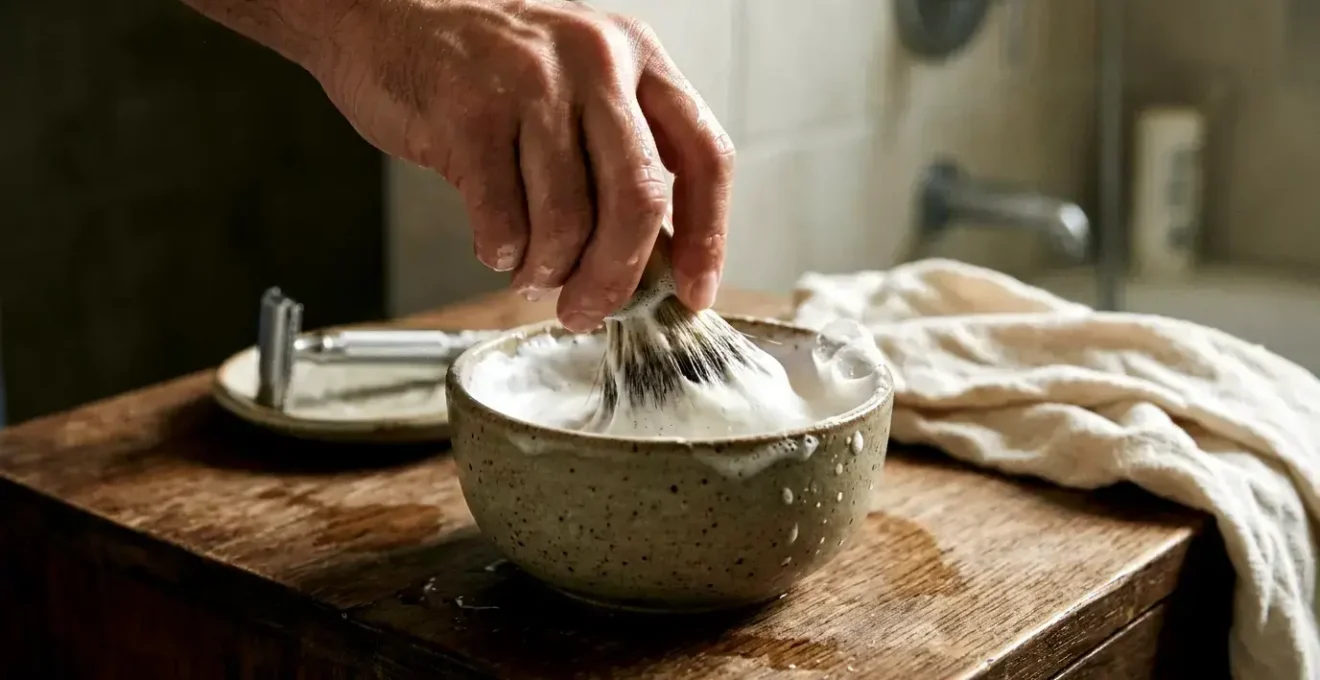
A rich shaving cream lather can help reduce razor burn, but only when it provides effective lubrication. A towering mound of foam does not necessarily protect the skin better than a thin, creamy layer. What matters is how the formulation holds water, supports blade movement and limits friction during each shaving stroke.
Razor burn develops when shaving causes irritation and superficial damage to the skin. Poor lubrication, excessive pressure, repeated strokes and shaving against hair growth can all contribute. Even an expensive shaving cream cannot compensate for an unsuitable razor or aggressive technique.
The practical objective is therefore not to produce the largest possible lather. It is to create a hydrated, stable layer that allows the blade to cut softened beard hair without unnecessary pulling or scraping. Understanding the relationship between lather texture, water content and shaving mechanics makes it easier to distinguish a genuinely protective cream from one that merely looks luxurious.
What matters most for comfortable shaving
- Lubrication matters more than foam volume: a hydrated cream that maintains a slippery film can perform better than a visually impressive but poorly lubricating foam.
- Water preparation is essential: moist beard hair is easier to cut, reducing the mechanical demands placed on the razor.
- Technique determines the final result: light pressure, appropriate blade angle and fewer passes help limit irritation even when the lather is excellent.
- Why Does Thickaving Foam Sometimes Provide Poor Razor Glide?
- How to Build a Creamy Shaving Lather Without Making It Too Dry?
- Brushless Shaving Cream or Traditional Lather: Which Suits Sensitive Skin?
- Why Dry Shaving Lather Can Increase Drag and Discomfort
- When Should You Apply Shaving Lather After Softening Coarse Beard Hair?
- Why Pressing Harder With a Razor Can Increase Cuts Without Improving the Shave
- Why Does Your Neck Turn Redder Than Your Cheeks After Shaving?
- How to Get a Precise Close Shave Without Increasing Razor Irritation?
Why Does Thickaving Foam Sometimes Provide Poor Razor Glide?
Thick shaving foam can provide poor razor glide because visible volume is not the same as effective lubrication. A foam containing large amounts of air may look substantial but leave an inconsistent lubricating layer against the skin. A less voluminous, properly hydrated shaving cream can sometimes deliver smoother blade movement, depending on its formulation and application.
Shaving products perform several related functions. They help keep facial hair moist, spread lubricating ingredients across the skin and provide a medium through which the razor can move. Foam is one way of distributing those ingredients, but bubbles themselves do not establish how effectively a product reduces friction.
The distinction becomes clearer when considering the chemistry of shaving cream. Surfactants, including soap-based stearates, help create and stabilize lather. Humectants such as glycerin help retain moisture, while emollients and other lubricating components can contribute to the product’s feel and performance. Oils and lipid-derived ingredients may also influence the film left on the skin, although their effectiveness depends on the complete formulation.
The scientific review of blade-shaving biomechanics, published in the International Journal of Cosmetic Science in 2016, explains the importance of lubrication in controlling shaving drag and mechanical interaction between blades, hair and skin. Its authors were affiliated with Gillette‘s Reading Innovation Centre, an industry connection worth considering when interpreting the review.
This research supports the mechanical importance of lubrication, but it does not demonstrate that every thick foam performs worse than every low-foaming cream.
A simple practical check is to spread a thin layer of prepared lather over wet skin and move a clean, damp fingertip across it. A consistently slippery sensation is encouraging. A layer that feels sticky, patchy or resistant may need more water or a different formulation.
This fingertip check is a qualitative observation, not a validated friction test. Razor performance also depends on the blade, shaving angle and skin surface.
When a foam collapses quickly or fails to leave sufficient lubrication, the razor may catch rather than move smoothly. Shavers sometimes respond by repeating strokes, which adds mechanical stress and can increase irritation.
The next step is to control the factor that strongly influences lather consistency: the amount of water incorporated during preparation.
How to Build a Creamy Shaving Lather Without Making It Too Dry?
Build a creamy shaving lather by adding water gradually to a small amount of shaving cream while mixing until the texture becomes smooth, cohesive and easy to spread. The goal is a hydrated, yoghurt-like consistency that remains slippery on wet skin. Avoid relying on a fixed water-to-cream ratio because different formulations and water conditions produce different results.
Start with a small amount of shaving cream in a bowl or on a damp shaving brush. Work the product gently, then incorporate a few drops of water at a time. Continue until visible dry patches disappear and the mixture develops a fine, creamy structure.
Water hardness can influence how readily soap-based shaving products lather. Likewise, concentrated creams may require different amounts of water from softer formulations. Rather than counting drops, evaluate how the lather behaves when spread thinly.
A useful preparation target is a lather that forms soft peaks, spreads without excessive resistance and retains a slightly glossy surface. These are practical texture cues, not laboratory measurements of lubrication.
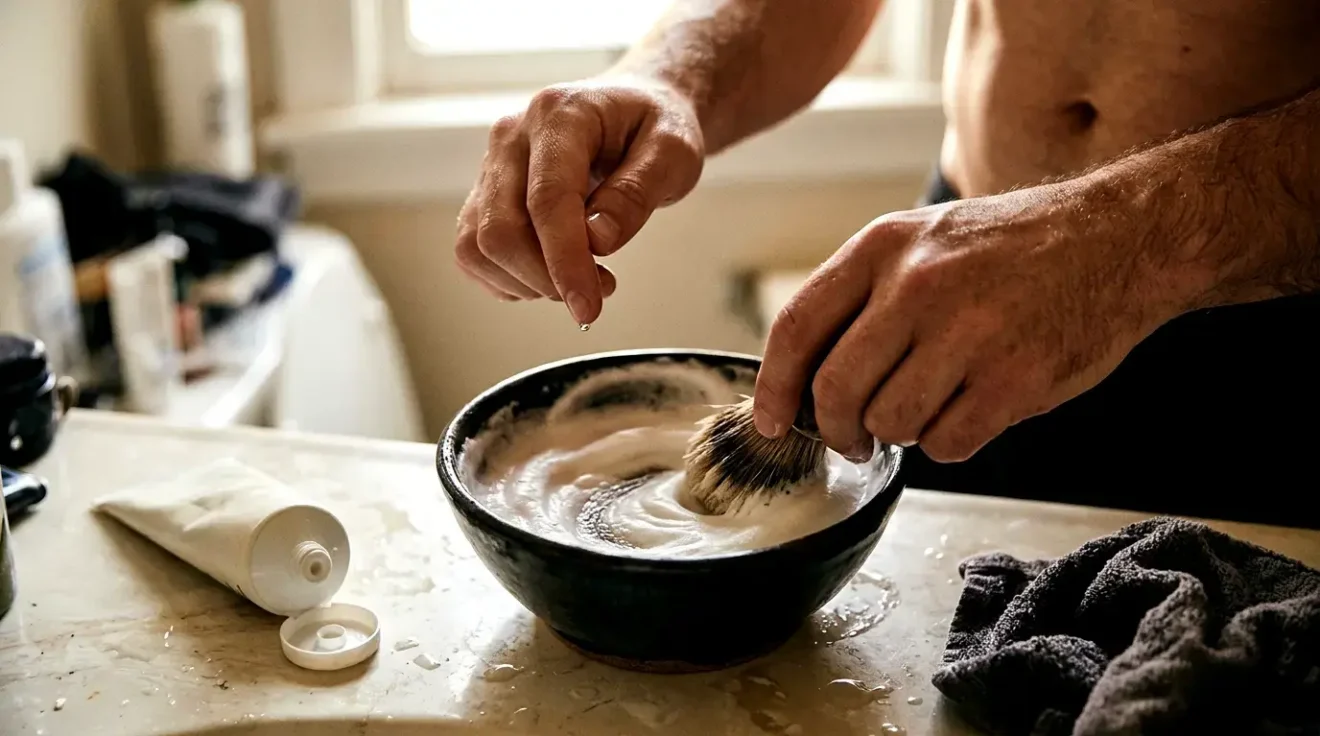
Another useful observation is how the lather stretches between two fingers. A hydrated mixture generally spreads smoothly, while an overly dry one may break apart or feel pasty. Excessively watery lather, meanwhile, can run off the face before the razor reaches it.
Large bubbles do not automatically indicate inadequate hydration. They may result from excessive aeration, insufficient product or the formulation itself. Try working the brush gently against the bowl to reduce large bubbles. If the mixture remains stiff, incorporate a little more water; if it is already runny, additional water will make it worse.
Leaving prepared lather exposed for too long may also change its consistency as water evaporates. When shaving takes longer than expected, refresh the lather with a damp brush rather than applying a visibly dried layer.
Five checks for preparing a comfortable shaving lather
- Measure a small starting amount: place one modest portion of shaving cream in the bowl and confirm that no unmixed lumps remain.
- Add water progressively: incorporate a few drops at a time until the mixture spreads evenly without running.
- Inspect the texture: look for a cohesive surface with fine bubbles and no visibly dry patches.
- Test a thin application: spread lather over wet skin and check that a damp fingertip moves without obvious sticking.
- Verify stability before shaving: inspect the lather after preparation and add moisture if it has become stiff or crusted.
Once consistency is under control, the next consideration is whether a brush is helpful at all, especially for skin that reacts easily to shaving.
Brushless Shaving Cream or Traditional Lather: Which Suits Sensitive Skin?
Brushless shaving cream may suit very sensitive skin when brushing itself causes redness or discomfort. Traditional lather can also work well when prepared properly and applied with minimal friction. Neither format is universally gentler: the formulation, skin tolerance and application technique matter more than whether a shaving brush is used.
Brushless creams are designed to be distributed directly using the fingers. They often provide a creamy layer without requiring extensive foaming, making them convenient for short routines or shaving in the shower.
Traditional shaving creams and soaps generally require water and mechanical mixing to build lather. A soft brush can help distribute the product across facial hair, but vigorous brushing also introduces another source of friction.
The choice becomes easier when comparing practical requirements rather than assuming one format is superior.
| Criterion | Brushless shaving cream | Traditional lather |
|---|---|---|
| Preparation time | Usually quicker to apply | Requires mixing and hydration adjustment |
| Brush contact | Not required | Common, but application can be gentle |
| Water availability | Often convenient with limited preparation | Usually benefits from accessible water for mixing |
| Highly reactive skin | Avoids brush-related friction | May be comfortable with a soft brush and light touch |
| Lubrication | Depends on the complete formula | Depends on the formula and prepared consistency |
There are also formulation differences worth considering. Some traditional shaving soaps rely on saponified fatty acids and are relatively alkaline. Brushless products may instead use emulsified oils, non-soap surfactants and other conditioning ingredients. These are common formulation approaches, not fixed rules defining either category.
A scientific study comparing four soap formulations, published in the Journal of Cosmetic Dermatology, examined 60 healthy participants over seven days. Researchers compared different cleansing products applied repeatedly to forearm skin.
The study found greater mean redness with the alkaline soap than with the glycerin and creamy soaps. However, this was a cleansing experiment, not a clinical shaving trial. It cannot establish that traditional alkaline shaving soaps inevitably cause razor burn.
What a comparative soap study can tell sensitive shavers
Sixty healthy participants were divided into four groups of 15. Each group used one cleansing formulation on the left forearm at least four times daily for seven days.
Alkaline soap increased skin pH and produced higher mean erythema than certain alternative formulations. The findings illustrate how cleanser chemistry can affect skin measurements, but they do not directly compare shaving creams, brushes or razor-burn outcomes.
For a practical comparison, try each suitable product on a small shaving area during separate shaving sessions, keeping the razor, blade and number of strokes consistent. Record redness, tightness and stinging afterward. Consecutive-day testing is not advisable if the skin is already irritated; allow it to recover before comparing another product.
Fragrance sensitivity, preservative reactions and individual ingredient tolerance may matter as much as the product category. A fragrance-free formulation can be a reasonable starting point for reactive skin, but even products marketed as gentle can cause reactions.
A suitable product should remain comfortable throughout the shave. If it begins to feel sticky or resistant, the problem may be its changing hydration rather than the original product choice.
Why Dry Shaving Lather Can Increase Drag and Discomfort
Dry shaving lather can increase drag because an insufficiently hydrated layer may no longer spread or lubricate effectively beneath the razor. Instead of moving smoothly across the skin, the blade may encounter greater resistance from the cream, hair and skin surface. This can encourage harder pressure or repeated strokes, increasing the likelihood of irritation.
A shaving cream needs enough water to distribute its lubricating components and maintain suitable contact with the skin. When the mixture becomes too concentrated or begins drying on the face, its consistency can change from creamy to sticky or paste-like.
That does not mean dried lather is literally an abrasive containing hard particles. Its practical problem is that it may interfere with smooth razor movement, especially when residue accumulates around the blade.
Warning signs include a dragging sensation, irregular blade movement, visible paste-like deposits and a tendency to press harder to complete a stroke. Audible scraping can also indicate a problem, although blade type, hair density and shaving angle affect shaving sounds.
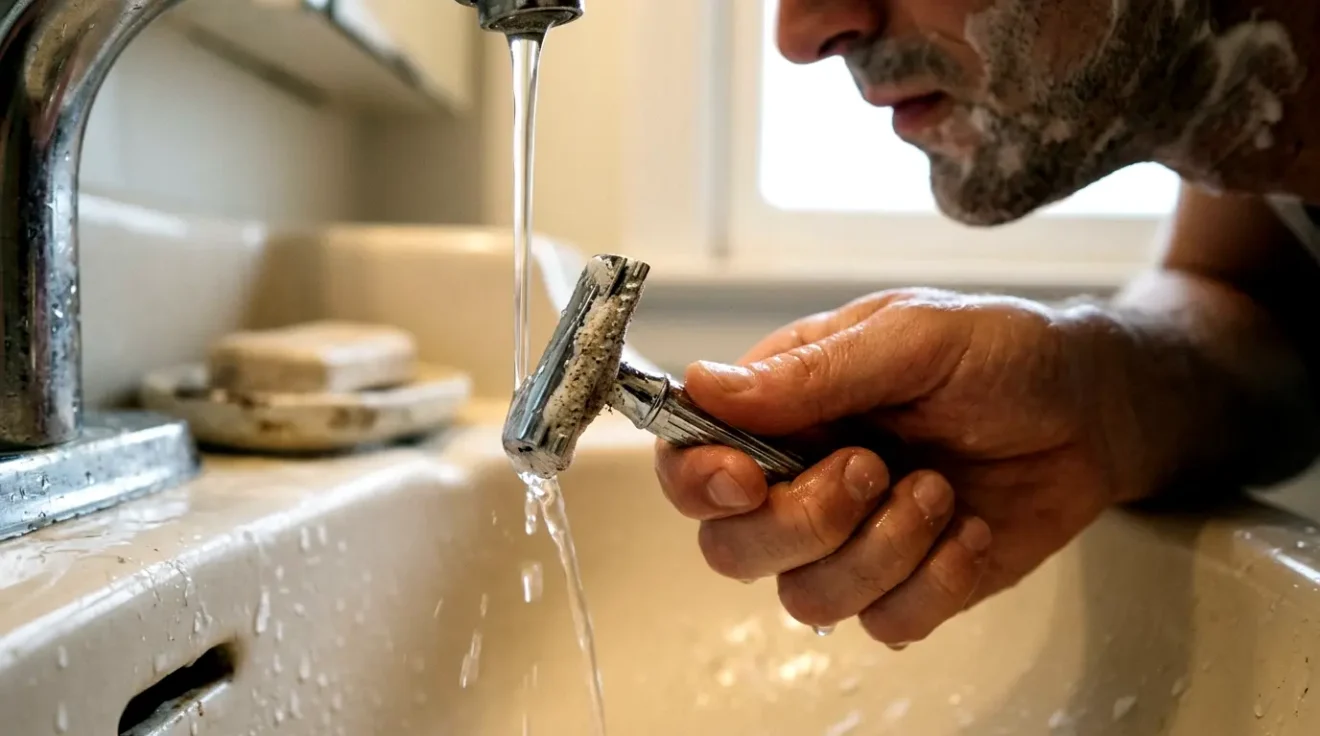
If lather begins drying during shaving, stop the stroke, rinse the razor under running water and wet the affected area again. A few drops of water worked gently into the remaining lather may restore spreadability. If the cream has become patchy or crusted, rinsing and applying fresh lather is more reliable.
Never try to clear a razor blade by rubbing your thumb directly across its cutting edge. Rinse according to the manufacturer’s instructions and use a suitable cleaning method when necessary.
It is also important to distinguish razor burn from ingrown hairs. Razor burn typically involves irritation arising during or soon after shaving. Ingrown hairs develop when growing hair becomes trapped or re-enters the skin and can appear later as bumps or inflammation.
Poor lubrication may contribute to shaving irritation, but it does not establish that a hair tip will become frayed or inevitably grow inward. Hair curvature, cutting direction, shaving closeness and individual susceptibility are also relevant.
Finally, even a correctly prepared cream may perform poorly when applied to completely dry facial skin. Wetting the beard first helps create the conditions needed for a comfortable shave, rather than forcing the cream to compensate for inadequate preparation.
Maintaining moisture during the shave is important, but preventing discomfort begins earlier, when coarse facial hair is prepared for cutting.
When Should You Apply Shaving Lather After Softening Coarse Beard Hair?
Apply shaving lather after wetting coarse beard hair with comfortably warm water, ideally once the hair has had time to absorb moisture. A warm shower or several minutes of facial wetting can provide useful preparation. The cream then helps maintain hydration while providing lubrication, although a well-hydrated shaving cream can also contribute to further hair softening.
Beard hair consists largely of keratin, a protein structure whose mechanical properties change as water enters the fibre. Hydration makes hair more flexible and reduces the force required to cut it.
A 2016 scientific review of beard hair and facial skin, published in the International Journal of Cosmetic Science, summarizes research into these mechanical effects. The review included authors affiliated with Procter & Gamble, including its Braun innovation centre, alongside academic researchers.
Approximately 40%
Reduction in the force required to cut beard hair after around four minutes of water contact, as reported from earlier research summarized in the 2016 review. This is a hair-cutting measurement, not a demonstrated reduction in razor burn.
International Journal of Cosmetic Science, 2016; review of beard hair properties and shaving challenges.
The same review reports that hydration can reduce beard hair stiffness by approximately 30–65%, while cutting force may decrease by around 20% during the first minute of water contact. These figures describe findings from research discussed in the review and should not be treated as guaranteed outcomes for every beard.
A simple preparation sequence is to wash the face with warm water, keep the beard moist while preparing the shaving cream, then apply lather and begin shaving before the surface dries.
DermNet‘s dermatological reference on shaving also recommends allowing shaving cream to remain on the skin for two to three minutes during preparation. That is a practical recommendation rather than proof of one universally optimal waiting period.
After a warm shower, additional prolonged waiting is generally unnecessary if facial hair is already thoroughly wet. Conversely, applying lather directly to a completely dry beard and leaving it indefinitely does not guarantee equivalent hydration.
Coarse or densely distributed facial hair may benefit particularly from careful wet preparation because stiff hairs can create greater resistance during cutting. Extremely hot water is not required and may aggravate reactive or dry skin.
Once the hair is softened, the razor should cut with minimal force. If substantial pressure still seems necessary, examine the blade and technique rather than immediately adding more cream.
Why Pressing Harder With a Razor Can Increase Cuts Without Improving the Shave
Pressing harder with a razor increases the force applied to the skin without necessarily improving hair cutting. Excess pressure can deform the skin around the blade, increase scraping and make cuts or irritation more likely. A sharp, appropriate blade used at the correct angle should remove hair with light, controlled strokes rather than forceful pushing.
During shaving, the blade must contact hair closely enough to cut it while avoiding unnecessary damage to the surrounding skin. The lubricating film helps manage friction, but it cannot fully compensate for aggressive pressure.
Excessive force can compress or displace the product layer and change how the blade interacts with the skin. The result may be increased irritation, particularly across uneven facial contours.
A useful technique check is to hold the razor handle with a relaxed grip rather than clenching it in the palm. For a traditional safety razor, let its weight do much of the work while maintaining a suitable cutting angle.
With lightweight cartridge razors, some controlled contact is necessary. The instruction to use literally zero pressure should therefore be understood as avoiding unnecessary downward force, not preventing the razor from touching the skin.
If the blade seems unable to cut without pressure, investigate several potential causes:
- Blade condition: a worn, damaged or clogged blade may pull rather than cut smoothly.
- Razor angle: an unsuitable angle can reduce cutting efficiency or increase skin contact.
- Lather condition: insufficient lubrication may make each stroke feel resistant.
- Hair preparation: coarse, poorly hydrated hair requires greater cutting force.
- Stroke direction: shaving against the grain may feel more resistant and irritate susceptible areas.
Small superficial abrasions can contribute to the burning or stinging sensation associated with razor burn, even when no obvious cut is visible. However, irritation can also occur through friction and barrier disruption without a visible wound.
A more comfortable shaving result therefore depends on identifying the reason for resistance rather than overpowering it.
Pressure control is especially important on the neck, where hair growth patterns and skin contours make consistent blade movement more difficult.
Why Does Your Neck Turn Redder Than Your Cheeks After Shaving?
The neck often becomes redder than the cheeks because it is a mechanically challenging shaving area. Hair may emerge at lower angles, grow in several directions and lie across uneven or mobile skin. Repeated strokes, excessive pressure and shaving against the grain can therefore produce more irritation around the neck, even when the same shaving cream works comfortably elsewhere.
Beard growth beneath the jawline is frequently less uniform than on the cheeks. Hairs may point sideways, upward or in curved patterns, making it difficult to maintain one effective cutting direction across the entire area.
Scientific discussions of shaving biomechanics also identify lower hair emergence angles, differences in surface topography and looser skin attachment as contributing factors. These characteristics can make the neck more vulnerable to unwanted blade interaction.
However, neck redness is not proof that the skin is universally thinner than cheek skin. Skin thickness and sensitivity vary between individuals and anatomical locations.
It is helpful to distinguish temporary redness from persistent irritation. Brief flushing after warm water or friction may settle relatively quickly. Burning, tenderness, recurring bumps or prolonged redness suggest that the shaving method, product tolerance or an underlying skin condition deserves attention.
Clothing can add another source of discomfort. A tight collar rubbing against freshly shaved skin may worsen an already irritated area.
To isolate the effect of technique, examine neck hair growth before shaving. Use a mirror and observe the direction in which the hairs lie, then shave gently with the grain.
For several shaving sessions, consider limiting the neck to one careful pass while keeping other variables consistent. Record whether the burning sensation and redness decrease. This is a personal troubleshooting exercise, not a clinical diagnostic test.
Avoid repeating the experiment daily when irritation is active. Allow the skin to recover, and seek professional assessment for persistent inflammation, painful bumps or signs of infection.
Once the neck’s limitations are recognized, the final challenge is choosing a shaving method that delivers sufficient closeness without sacrificing skin comfort.
Key takeaways before your next close shave
- A smoother result does not require equal closeness across every facial area; the neck may need a more conservative approach.
- Evaluate the first pass before deciding whether another stroke is justified, rather than automatically following a fixed multi-pass routine.
- If irritation persists despite careful preparation and lubrication, reassess the blade, razor design and shaving frequency.
How to Get a Precise Close Shave Without Increasing Razor Irritation?
For a precise shave with less irritation, prioritize beard hydration, effective lubrication, light razor pressure and a controlled first pass with the direction of hair growth. Additional passes may improve closeness, but they also increase skin contact and potential irritation. The most comfortable result is often achieved by removing hair efficiently without repeatedly chasing an exceptionally smooth finish.
The central trade-off is between cutting hair close to the skin and limiting mechanical stress. Against-the-grain shaving can produce a closer result for some people, but it is not essential for a clean appearance and may aggravate razor bumps or sensitive skin.
First, prepare the beard. Use comfortably warm water to wet the hair thoroughly. Apply hydrated shaving cream evenly, making sure the areas around the jaw and neck remain covered.
Second, complete a controlled first pass. Follow the direction of hair growth with short, gentle strokes. Rinse the razor frequently and avoid shaving areas where the lather has already been removed.
Third, decide whether another pass is necessary. If some areas still require greater closeness, reapply fresh lather. A cross-grain pass may be better tolerated than directly shaving against the grain, although individual responses vary.
On sensitive neck areas, stopping after the first pass may be the best option. Repeatedly removing tiny amounts of remaining stubble can create disproportionately greater irritation.
Skin care after shaving also influences comfort. Rinse away remaining cream using cool or lukewarm water, pat the skin dry and apply a suitable moisturizer or soothing aftershave.
Cool water may feel calming, but it does not literally close pores. Its benefit is primarily sensory comfort and the removal of remaining product without additional heat exposure.
For easily irritated skin, avoid strongly fragranced aftershaves or products containing high concentrations of potentially drying alcohols. Ingredient tolerance depends on the complete formulation: naturally derived products are not automatically safer, and fragrance-free options are not guaranteed to be non-irritating.
DermNet’s dermatological reference on shaving describes the roles of shaving cream in moisturizing, softening hair and protecting skin, while also emphasizing appropriate preparation and avoiding repeated shaving over the same area. It is an educational reference published in 2013, not a recent comparative trial of individual shaving creams.
If irritation persists despite improved technique, examine the condition and suitability of the razor. A dull blade, an aggressive razor design or shaving too frequently may be more important than the thickness of the lather.
Persistent redness, recurrent ingrown hairs or painful lesions may require an alternative hair-removal approach or advice from a dermatologist.
For your next shave, change one variable at a time: hydrate the beard carefully, prepare a consistently moist lather and complete one gentle pass. Observe your skin afterward. If comfort improves, retain the adjustment; if irritation continues, investigate the blade, shaving direction and skin sensitivity before assuming that a richer cream is the solution.
Can a shaving cream prevent razor burn completely?
No shaving cream can guarantee complete prevention of razor burn. Good lubrication may reduce friction and improve comfort, but blade condition, shaving pressure, stroke direction and individual skin sensitivity also influence irritation. Persistent symptoms deserve attention even when the shaving cream appears effective.
Is glycerin in shaving cream beneficial for sensitive skin?
Glycerin is a humectant that helps retain water in cosmetic formulations. It can contribute to a comfortable, hydrated shaving cream, but its presence alone does not prove superior lubrication or suitability for sensitive skin. The complete ingredient system and individual tolerance determine product performance.
Should shaving cream be applied to wet or dry skin?
Shaving cream is generally best applied to skin and beard hair that have already been moistened with comfortably warm water. This supports hair softening and helps the product spread evenly. Applying shaving cream directly to dry facial hair may provide less effective preparation, particularly for coarse beards.
Does shaving cream need to contain natural oils to provide good lubrication?
No. Shaving lubrication can be provided by different combinations of emollients, polymers, surfactants and other formulation ingredients. Natural oils can contribute to certain products, but they are not essential for every effective shaving cream. A product should be evaluated by its actual glide, stability and skin compatibility rather than its natural marketing claims.
Why does shaving cream sometimes sting immediately after application?
Immediate stinging may indicate an already compromised skin barrier or sensitivity to an ingredient, including fragrance or another formulation component. Stop using a product that repeatedly causes discomfort and rinse it off. If reactions are persistent, severe or accompanied by swelling, consult an appropriate healthcare professional.