
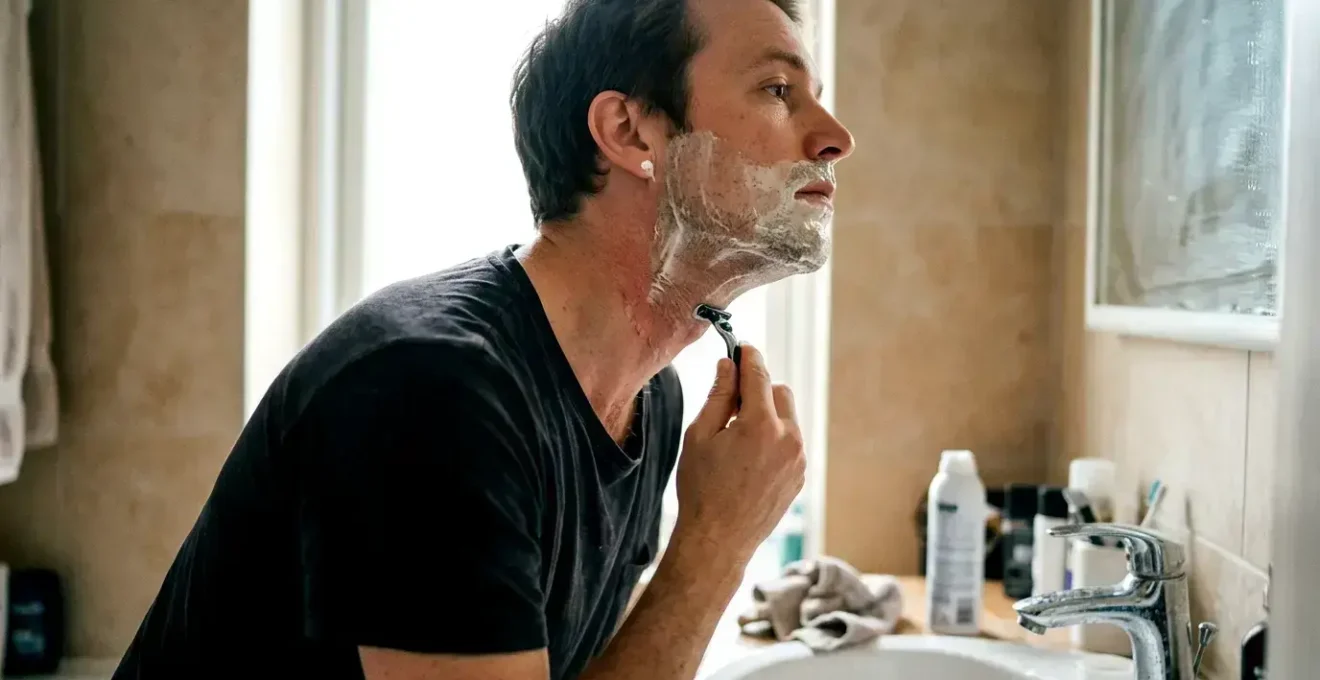
Facial redness after shaving is often caused by temporary irritation, but it does not always have the same explanation. A razor can disrupt the skin’s outer barrier, create microscopic injuries and trigger inflammation. The result may be a warm, red or uncomfortable complexion that appears shortly after shaving.
However, redness that remains visible, repeatedly returns or develops into individual bumps deserves closer attention. Ingrown hairs, contact dermatitis and existing skin conditions such as rosacea can produce symptoms that resemble ordinary razor burn. The timing, appearance and duration of the reaction provide useful clues, although they cannot establish a diagnosis on their own.
The most helpful approach is to identify what is irritating the skin before adding more products. Adjusting shaving direction, reducing repeated blade contact and simplifying post-shave care can help many men. Persistent, worsening or recurrent symptoms may require assessment by a healthcare professional.
Understanding and Reducing Facial Redness After Shaving
- Temporary razor burn usually appears shortly after shaving as diffuse redness, burning or tenderness and may last from several hours to several days.
- Persistent, raised bumps can indicate ingrown hairs or follicular inflammation rather than ordinary razor burn.
- Cool compresses, fragrance-free moisturizers and gentler shaving techniques can help reduce irritation without overloading the skin.
- Why Does the Neck Turn Redder Than the Cheeks After Shaving?
- How to Calm Mild Shaving Redness Without Applying Multiple Active Products?
- Razor Burn or Ingrown Hairs: Which Is Causing Red Bumps After Shaving?
- Why Menthol Aftershave Can Make Red, Irritated Skin Feel Worse
- When Should Post-Shave Redness Be Checked by a Healthcare Professional?
- Why Does Shaving Against the Grain Cause More Razor Bumps?
- Irritant Contact Dermatitis or Allergic Contact Dermatitis: What Signs Differ?
- How to Care for Freshly Shaved Skin Without Alcohol-Based Aftershave?
Why Does the Neck Turn Redder Than the Cheeks After Shaving?
The neck often becomes redder than the cheeks because its curved surface, changing blade angles and irregular hair-growth patterns make shaving more difficult. Hair beneath the jawline can grow in several directions, increasing the likelihood of repeated blade contact and irritation. This makes the neck particularly susceptible to shaving-related inflammation.
One important difference is the direction of hair growth. Cheek hair may follow a relatively consistent pattern, whereas follicles beneath the jawline frequently point in different directions. A stroke that follows the grain on one part of the neck may therefore work against the grain a few centimetres away.
DermNet describes the area beneath the jawline as a typical location for pseudofolliculitis barbae because follicles grow in various directions. This condition occurs when closely shaved hairs penetrate surrounding skin or grow back into the follicular wall, producing inflammatory bumps.
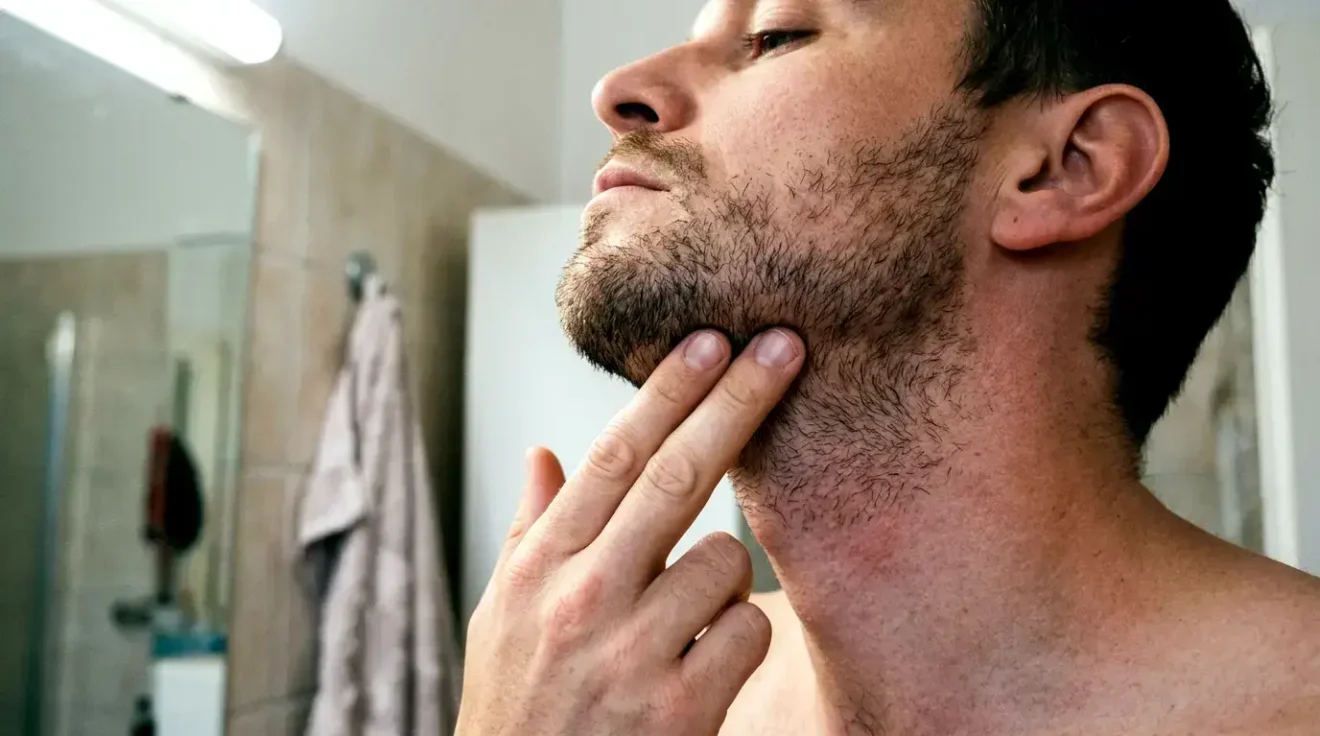
The neck’s anatomy also changes how the razor meets the skin. Moving over the jawline, Adam’s apple and curved sides of the neck requires frequent adjustments to the blade angle. Stretching the skin to obtain a closer shave can make the problem worse by allowing cut hairs to retract beneath the surface.
It is not necessary to assume that the neck always has thinner skin or fewer sebaceous glands than the cheeks to explain the difference. Hair direction, surface curvature, shaving pressure and individual skin sensitivity are more practical factors to assess.
A useful technique is to inspect the neck in good lighting before shaving. Observe the direction in which short hairs lie and divide the area into small zones. Follow the direction of growth in each zone rather than treating the entire neck as one uniform surface.
Redness concentrated beneath the jawline, particularly when accompanied by small follicular bumps, may suggest ingrown hairs. It does not automatically prove that the blade angle is wrong or that a shaving product is responsible. Both technique and product exposure should be considered.
Once the source of repeated irritation becomes clearer, the next priority is allowing the skin to recover. Adding several soothing products immediately after shaving may create another source of discomfort rather than solving the original problem.
How to Calm Mild Shaving Redness Without Applying Multiple Active Products?
Mild shaving redness can often be managed with a simple routine rather than several active skincare products. A cool rinse, a gentle fragrance-free soothing product and a basic moisturizer may help reduce discomfort while supporting the skin barrier. The priority is to stop adding irritation and give the skin time to recover.
Shaving can produce small disruptions in the epidermis and contribute to temporary inflammation and moisture loss. Applying exfoliating acids, retinoids, alcohol-based products or strongly fragranced cosmetics immediately afterwards may increase discomfort, particularly when the skin already feels tight or sensitive.
This is why simplifying the routine matters. Each additional formulation introduces more ingredients and another opportunity for irritation or an unwanted reaction. More products do not necessarily mean faster recovery.
A practical minimal routine has three stages:
- Cool the skin. Rinse gently with cool or lukewarm water, or briefly apply a clean, cool damp cloth. Avoid ice directly on the face and do not rub the irritated area.
- Choose one soothing product. A fragrance-free formulation containing aloe vera, panthenol or colloidal oatmeal may be suitable if the skin tolerates it. Introduce one product at a time.
- Restore moisture. Apply a simple, fragrance-free moisturizer once the skin tolerates the soothing product. Ingredients such as glycerin and ceramides can support hydration and barrier care.
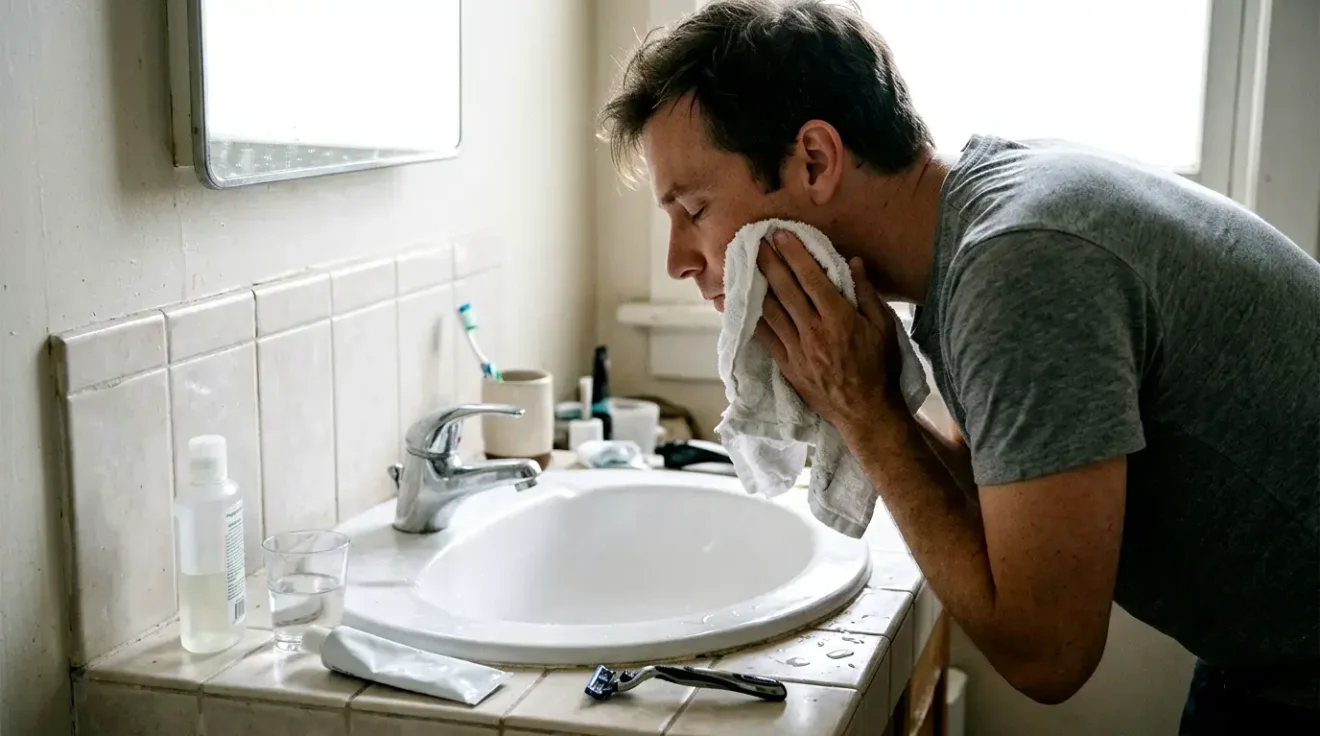
Apply products gently, preferably while the skin is slightly damp, and avoid vigorous rubbing. If a product causes persistent stinging, itching or increased discomfort, stop using it rather than applying more to counteract the reaction.
Introducing new skincare products gradually also makes it easier to identify possible triggers. A small-area use test can reveal immediate irritation, but a short home test cannot reliably exclude delayed allergic contact dermatitis. Formal diagnostic patch testing may be needed when allergy is suspected.
For the same reason, avoid combining shaving with a new exfoliating acid, retinoid or strong spot treatment. These products may be useful in an appropriate skincare routine, but irritated or freshly shaved skin is not the ideal time to experiment with them.
The Cleveland Clinic’s medical overview of razor burn recommends soothing irritated skin with cool compresses and moisturizers while avoiding potentially irritating ingredients such as fragrance and alcohol.
If redness develops into individual raised bumps or persists despite simplifying skincare, the cause may involve the hair follicles rather than surface irritation alone. Recognising that distinction helps determine the next appropriate step.
Razor Burn or Ingrown Hairs: Which Is Causing Red Bumps After Shaving?
Razor burn and ingrown hairs can both make the face look red after shaving, but they often appear differently. Razor burn generally produces widespread irritation shortly after blade contact, whereas ingrown hairs tend to cause individual raised bumps around hair follicles. Their appearance, timing and persistence provide useful clues when assessing the problem.
Razor burn is a form of shaving-related skin irritation. It can produce diffuse redness, burning, stinging, tenderness or mild swelling. According to Cleveland Clinic, symptoms commonly begin within minutes of shaving and may last from several hours to several days.
Ingrown hairs involve a different mechanism. A closely cut hair can retract beneath the skin or curl back into the surrounding tissue as it grows. The resulting inflammatory response is known as pseudofolliculitis barbae.
This problem is particularly relevant for men with coarse or tightly curled facial hair. The cheeks, jawline and neck can all be affected, especially when shaving repeatedly and very closely.
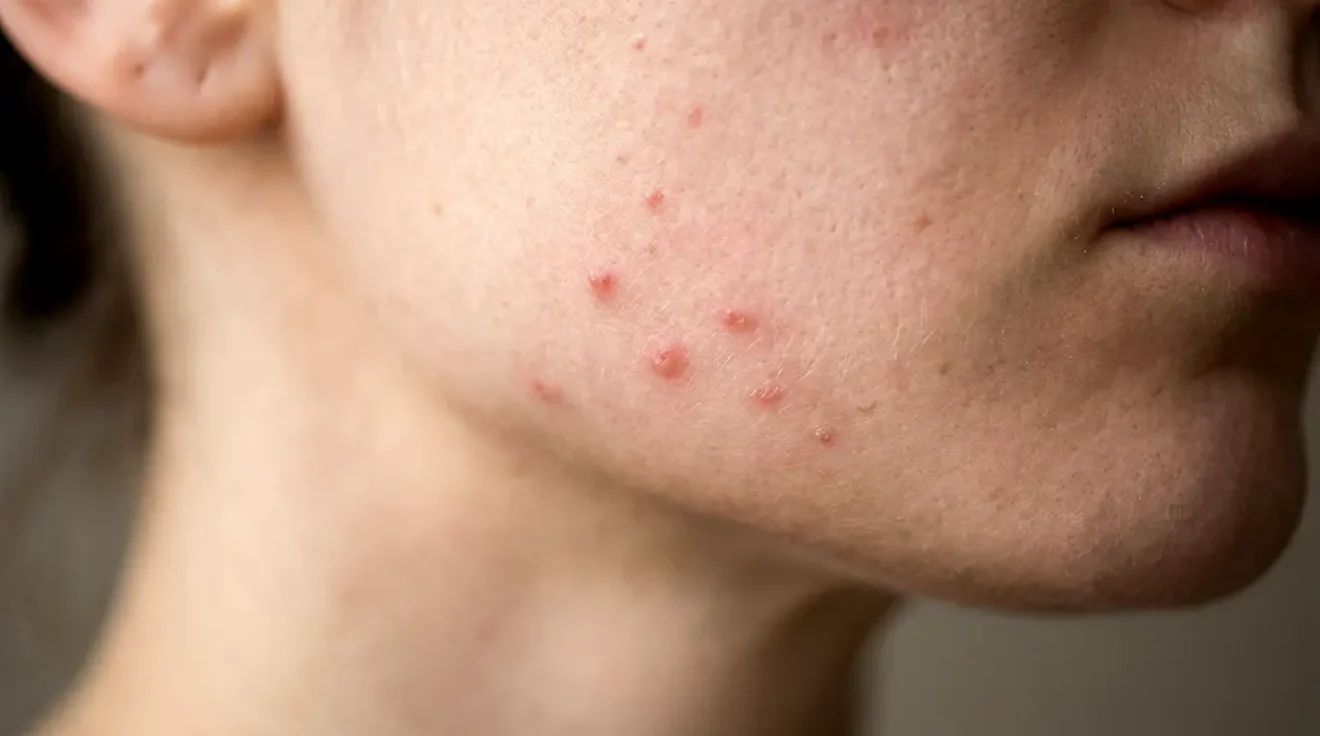
The following comparison can help identify which pattern is more likely:
| Characteristic | Razor burn | Ingrown hairs |
|---|---|---|
| Appearance | Diffuse redness or irritated patches | Individual raised follicular bumps |
| Typical onset | Often within minutes of shaving | May become noticeable as cut hairs grow back |
| Sensation | Burning, stinging, tenderness or itching | Itching, tenderness or local inflammation |
| Duration | Several hours to several days | May persist for days or longer |
| Common trigger | Friction, repeated passes, dull blades or irritating products | Hair re-entering or penetrating surrounding skin |
These are useful patterns, not definitive diagnostic rules. A bump lasting more than 48 hours is not automatically an ingrown hair, and follicular inflammation can sometimes become infected. A visible trapped hair may support suspicion of an ingrown hair, but it is not always present.
For widespread flat redness, pause shaving until the skin feels comfortable again. Use a cool compress and a simple moisturizer. For isolated bumps, avoid shaving directly over the affected follicles and do not pick, scratch or squeeze them.
Repeated close shaving can prolong pseudofolliculitis barbae. DermNet recommends shaving in the direction of hair growth, avoiding skin stretching, using short strokes and reducing repeated passes. Temporarily stopping shaving may be necessary to allow inflammation to settle.
Picking at bumps can increase inflammation and contribute to infection, scarring or post-inflammatory hyperpigmentation. This can be particularly noticeable on darker skin tones. Avoid digging into the skin to extract a hair, especially when it is not clearly visible.
When the reaction seems to follow a particular aftershave or shaving product, another possibility deserves consideration: the ingredients may be contributing to the redness independently of razor technique.
Why Menthol Aftershave Can Make Red, Irritated Skin Feel Worse
Menthol can make freshly shaved skin feel cooler without necessarily reducing the underlying irritation. It activates a cold-sensitive receptor called TRPM8, changing how temperature is perceived. This sensory cooling effect should not be confused with repairing the skin barrier or treating inflammation.
Menthol is commonly included in aftershaves because it creates a noticeable cooling sensation. When applied to skin that feels hot after shaving, this sensation may initially seem reassuring. However, the perception of coolness does not establish that the irritated tissue is recovering.
The molecular mechanism was investigated in the original Cell research, original Cell study on menthol and the TRPM8 cold receptor. The researchers demonstrated that menthol activates TRPM8, a cold-sensitive ion channel involved in temperature perception.
That experimental finding explains the cooling sensation, but it does not show that menthol-based aftershaves improve razor burn or repair damaged skin. Nor does it establish that menthol universally causes increased redness or reactive flushing after its cooling effect disappears.
The distinction between sensory relief and skin recovery is important. A product may feel refreshing while still containing alcohol, fragrance or other ingredients that irritate sensitive skin. Its immediate sensation is not a reliable measure of its overall suitability.
For someone experiencing repeated post-shave redness, it is worth reviewing the full ingredient list rather than focusing exclusively on menthol. Fragrance, alcohol and certain active ingredients may be responsible for discomfort in some formulations.
Ingredients such as panthenol, allantoin and ceramides are commonly used in skin-care formulations intended to support hydration and barrier care. Their presence does not guarantee that every product will be suitable for every individual, however.
A practical way to assess tolerance is to stop using a product that repeatedly causes discomfort and simplify the routine. Persistent burning, itching or worsening redness after application suggests that the formulation may not suit the skin.
There is no scientifically established universal one-minute stinging threshold that diagnoses product irritation. The intensity, persistence and recurrence of symptoms matter more than a fixed stopwatch rule.
If redness continues despite avoiding potentially irritating products and adjusting shaving technique, it is important to consider whether a persistent skin condition requires medical assessment.
When Should Post-Shave Redness Be Checked by a Healthcare Professional?
Post-shave redness should be assessed by a healthcare professional when it persists without improvement, repeatedly returns despite changes in shaving technique, becomes increasingly painful or develops signs of infection. Spreading redness, pus, significant swelling or fever also warrants prompt medical attention. Facial or neck swelling accompanied by breathing or swallowing difficulty requires emergency care.
Ordinary razor burn generally improves over several hours to a few days. When symptoms do not follow this pattern, another explanation may need to be considered. Continuing to apply aftershave or repeatedly shaving the affected area can make assessment more difficult by introducing additional irritation.
Several conditions can resemble or aggravate shaving-related redness:
- Rosacea: A chronic inflammatory skin condition that can cause persistent facial redness, flushing and visible small blood vessels. Shaving may act as an individual trigger.
- Seborrheic dermatitis: A condition that commonly affects areas such as the sides of the nose, eyebrows and beard region. Redness may occur alongside scaling or flaky skin.
- Folliculitis: Inflammation involving hair follicles that can cause small bumps or pustules. Some forms are infectious and require different management from simple razor burn.
- Contact dermatitis: A reaction to an irritating or allergenic substance in shaving products, moisturizers or fragrances.
Seek medical advice when bumps become painful, enlarge, produce pus or are surrounded by increasing redness. Fever, spreading inflammation and substantial facial swelling should not be treated as routine shaving irritation.
It can be helpful to document the progression of symptoms before an appointment. Take photographs of the affected area under similar lighting and at approximately the same time each day. Record when shaving occurred, which products were used and whether symptoms improved or worsened.
This information does not replace a clinical examination, but it can help a healthcare professional understand the pattern. In particular, redness returning in exactly the same location after every shave deserves attention even when the symptoms are relatively mild.
The NHS advises seeking medical advice when contact dermatitis is persistent, recurrent or severe. A clinician may assess whether the reaction is related to an irritant, an allergy or another skin condition. Dermatological evaluation may be useful when the cause remains unclear.
Professional assessment is especially important when repeated irritation is accompanied by scarring, dark marks or persistent follicular bumps. These complications may indicate that the current shaving approach needs more substantial changes.
A Practical Checklist Before Your Next Shave
- Inspect the affected area under good lighting and record whether redness is diffuse, raised or concentrated around individual follicles.
- Photograph the skin and note when the redness first appeared, how long it lasts and whether it is improving.
- Write down every shaving and skincare product used, including aftershave, cleanser, fragrance and moisturizer.
- Identify the direction of hair growth in the affected area and note whether repeated passes or shaving against the grain may contribute to irritation.
- Arrange a healthcare assessment if symptoms persist, recur or worsen, and seek prompt attention for signs of infection or systemic illness.
Once persistent skin problems have been considered, prevention becomes the next priority. One of the most useful adjustments is understanding how shaving direction influences the likelihood of hairs becoming trapped beneath the skin.
Key Points to Remember
- Shaving against the grain can increase the likelihood of closely cut hairs re-entering the skin, particularly in men with coarse or tightly curled facial hair.
- Following the natural direction of hair growth and reducing repeated blade contact can help prevent irritation and ingrown hairs.
- A closer shave is not always a healthier shave: comfort and the absence of recurring inflammation should guide technique.
Why Does Shaving Against the Grain Cause More Razor Bumps?
Shaving against the grain can increase razor bumps because it often cuts hairs more closely and may leave sharp tips that retract beneath the skin or penetrate surrounding tissue as they grow. This is particularly relevant for men with curly or coarse facial hair, whose hair can bend back towards the follicle wall.
Shaving against hair growth is attractive because it can produce a smoother finish. However, achieving a closer shave can come at the cost of greater irritation, especially when the razor repeatedly passes over the same area.
When a hair is cut very short, its sharp tip may retract beneath the skin surface. As it grows, it can curl back into the surrounding tissue and trigger inflammation. This is a key mechanism involved in pseudofolliculitis barbae.
The risk is particularly relevant beneath the jawline and across the neck, where hair-growth directions may change over short distances. Men with tightly curled facial hair may experience more frequent ingrown hairs because the regrowing hair can curve towards the skin.
The solution is not necessarily to avoid every close shave forever. Instead, the aim is to find the closest shaving technique that does not repeatedly produce inflammation.
A progressive approach is generally more practical:
- Start by shaving in the direction of hair growth using short, gentle strokes.
- Check the skin’s response after the first pass rather than automatically repeating the stroke.
- If the skin tolerates shaving well, consider whether a pass across the grain is comfortable and necessary.
- Avoid shaving against the grain in areas that regularly develop ingrown hairs or remain irritated.
- Do not make additional passes over bumps, cuts or visibly inflamed areas.
Hair texture and individual tolerance both matter. Men with straight, fine hair may tolerate closer shaving more easily than those with coarse or tightly curled hair. Even then, there is no guarantee that shaving against the grain will be irritation-free.
DermNet’s clinical guidance on pseudofolliculitis barbae recommends shaving in the direction of hair growth, avoiding skin stretching and reducing repeated passes. An electric razor that leaves a little hair above the skin may also be worth considering for men who experience recurrent ingrown hairs.
Another important consideration is shaving pressure. Pressing harder does not necessarily produce a better shave. It can increase friction and skin disruption, especially when the blade is dull or clogged.
Allowing irritated skin to recover between shaves is equally important. Repeatedly shaving over an inflamed follicle can prolong discomfort and increase the likelihood of visible marks.
Technique is only one part of the picture, however. When redness is accompanied by itching, scaling or a reaction that follows product application, contact dermatitis may provide a better explanation.
Irritant Contact Dermatitis or Allergic Contact Dermatitis: What Signs Differ?
Irritant contact dermatitis and allergic contact dermatitis can both cause redness after shaving, but they develop through different mechanisms. Irritant dermatitis results from direct damage to the skin barrier, while allergic contact dermatitis involves an immune response to a substance the body has become sensitised to. Their symptoms can overlap, so appearance alone cannot confirm which reaction is occurring.
Irritant contact dermatitis is associated with substances or repeated exposure that damage the outer skin layer. Shaving friction, harsh cleansers, alcohol-containing formulations and certain active ingredients may contribute to irritation, particularly when the skin barrier is already disrupted.
Symptoms can include burning, stinging, dryness, tightness and redness. They often affect the area exposed to the irritating substance, although the precise distribution depends on the exposure and severity.
Allergic contact dermatitis is different. It occurs when the immune system reacts to an allergen following sensitisation. Cosmetic ingredients, including certain fragrances and preservatives, can trigger this type of reaction.
Itching is often a prominent feature. The affected skin may also develop small blisters, dryness, cracking or crusting. Reactions can develop hours or days after exposure, meaning the product responsible may not be the one most recently applied.
The NHS overview of contact dermatitis explains the distinction between direct irritant damage and an immune-mediated allergic reaction. It also notes that cosmetics can be responsible for allergic contact dermatitis.
| Feature | Irritant contact dermatitis | Allergic contact dermatitis |
|---|---|---|
| Mechanism | Direct damage to the skin barrier | Immune response to an allergen |
| Onset | May develop rapidly or after repeated exposure | Often delayed after exposure |
| Common sensations | Burning, stinging and tightness | Itching and discomfort |
| Visible signs | Redness, dryness and cracking | Redness, itching, blisters and possible crusting |
| Management principle | Reduce exposure to the irritant and support barrier recovery | Identify and avoid the allergen |
Ingredient labels can provide useful clues. Look for terms such as fragrance or parfum, particularly when redness repeatedly follows the use of an aftershave or scented shaving cream. Alcohol and strong exfoliating ingredients may also be relevant when the reaction involves burning or dryness.
However, these clues are not definitive. Fragrance can cause either irritation or allergy, and alcohol does not automatically explain every reaction. A person may also develop sensitivity to an ingredient that previously caused no obvious problem.
Stopping a suspected product and simplifying skincare can help reduce further exposure. Nevertheless, persistent or recurrent symptoms may require a healthcare professional to identify the trigger. Formal patch testing can help investigate suspected allergic contact dermatitis.
A home test lasting 48 hours cannot reliably rule out an allergy. Delayed reactions and differences in exposure conditions make professional assessment important when symptoms keep returning.
Regardless of the underlying mechanism, freshly shaved skin benefits from careful handling. Avoiding unnecessary alcohol-based aftershaves and choosing simpler formulations can reduce another potential source of irritation.
How to Care for Freshly Shaved Skin Without Alcohol-Based Aftershave?
Freshly shaved skin can be cared for without alcohol-based aftershave by using a gentle rinse, a suitable soothing moisturizer and clean shaving equipment. Alcohol-containing formulations may sting on recently shaved skin, especially when microscopic surface injuries are present. A fragrance-free alternative can help reduce unnecessary irritation while supporting skin hydration.
Aftershave is often marketed around a sharp, cooling or refreshing sensation. However, that sensation does not establish that a formulation is improving the skin barrier. Some products contain alcohol or fragrance that can be uncomfortable when applied immediately after shaving.
Shaving can disrupt the outer skin layer and contribute to temporary moisture loss. A product that causes persistent stinging or dryness may add to the discomfort rather than help the skin recover.
A simpler post-shave routine can focus on three priorities:
- Clean gently. Rinse away remaining shaving cream with cool or lukewarm water. If cleansing is necessary, use a mild, fragrance-free cleanser rather than a harsh soap.
- Soothe without overloading. Choose one suitable fragrance-free product containing an ingredient such as aloe vera, oat extract or panthenol. Natural ingredients are not automatically safer, so individual tolerance remains important.
- Support the skin barrier. Apply a lightweight moisturizer containing suitable emollients and humectants. Squalane or jojoba oil may be tolerated by some individuals, but a well-formulated moisturizer is often a more complete option.
Applying moisturizer while the skin is slightly damp can help retain hydration. Use a small amount and spread it gently without rubbing. There is no universal requirement to wait a specific number of minutes between every product, particularly when a simple routine contains only one moisturizer.
It is also important to consider hygiene. A clean razor, clean hands and properly maintained shaving equipment help reduce avoidable contamination. Avoid sharing razors and do not repeatedly touch irritated skin.
For men prone to ingrown hairs, blade choice and shaving frequency may be just as important as aftershave selection. A sharp, clean blade used gently can reduce unnecessary friction. An electric trimmer that leaves some hair length may be a useful alternative when close shaving repeatedly causes problems.
Do not apply several new natural oils, botanical extracts or essential oils at once. Chamomile, aloe and other plant-derived ingredients can still cause sensitivity or allergic reactions in some people. A fragrance-free formulation with a short ingredient list may make it easier to identify what the skin tolerates.
When redness is already present, avoid exfoliating aggressively or trying to remove visible ingrown hairs by digging into the skin. Let the area recover and seek advice if inflammation persists or becomes infected.
The objective is not to reproduce the traditional aftershave sensation. It is to leave the skin comfortable, hydrated and free from unnecessary irritation.
If facial redness continues despite gentle shaving, suitable moisturization and avoidance of suspected triggers, a healthcare professional can help identify whether an underlying skin condition is involved. The most effective routine is the one that respects the skin’s response rather than repeatedly trying to mask its symptoms.
How long should facial redness last after shaving?
Ordinary razor burn usually begins within minutes of shaving and may last from several hours to several days. The duration depends on the degree of irritation and individual skin sensitivity. Redness that persists without improvement, repeatedly returns or becomes more painful should be assessed by a healthcare professional.
Should I shave again if my face is still red?
It is generally better to avoid shaving directly over visibly irritated skin until it has recovered. Another pass can increase friction and prolong inflammation. If recurring redness is associated with ingrown hairs, consider reducing shaving frequency or using an electric trimmer that does not cut as closely.
Can moisturizer make post-shave redness worse?
Yes, some moisturizers can aggravate redness if they contain ingredients that irritate the skin or trigger an allergic reaction. Fragrance, certain preservatives and botanical extracts may be responsible. Choose a simple fragrance-free formulation and discontinue it if discomfort, itching or redness increases after application.
Why does my face become red after every shave even when I use a new razor?
A new razor does not eliminate every cause of shaving-related redness. Repeated blade contact, shaving against the grain, individual skin sensitivity, ingrown hairs and reactions to shaving products can all contribute. If redness occurs consistently despite changes in technique and skincare, a professional assessment can help identify an underlying condition.
Is cold water enough to treat razor burn?
Cool water or a clean, cool damp cloth can help soothe mild razor burn, but it does not necessarily address every cause of irritation. A suitable fragrance-free moisturizer can support hydration while the skin recovers. Persistent bumps, worsening redness or signs of infection require a different approach and may need medical assessment.