
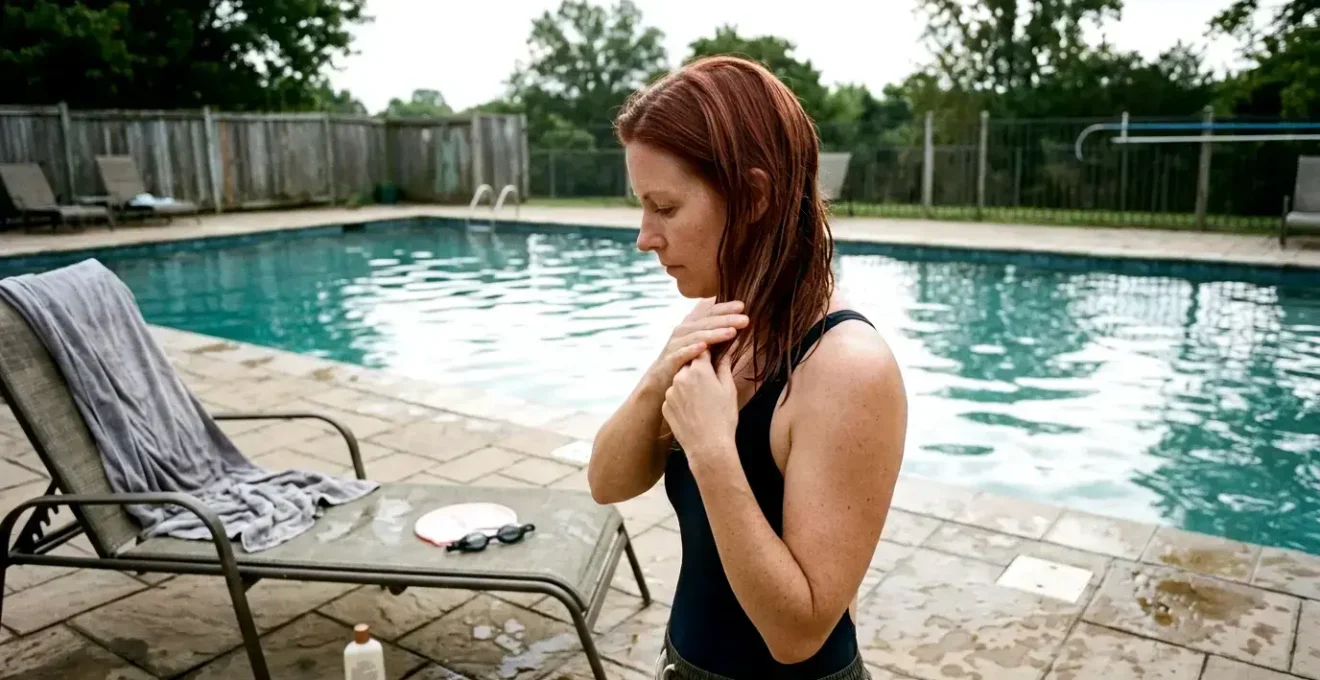
Protecting dyed hair from sunlight, swimming pools and everyday environmental exposure requires more than choosing a colour-safe shampoo. Artificial colour gradually loses vibrancy through a combination of ultraviolet radiation, repeated washing, chemical exposure, mineral deposits and physical wear. Chemically treated hair can also become more porous, making its lengths particularly vulnerable to changes in texture and appearance.
The most effective approach combines physical protection, lightweight leave-in conditioning, appropriate cleansing and regular assessment of the hair fibre. A sun hat, for example, provides a more predictable physical barrier than relying exclusively on a cosmetic UV spray, while rinsing before and after swimming helps manage exposure to pool chemicals and minerals. Neither strategy works as a complete solution on its own.
For adults who regularly spend time outdoors or swim frequently, the objective is to slow colour deterioration without accumulating heavy products or compromising the natural movement of the hair. Understanding what causes fading makes it easier to select protective treatments that genuinely address the relevant exposure.
Dyed Hair Protection: The Essential Points
- Use physical shade and appropriate hair protection to reduce UV exposure and preserve colour between salon appointments.
- Pre-rinse dyed hair before swimming, limit prolonged exposure to pool water and rinse thoroughly afterwards.
- Maintain the fibre with lightweight conditioning, occasional targeted treatments and gentle cleansing rather than relying on a single protective ingredient.
- Why Does Dyed Hair Change Shade After Repeated Sun Exposure?
- How to Prepare Dyed Hair for a Chlorinated Pool Without Heavy Products?
- Sun Hat or UV Hair Spray: Which Offers More Reliable Protection Outdoors?
- Why Sunflower Extract Alone Cannot Guarantee UV Protection for Coloured Hair
- When Should You Apply Hair Protection Before a Day at the Beach?
- When Should You Recondition Hair After Frequent Pool Sessions?
- Why Does Hair Feel Rougher After Permanent Colouring?
- How to Keep Hair Colour Looking Vibrant Between Salon Visits?
Why Does Dyed Hair Change Shade After Repeated Sun Exposure?
Dyed hair changes shade after repeated sun exposure because ultraviolet radiation can affect both artificial colour molecules and the hair’s natural pigments. UVA and UVB radiation also contribute to protein damage within the fibre. The resulting colour changes depend on the original shade, colouring process, hair condition and intensity of exposure. Fading therefore does not always mean that hair simply becomes lighter.
Artificial pigments can undergo photochemical degradation when exposed to sunlight. As colour molecules break down, the original shade becomes less saturated and underlying tones become more visible. Depending on the starting colour and formulation, brunettes may notice warmer or coppery reflections, while blonde and lightened hair can develop unwanted yellowish or dull appearances.
Natural melanin also responds to ultraviolet exposure. Its degradation can alter the underlying colour balance, contributing to uneven-looking results. An experimental investigation published in 2004 documented significant colour changes across different human hair types exposed to artificial or solar radiation. The researchers also identified protein damage, with UVB producing greater protein loss than UVA combined with visible light under the experimental conditions. These findings provide useful evidence of photodamage, although they do not directly quantify fading rates in artificially coloured hair. The study of ultraviolet-induced hair colour changes and protein damage helps establish this distinction.
Colour-treated hair can be particularly vulnerable because permanent oxidative colouring involves alkaline and oxidising agents that swell the cuticle during the colouring process. This facilitates the entry of colour precursors into the cortex and can alter the fibre’s structure. However, it would be inaccurate to assume that every coloured hair fibre remains permanently open or that UV radiation and chlorine necessarily penetrate more deeply in every case.
A practical way to assess the dominant problem is to observe the direction of colour change:
- Brassy or coppery: the original cool or neutral tone may be losing balance, with underlying warm pigments becoming more visible.
- Dull or washed-out: pigment degradation, repeated cleansing and general surface deterioration may be contributing.
- Greenish: after swimming, mineral deposits, particularly copper, should be considered rather than attributing the change automatically to sunlight.
Exposure conditions matter too. Open outdoor environments, reflective surfaces and prolonged time in direct sunlight can increase cumulative exposure. Water can reflect sunlight, but the amount of additional UV reaching the hair varies with the environment and cannot be assumed to follow a universal pattern. Overcast weather also does not eliminate UV exposure.
Once the likely cause is understood, prevention becomes more targeted: physical shade for sunlight, appropriate rinsing for swimming and conditioning for weakened lengths. This distinction is especially important when moving from outdoor exposure to chlorinated water.
How to Prepare Dyed Hair for a Chlorinated Pool Without Heavy Products?
The simplest way to prepare dyed hair for a chlorinated pool is to wet it thoroughly with clean water before swimming, apply a small amount of suitable lightweight leave-in conditioner if needed, and use a swim cap for additional physical protection. Pre-wetting reduces the amount of additional pool water the hair can take up, while avoiding excessive product prevents fine coloured lengths from becoming weighed down.
Hair is porous and absorbs water. When dry hair enters a swimming pool, it can take up pool water, including its dissolved substances. Saturating the fibre beforehand with clean water can reduce the opportunity for additional absorption, although it does not create a waterproof barrier or prevent all chemical exposure.
The choice of leave-in product should depend on hair density and porosity. Fine hair generally benefits from a lightweight, water-based formulation, whereas thick, coarse or highly porous hair may tolerate a slightly richer conditioner or a small amount of plant oil on the mid-lengths and ends.
These textures serve different purposes. A watery botanical leave-in primarily conditions the surface and improves manageability. An oil-based product can provide lubrication and reduce friction, but its protective effect against chlorine is not guaranteed. Neither aloe vera nor plant oil should be treated as a substitute for rinsing or a properly fitted swimming cap.
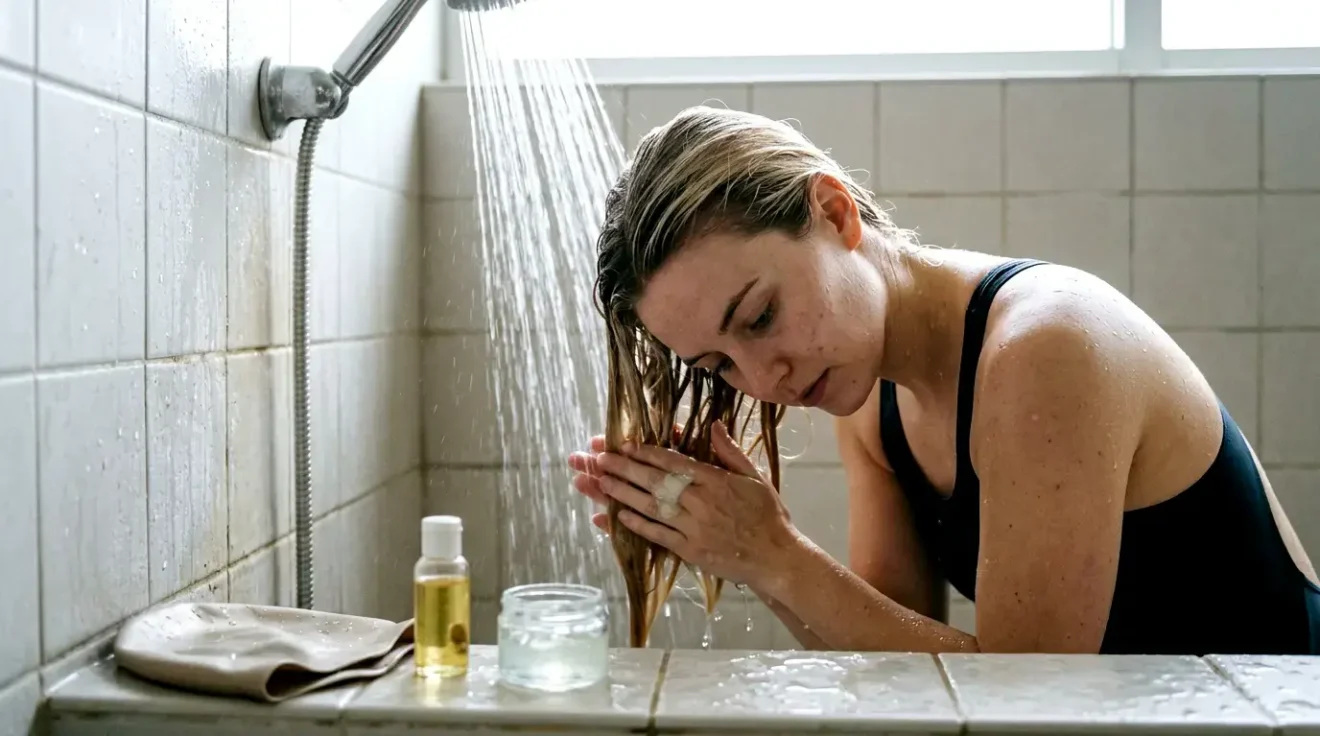
A practical preparation routine can be kept to three stages:
- Rinse: Saturate the hair with clean water before entering the pool, paying attention to the lengths and ends.
- Seal: Distribute a small quantity of lightweight leave-in conditioner through the mid-lengths and ends. Add richer products only where the hair needs them.
- Cover: Use a properly fitted swim cap when practical, particularly for frequent or prolonged swimming.
For fine hair, begin with a small amount of leave-in rather than coating the entire head. Medium-density hair may need more even distribution, while thick hair generally requires more product to cover its full length. The correct amount is the minimum that provides even coverage without leaving a greasy or sticky finish.
Long swimming sessions require additional caution. Oils may make hair feel smoother, but they do not prevent all water penetration. Excess product under a swim cap can also create an uncomfortable, heavy coating. A cap and a consistent rinsing routine are more dependable foundations than attempting to create a waterproof layer with botanical ingredients.
Your Five-Step Pre-Swim Hair Protection Checklist
- Wet the hair thoroughly with clean water before entering the pool. Deliverable: fully saturated lengths.
- Choose a lightweight leave-in suited to the hair’s density. Deliverable: a product that does not leave visible residue.
- Apply the conditioner evenly to the mid-lengths and ends. Deliverable: consistent coverage without excessive product accumulation.
- Prepare a well-fitting swimming cap for longer sessions. Deliverable: hair covered as effectively as the cap design allows.
- Keep a clean-water rinse available for immediately after swimming. Deliverable: a post-swim rinsing step included in the pool routine.
Preparation reduces unnecessary exposure but cannot eliminate it. The next step is understanding how to remove pool residues after swimming, while choosing the right protection for outdoor sunlight rather than relying on a single cosmetic product.
Sun Hat or UV Hair Spray: Which Offers More Reliable Protection Outdoors?
A tightly woven sun hat generally offers more predictable protection for coloured hair than relying on UV hair spray alone. A hat physically shades the covered areas, whereas a spray depends on its formulation, distribution and application. However, sprays can help protect exposed partings, hairlines and styles that hats do not completely cover. Combining both methods is usually the more sensible approach.
Sunlight affects the hair fibre through several mechanisms, including pigment degradation and protein damage. Physical shade reduces direct exposure to the covered sections without depending on the deposition of a cosmetic film. A wide-brimmed hat or another suitable covering is therefore a useful first choice during prolonged outdoor activities.
UV hair sprays work differently. Depending on their ingredients, they may contain UV-absorbing substances, film-forming agents and antioxidants. These components can help reduce certain effects of exposure, but their performance varies between formulations. An antioxidant is not necessarily a UV filter, and a conditioning film does not automatically provide measurable photoprotection.
Evidence also warrants caution when interpreting commercial claims. A 2023 experimental investigation evaluated three hair cosmetics using a reflectance-based method and included nine participants across different hair-colour groups. The products tested did not demonstrate the expected photoprotective properties under the study conditions. This limited finding does not prove that all UV hair sprays are ineffective, but it illustrates why marketing claims should not be treated as independent proof. The experimental assessment of photoprotection properties in hair cosmetics provides relevant context.
The following comparison highlights the practical differences:
| Criterion | Sun hat | UV hair spray |
|---|---|---|
| Protection mechanism | Physical shade over covered hair | Depends on UV filters, film-forming agents and formulation |
| Consistency | Relatively predictable when coverage is adequate | Depends on even application and product performance |
| Exposed partings | May remain uncovered | Can be applied to accessible exposed areas |
| After swimming or sweating | Can continue providing shade when worn | Product retention may change and reapplication may be needed |
| Structural hair repair | Does not repair existing damage | Not guaranteed; depends on conditioning ingredients |
When selecting a spray, examine the ingredient list rather than relying exclusively on phrases such as UV shield, sun defence or colour protection. Look for identifiable UV-filter ingredients where appropriate, alongside conditioning agents and antioxidants. Check the manufacturer’s directions concerning application and reapplication.
It is also important to distinguish cosmetic hair protection from sunscreen. A hair product should not be assumed to provide tested skin protection. The scalp, hairline and exposed ears require appropriate sun protection designed for skin, especially when hair is thin or parted.
The choice of protective product becomes more straightforward when its active ingredients are understood. In particular, natural antioxidants such as sunflower extract can support colour maintenance, but their role needs to be distinguished from that of actual UV filters.
Why Sunflower Extract Alone Cannot Guarantee UV Protection for Coloured Hair
Sunflower extract alone cannot guarantee UV protection for coloured hair because antioxidant activity and ultraviolet filtering are different functions. Sunflower-derived ingredients may help limit oxidative stress and support the conditioning of the fibre, depending on their formulation. However, their presence does not establish that a product absorbs or blocks enough UV radiation to protect hair reliably during prolonged exposure.
Sunflower ingredients are often associated with vitamin E and other antioxidant compounds. These substances can help counter oxidative processes that contribute to cosmetic deterioration. Their usefulness depends on the specific ingredient, concentration, stability and finished formulation.
Three complementary protection mechanisms should be distinguished when evaluating natural haircare:
- Antioxidants: Ingredients that help limit oxidative reactions. They can support colour maintenance but do not automatically prevent UV radiation from reaching the hair.
- Film-forming botanicals: Ingredients that deposit a coating on the fibre and may improve lubrication, manageability or resistance to certain forms of external stress.
- UV filters: Ingredients specifically intended to absorb or otherwise attenuate ultraviolet radiation, subject to their formulation and demonstrated performance.
A product containing sunflower extract may therefore be useful as part of a wider conditioning routine, but it should not be confused with a complete photoprotective treatment. The same principle applies to aloe vera, plant oils and other botanical ingredients: a natural origin does not establish a particular level of UV protection.
Reading an ingredient list helps establish what a product can realistically do. Ingredients are generally listed according to their concentration in descending order, subject to applicable labelling rules and exceptions. An ingredient appearing near the end of the list may still have a functional purpose, but its presence alone does not demonstrate meaningful performance.
Consider the following selection criteria:
- Identify sunflower-derived ingredients and determine whether they are being used primarily for conditioning or antioxidant support.
- Look for complementary film-forming or conditioning ingredients if the objective is to improve the feel and manageability of porous lengths.
- Check whether the manufacturer identifies actual UV-filter ingredients and provides meaningful information about the intended protection.
- Assess the complete formulation rather than assuming that one highlighted botanical determines the product’s effectiveness.
There is also a behavioural risk associated with relying on a single natural claim. Someone who assumes that a sunflower-based conditioner provides complete sun protection may stop wearing a hat or fail to renew protection after swimming. This creates a false sense of security without addressing cumulative exposure.
Natural cosmetics can play a useful supporting role in a colour-preservation routine, particularly when they improve fibre condition. Their limitations become especially important during beach days, when sunlight, salt water and repeated drying can act together.
When Should You Apply Hair Protection Before a Day at the Beach?
Apply leave-in hair protection shortly before beach exposure, following the manufacturer’s directions and ensuring that the product is evenly distributed through the lengths. Applying it to clean, slightly damp hair can help with distribution, although some formulations are designed for dry hair. Reapply when directed, particularly after swimming or towel-drying, because water and friction can remove or redistribute cosmetic products.
The timing depends on the type of protection being used. A conditioning leave-in is generally applied before exposure so that it can coat the fibre and improve manageability. A product containing UV filters should be used according to its specific instructions rather than assuming that every spray needs the same waiting period or application quantity.
A useful beach preparation sequence is:
- Before leaving: Detangle gently and apply a suitable leave-in to the lengths. Concentrate on porous ends without saturating fine roots.
- Before direct exposure: Wear a suitable sun hat or cover the hair whenever possible.
- After swimming: Rinse seawater from the hair with fresh water when available.
- After towel-drying: Assess whether the protective product needs to be reapplied according to its instructions.
- During prolonged exposure: Maintain physical shade and avoid leaving the same exposed parting under direct sunlight for extended periods.
Salt water introduces a different challenge from chlorinated pool water. Seawater contains dissolved salts that remain on the fibre as the water evaporates. Combined with sunlight and wind, repeated exposure can leave the hair feeling rough, tangled and dehydrated. Rinsing with fresh water helps remove surface salt residues and makes subsequent conditioning easier.
The hairline and scalp deserve particular attention. A protective hair product is not necessarily formulated or tested for exposed skin. Apply suitable broad-spectrum sunscreen to exposed scalp areas and the hairline, following its directions. A hat provides additional physical shade, especially where the hair is parted or naturally sparse.
Fine coloured hair may benefit from a lightweight spray or lotion rather than a rich oil-based treatment. Coarse or highly porous hair can generally tolerate a more substantial leave-in, provided it does not create excessive residue or discomfort.
Beach protection should also account for changing conditions. Strong sunlight, wind and repeated immersion can make a single morning application insufficient for a full day outdoors. There is no universal reapplication interval for all hair products, so the manufacturer’s instructions remain essential.
After a day outdoors, the priority shifts from prevention to removing accumulated residues and restoring manageability. For regular swimmers, that transition should become a consistent part of the weekly haircare routine.
Key Takeaways Before Building a Maintenance Routine
- Repeated exposure to sunlight and pool water affects both colour appearance and fibre condition, so protection must address both.
- Post-swim cleansing and appropriate conditioning serve different purposes: removing residues is not the same as repairing roughness.
- Long-term colour maintenance depends on adjusting care to actual exposure frequency and the condition of the hair, not applying increasingly heavy treatments.
When Should You Recondition Hair After Frequent Pool Sessions?
Recondition dyed hair immediately after swimming by rinsing it thoroughly with fresh water and cleansing when necessary to remove accumulated pool residues. Follow with a suitable conditioner to improve softness and manageability. For frequent swimmers, a more intensive conditioning treatment can be incorporated periodically, with its frequency adjusted according to hair condition rather than following an inflexible daily schedule.
Swimming-pool water can contain chlorine-based disinfectants and dissolved minerals. Repeated exposure may contribute to dryness, changes in feel and surface deterioration, particularly in hair that has already undergone chemical colouring or lightening.
One important distinction concerns greenish discolouration. Green hair after swimming is not necessarily caused directly by chlorine. Copper-containing compounds in pool water can deposit on the hair, especially when the fibre is damaged or previously lightened. These deposits can produce a green appearance that ordinary moisturising conditioner cannot necessarily remove.
A clinical report published in 2022, titled Pseudo Green Hair, documented a case involving blonde hair and a swimming pool with an elevated measured copper concentration. The investigation reported 3 ppm of copper before partial water replacement and 1.1 ppm afterwards. These measurements describe one particular pool and should not be interpreted as typical swimming-pool concentrations. The clinical investigation of green hair associated with swimming-pool copper deposits illustrates why mineral contamination and chlorine exposure must be distinguished.
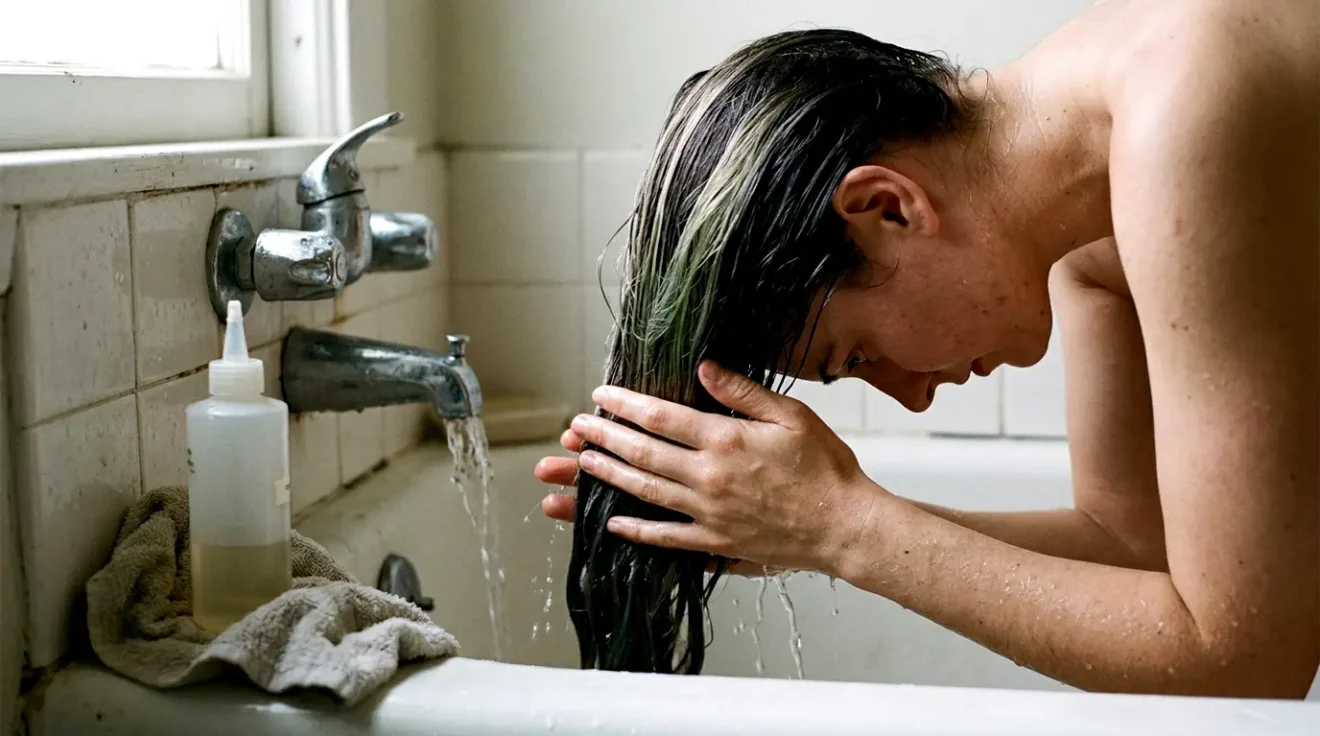
Reconditioning and residue removal should therefore be treated as separate steps. A moisturising mask can improve the feel of dry or rough lengths, but it is not a substitute for a suitable cleansing product when mineral deposits have accumulated. If green discolouration persists, a targeted treatment designed for mineral removal may be more appropriate than repeatedly applying richer conditioners.
For regular swimmers, a practical maintenance rhythm can include:
- After every swim: Rinse thoroughly with fresh water and use a gentle cleanser when necessary, followed by an appropriate conditioner.
- Between sessions: Assess roughness, tangling, elasticity and changes in colour.
- Periodically: Use a more intensive conditioning treatment according to the fibre’s needs and the manufacturer’s directions.
- When mineral build-up is suspected: Consider a targeted chelating or mineral-removing treatment formulated for hair rather than relying on a standard moisturising mask.
Over-conditioning is another concern. Repeated application of heavy masks, oils and leave-ins can leave fine or low-density hair flat, coated and less vibrant in appearance. The solution is not to accumulate more products but to alternate appropriate cleansing with conditioning that matches the actual condition of the fibre.
Frequent swimming makes this distinction particularly important because the hair may already be structurally vulnerable before the next session. Understanding that baseline vulnerability helps explain why some coloured hair feels rough even outside the swimming season.
Why Does Hair Feel Rougher After Permanent Colouring?
Hair often feels rougher after permanent colouring because the chemical process changes the structure of the fibre. Alkaline agents swell the cuticle, while oxidising ingredients facilitate colour development inside the cortex. These changes can increase porosity and affect the hair’s surface properties. The resulting roughness is therefore not always a simple lack of moisture that can be corrected with one conditioning treatment.
Permanent oxidative colouring generally involves a combination of alkaline ingredients and oxidising agents. The alkaline environment causes the cuticle to swell, allowing colour precursors to enter the cortex, where oxidation reactions produce larger coloured molecules.
A scientific review published in 2023, Mechanisms of impairment in hair and scalp induced by hair dyeing and perming and potential interventions, describes these structural and chemical mechanisms. It explains how the colouring process can affect the cuticle and internal structure of the hair. The scientific review of hair damage associated with colouring and perming provides a useful foundation for understanding why coloured hair may require additional care.
Importantly, the cuticle does not necessarily remain permanently open after colouring. The extent of structural change depends on the formulation, processing conditions, initial hair condition and subsequent maintenance. Different colouring techniques, including direct dyes and temporary colour treatments, should not be assumed to cause identical changes.
In practical terms, higher porosity can make coloured hair harder to manage. The fibre may absorb water readily, lose moisture more easily under certain conditions and become more prone to tangling or friction. Exposure to sunlight, salt water and pool minerals can compound these existing problems.
A simple home assessment can provide clues about hair behaviour, although it cannot diagnose porosity precisely. Observe how the hair responds during ordinary washing and drying:
- Does it become saturated quickly during washing?
- Does it tangle easily when wet?
- Do the ends feel noticeably rougher than the roots?
- Does the hair lose its smooth appearance quickly after conditioning?
The commonly suggested glass-of-water float test is not a reliable standalone measure of porosity because surface coatings, strand condition and trapped air can influence the result.
It is also useful to distinguish immediate post-colouring roughness from progressive damage. A temporary change in texture shortly after a chemical service may improve with suitable conditioning and gentle handling. Persistent or increasing roughness suggests that the hair may be experiencing cumulative environmental or mechanical stress.
Acidic products formulated for hair can help improve surface feel in some routines, but concentrated household vinegar rinses are not a universal treatment. Incorrect dilution or unsuitable use can irritate the scalp and worsen the experience of damaged hair. Products specifically formulated for coloured hair are generally a more controlled option.
Once the hair’s baseline condition is understood, protective care becomes more precise. The final step is combining cleansing, conditioning and environmental protection into a repeatable maintenance routine between salon visits.
How to Keep Hair Colour Looking Vibrant Between Salon Visits?
Keeping dyed hair vibrant between salon visits requires a consistent routine that combines gentle cleansing, appropriate conditioning, protection from UV exposure and careful management of swimming-related residues. The goal is to slow pigment deterioration while maintaining a healthy-feeling fibre. Natural cosmetics and protective styling can support this process, but no routine can completely prevent colour fading.
A weekly schedule is often easier to maintain than a collection of disconnected treatments. It should reflect how often the hair is washed, how frequently it encounters sunlight or swimming-pool water, and whether the fibre is fine, coarse, naturally curly or chemically lightened.
A practical weekly maintenance routine can be organised around the following principles:
- On wash days: Use a gentle shampoo formulated for coloured hair. Avoid unnecessarily aggressive cleansing when the hair is already dry or porous.
- After cleansing: Apply a suitable conditioner to improve manageability and reduce friction during detangling.
- After swimming: Rinse away pool or seawater residues and condition according to the hair’s condition.
- Before outdoor exposure: Use a hat or other physical covering and an appropriate leave-in product when useful.
- Periodically: Assess whether the hair needs a more intensive conditioning treatment or targeted mineral-removal care.
Environmental exposure does not stop at the beach or swimming pool. Everyday habits can also influence colour appearance and fibre quality.
Hard water, for example, contains dissolved minerals that may accumulate on hair over repeated washes. The effects depend on water composition, washing frequency and the hair’s condition. A suitable clarifying or chelating product may help when mineral build-up is suspected, while a shower filter should not automatically be assumed to remove every dissolved mineral.
Heat styling is another important consideration. Frequent use of high-temperature styling tools can contribute to surface damage and make already porous lengths more difficult to manage. Reducing unnecessary heat, using a suitable heat protectant and avoiding repeated passes over the same section can help limit additional stress.
Friction also matters. Rough towel-drying, aggressive brushing and repeated rubbing against clothing or bedding can increase tangling and mechanical wear. Gentle detangling, soft towels and smoother pillowcase fabrics can improve comfort and reduce friction, although a silk pillowcase cannot prevent chemical or UV-related fading.
Colour maintenance should also include periodic assessment of tone rather than waiting until fading becomes pronounced. Different signs suggest different salon services:
- Warm or brassy reflections: A professional toner or colour-balancing service may help restore the intended shade, depending on the original colour.
- Reduced shine and saturation: A gloss treatment may refresh the appearance of the lengths without necessarily requiring a full permanent-colour service.
- Visible root regrowth: A targeted root service may be more appropriate than repeatedly colouring the entire length.
- Persistent greenish discolouration: Investigate possible mineral deposits before attempting another colour application.
Natural haircare products can help maintain softness, improve manageability and support a more consistent routine. However, botanical oils, antioxidant extracts and conditioning masks cannot guarantee permanent colour stability. Their role is supportive rather than absolute.
For people with frequent outdoor or swimming exposure, the most useful maintenance decision is to adjust protection to the activity rather than applying the same products in increasingly large quantities. A lightweight leave-in may be sufficient for everyday use, while prolonged sun exposure or repeated swimming calls for additional physical protection and more careful post-exposure cleansing.
Between salon visits, the realistic objective is to preserve colour vibrancy for longer while maintaining the condition of the fibre. Keeping track of changes in tone, texture and manageability makes it easier to recognise when home care is sufficient and when professional colour maintenance is needed. For anyone regularly exposed to sun and swimming-pool water, a consistent prevention routine is more useful than trying to reverse damage after it has accumulated.
Can swimming in a chlorinated pool make dyed hair fade faster?
Repeated exposure to chlorinated pool water can contribute to changes in the condition and appearance of coloured hair. The effects depend on the hair’s porosity, colouring history, pool-water composition and swimming frequency. Pre-rinsing with clean water, wearing a swimming cap and rinsing thoroughly after swimming can help limit unnecessary exposure.
Is coconut oil enough to protect coloured hair from the sun?
No. Coconut oil can provide lubrication and conditioning benefits, but it should not be treated as a reliable standalone UV filter. For better protection, combine appropriate conditioning with physical shade, such as a hat, and a hair product with clearly identified photoprotective ingredients where suitable.
Why does blonde hair sometimes turn green after swimming?
Greenish discolouration can result from copper-containing deposits accumulating on the hair. This is particularly noticeable on blonde or previously lightened hair. Chlorine exposure may contribute to fibre deterioration, but copper deposits are an important separate cause of green colour changes.
Should dyed hair be washed after every swimming session?
Dyed hair should be rinsed thoroughly with fresh water after every swimming session to remove pool or seawater residues. Whether shampoo is needed every time depends on exposure, product build-up and hair condition. When cleansing is necessary, choose a gentle shampoo suitable for coloured hair and follow with conditioner.
How often should coloured hair receive a deep conditioning treatment?
There is no universal schedule. Hair exposed to frequent swimming, sunlight or chemical processing may benefit from more regular intensive conditioning than relatively healthy hair with limited environmental exposure. Adjust treatment frequency according to roughness, tangling, manageability and product build-up rather than automatically applying heavy masks every day.