
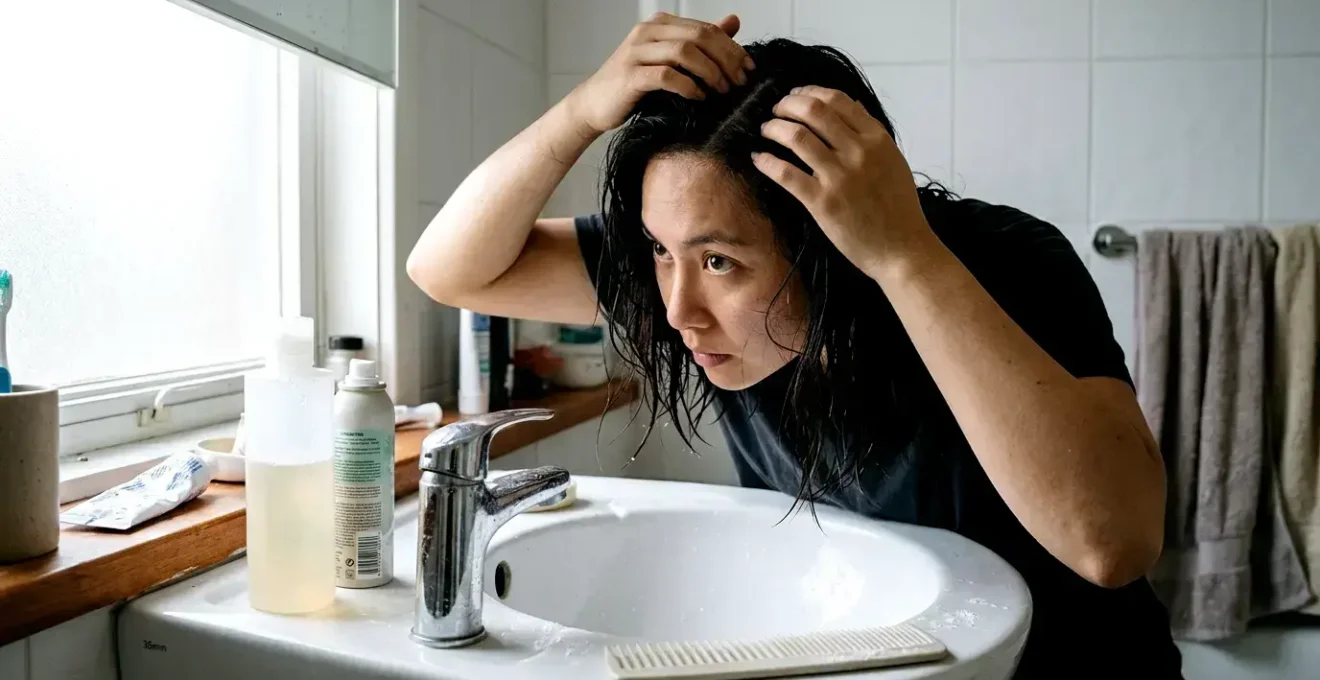
A scalp that feels coated, greasy or uncomfortable after repeated styling is not necessarily asking for a detox. More often, the explanation is considerably simpler: sebum, sweat, dead skin cells and cosmetic ingredients have accumulated faster than ordinary washing removes them. Dry shampoo, styling sprays, leave-in conditioners and finishing products can all contribute to this feeling, particularly when several formulas are applied close to the roots.
The distinction matters because the scalp does not require a special detoxification process to eliminate toxins. It requires appropriate cleansing, effective rinsing and a routine that matches the products being used. A clarifying shampoo can help remove persistent cosmetic residue, but aggressive scrubbing, excessive washing and concentrated essential oils can create additional irritation rather than solve the original problem.
The practical approach is to identify the type of buildup, select the least aggressive effective cleansing method and recognise when persistent itching or flaking may indicate a separate scalp condition. Understanding these differences makes it easier to restore comfortable roots without unnecessarily stripping the hair.
Scalp Cleansing: What Actually Makes a Difference?
- Product buildup is a physical accumulation of styling ingredients, sebum, sweat and dead skin cells, not a collection of toxins requiring detoxification.
- Clarifying shampoo can remove persistent styling residue, while gentle fingertip massage and thorough rinsing help prevent unnecessary irritation.
- The right cleansing frequency depends on product use, scalp condition and washing habits rather than a universal detox schedule.
- Why Does Your Scalp Feel Coated After Using Dry Shampoo Repeatedly?
- How to Remove Scalp Product Buildup Without Scrubbing Too Hard?
- Clarifying Shampoo or Scalp Scrub: Which Is Better for Styling Residue?
- Why Undiluted Tea Tree Oil Can Irritate an Already Itchy Scalp
- When Should You Use a Clarifying Shampoo if You Style Your Hair Daily?
- Why Several Light Hair Products Can Still Create Heavy Buildup
- Why Does Hair Snap Near the Roots Even When You Have No Noticeable Hair Loss?
- How to Revitalise Dull, Lifeless Hair Without Overloading It With Products?
Why Does Your Scalp Feel Coated After Using Dry Shampoo Repeatedly?
Your scalp can feel coated after repeated dry shampoo applications because the product absorbs surface oil without necessarily removing all its ingredients from the scalp and hair. Powder particles, residual styling ingredients, sebum and dead skin cells can contribute to a persistent film, particularly when another application is added before the previous one has been washed away.
Dry shampoo works differently from conventional shampoo. Its powders absorb some of the oil responsible for greasy-looking roots, temporarily improving their appearance. However, absorbing sebum does not mean that the absorbed material has disappeared. The resulting mixture remains among the hair fibres until it is adequately removed through washing.
This explains why repeated applications can produce a progressively heavier sensation. Each additional layer introduces more cosmetic material, while natural skin shedding and ordinary scalp activity do not guarantee that every particle will disappear. The result may be roots that look temporarily fresher but feel increasingly coated.
Two types of residue deserve particular attention. Loose product residue consists of particles or deposits remaining on the hair and scalp surface. A more persistent film can form when cosmetic ingredients mix with sebum and other substances. The first may respond to ordinary washing, whereas the second can require a more effective cleansing formulation.
Dermatological guidance explains that shampoo is designed to remove sebum, sweat, dead skin cells, environmental dirt and hair-care products. Its surfactants help disperse oily material so that it can be carried away during rinsing. This is the actual cleansing mechanism, not detoxification. DermNet’s dermatological overview of shampoo cleansing provides further information about these functions and the consequences of excessive washing.
Consequently, a coated sensation should be interpreted as a practical signal to reassess cleansing habits rather than evidence of accumulated toxins. Persistent discomfort, redness or itching also deserves attention because these symptoms can indicate irritation rather than simply inadequate washing.
Repeated dry shampoo use is not automatically harmful, but relying on it as a permanent replacement for washing can make residue management more difficult. Removing the material effectively, rather than masking its appearance with another application, is the more useful long-term strategy.
How to Remove Scalp Product Buildup Without Scrubbing Too Hard?
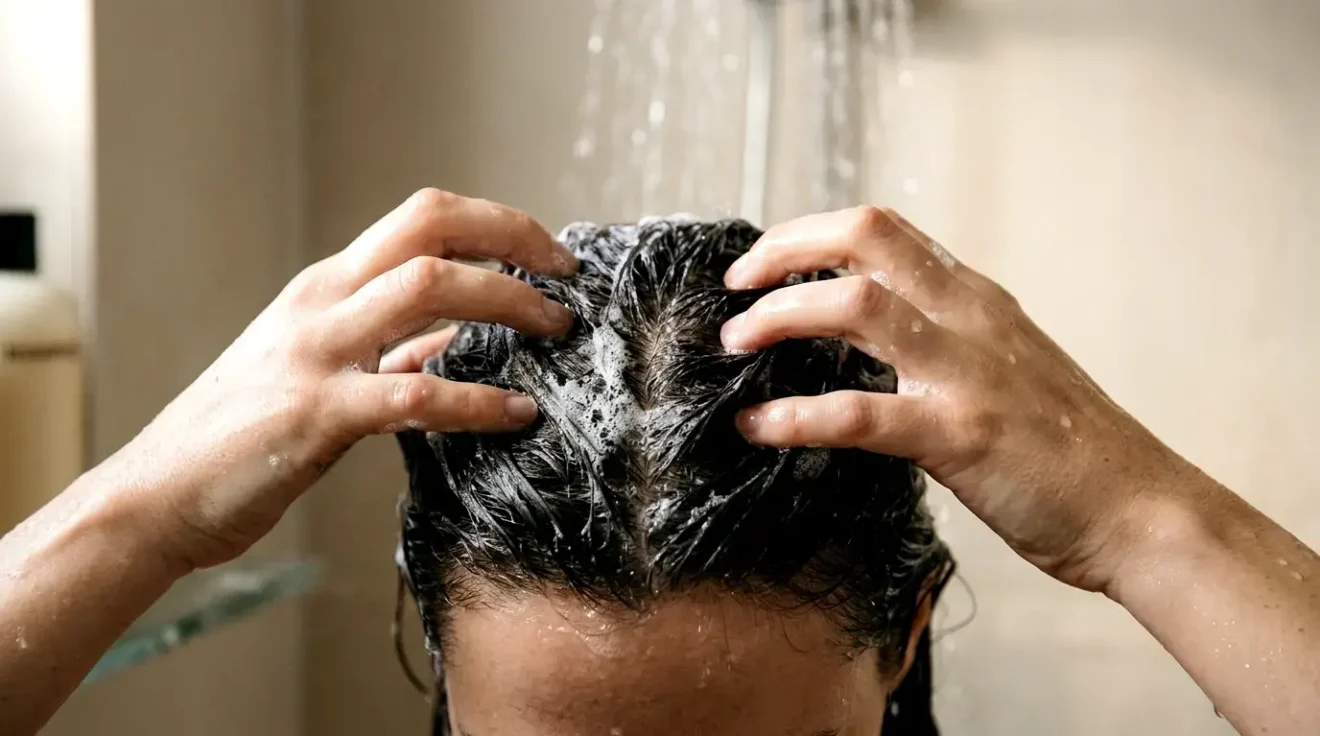
Removing scalp buildup does not require aggressive scrubbing. A properly distributed shampoo, gentle fingertip movements and thorough rinsing are generally more appropriate than scratching or applying excessive pressure. The objective is to allow the cleansing ingredients to disperse sebum and loosen cosmetic residue without unnecessarily disturbing the scalp’s protective surface.
Begin by thoroughly wetting the hair and scalp with lukewarm water. If the hair contains substantial styling residue, distribute the shampoo between your palms before applying it. This helps avoid concentrating a large amount of product in one small area.
Work through the root zone using the pads of your fingertips. Small circular movements can help distribute the shampoo across the scalp, including behind the ears, around the hairline and along the crown. Avoid using fingernails, scraping motions or forceful friction.
DermNet describes gentle scalp massage for approximately 30 seconds as part of its general shampooing instructions. This is practical guidance rather than a clinically validated duration for every buildup problem. The amount of massage should remain comfortable, and the product should be rinsed thoroughly.
There is an important reason to avoid excessive pressure. Scratching and repeated friction can aggravate an already sensitive scalp. The resulting redness, flaking or discomfort may then be mistaken for persistent residue, encouraging further washing and scrubbing. This creates a counterproductive cycle in which the attempted solution contributes to the problem.
A practical distinction is whether the problem improves after normal washing. If the roots remain visibly coated, a single appropriately selected clarifying wash may help. However, persistent itching, burning or flaking after cleansing should not automatically trigger another deep-cleaning session. Those symptoms can point towards irritation or an underlying scalp condition that requires a different approach.
A Five-Step Scalp Cleansing Routine
- Identify the residue: List the products applied since your previous wash. The deliverable is a short inventory of potential buildup sources.
- Prepare the scalp: Wet the hair thoroughly before applying shampoo. The deliverable is an evenly saturated root zone.
- Distribute the cleanser: Emulsify shampoo between your palms and apply it across the scalp. The deliverable is consistent product distribution.
- Massage gently: Use fingertip pads and small circular movements without scratching. The deliverable is a comfortable cleansing process without visible irritation.
- Rinse and assess: Remove the shampoo thoroughly and observe the scalp after washing. The deliverable is a record of whether the coated sensation, itching or visible residue has improved.
If discomfort continues despite an appropriate washing routine, stop increasing cleansing intensity. Persistent symptoms deserve a closer assessment rather than repeated attempts to scrub the scalp clean.
Clarifying Shampoo or Scalp Scrub: Which Is Better for Styling Residue?
Clarifying shampoo is generally the more appropriate first option when the main problem is accumulated styling residue. Its cleansing agents are designed to remove sebum and cosmetic deposits, including certain styling polymers. Scalp scrubs and exfoliating products address different concerns, particularly surface flakes and adhered dead skin cells, and are not automatically more effective against styling products.
The distinction comes down to the type of material being removed. Shampoo surfactants contain components that interact with oily substances and water, helping disperse deposits so they can be rinsed away. Stronger cleansing formulations can therefore be useful when ordinary shampoo does not adequately remove styling residue.
A review published in the International Journal of Trichology explains that clarifying shampoos are formulated to remove retained styling polymers, including those associated with sprays, gels and mousses. The publication also discusses how polymer deposits can affect the appearance and texture of hair. The scientific review on hair cleansing published in the International Journal of Trichology provides useful technical background, although its recommendations should be interpreted in light of its 2010 publication date.
Scalp scrubs operate differently. Physical exfoliants use particles and friction, while chemical exfoliating products use ingredients designed to loosen accumulated surface cells. These approaches may be relevant when flakes or adherent dead skin cells are the main concern, but they do not necessarily remove styling polymers more effectively than shampoo.
| Comparison criterion | Clarifying shampoo | Scalp scrub or exfoliant |
|---|---|---|
| Primary purpose | Remove sebum and cosmetic residue | Address surface flakes and accumulated dead skin cells |
| Action | Surfactant-based cleansing | Physical or chemical exfoliation |
| Most relevant situation | Heavy styling product use and coated roots | Specific surface flaking concerns |
| Potential drawback | Dryness and irritation if overused | Friction or irritation, particularly on sensitive skin |
For someone using styling sprays, gels and dry shampoo frequently, starting with a clarifying shampoo is generally the more logical choice. For someone experiencing flakes without substantial styling product use, introducing a gentle exfoliating formulation may be more relevant, provided the scalp is not already irritated.
Combining both approaches is not automatically beneficial. Using a strong clarifying shampoo followed by an abrasive scrub can increase the total cleansing intensity without providing a corresponding improvement. Tightness, burning, dryness and increased sensitivity are reasons to reduce or stop the treatment.
The most effective option is not necessarily the strongest one. A targeted cleansing product, used when genuinely needed, is generally preferable to stacking multiple intensive treatments on an already sensitive scalp.
Why Undiluted Tea Tree Oil Can Irritate an Already Itchy Scalp
Undiluted tea tree oil can aggravate an itchy scalp because it contains concentrated aromatic compounds capable of triggering irritation and allergic contact dermatitis. Applying it directly to already uncomfortable skin can intensify redness, itching and inflammation. Its natural origin does not make it automatically gentle, and discomfort after application should never be interpreted as evidence that toxins are leaving the body.
Tea tree oil, obtained from Melaleuca alternifolia, is frequently marketed in scalp-care products because of its recognised antimicrobial properties. However, its cosmetic reputation should not obscure its potential to cause adverse skin reactions.
A scientific review published in Contact Dermatitis examined the relationship between tea tree oil composition and contact allergy. It reported positive patch-test reactions ranging from 0.1% to 3.5% among the tested populations reviewed. These figures concern selected groups undergoing patch testing, not the general population.
The review also highlights the importance of oxidation. Fresh tea tree oil is described as a weak-to-moderate sensitiser, while oxidation can increase its allergenic potential. The majority of reported allergic reactions were associated with application of the pure oil. The Contact Dermatitis scientific review on tea tree oil allergy and chemical composition provides further information about these risks.
Two reactions should be distinguished. Irritant contact dermatitis results from direct damage or irritation caused by a substance. Allergic contact dermatitis involves an immune response following sensitisation. Both can produce itching and redness, but they are not the same mechanism.
Essential oils should not be applied undiluted to the scalp. Even diluted preparations are not guaranteed to be suitable for everyone, particularly when the skin barrier is already compromised. A finished formulation designed for its intended use is preferable to experimenting with concentrated ingredients.
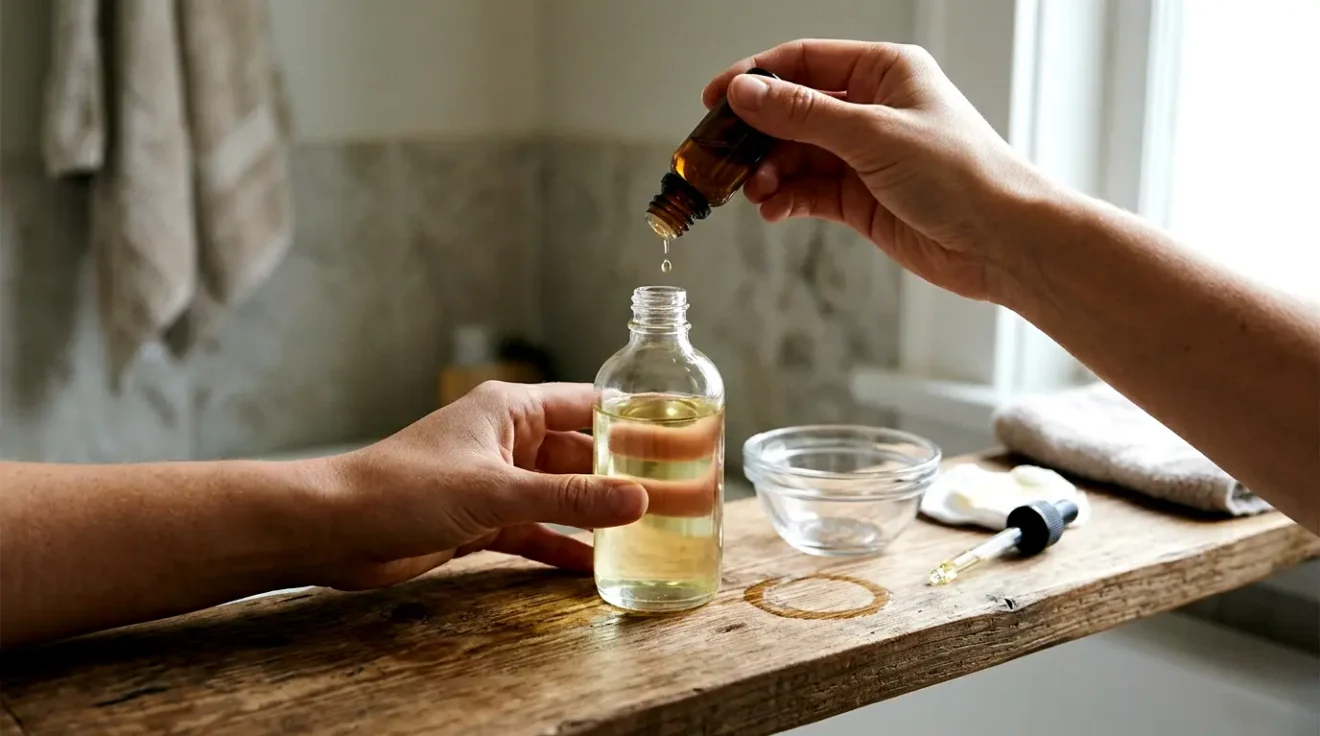
If itching becomes worse after applying tea tree oil or another essential oil, discontinue the product and rinse the affected area appropriately. Persistent or significant reactions should be assessed by a healthcare professional. Swelling, blistering or spreading inflammation should not be managed by adding further natural remedies.
The idea of a detox reaction, sometimes described as a temporary worsening before improvement, has no established physiological basis for scalp cleansing. An adverse reaction is a reason to reconsider the ingredient, not to increase exposure.
When the scalp is already itchy, simplicity and tolerance should take priority over experimental treatments. Effective cleansing should leave the skin comfortable rather than progressively more sensitive.
When Should You Use a Clarifying Shampoo if You Style Your Hair Daily?
Daily styling does not automatically mean that clarifying shampoo must be used every day or even at a fixed weekly interval. The appropriate frequency depends on the amount and type of product applied, scalp oiliness, sweating, water conditions and ordinary washing habits. A clarifying wash becomes relevant when observable residue or persistent heaviness suggests that regular shampoo is no longer sufficient.
People who use several styling products may notice a gradual change in how their hair behaves. Roots can become flatter, lengths may look duller and hairstyles may lose their definition. A persistent coated sensation after ordinary washing can also indicate that cosmetic deposits remain.
These signs are more useful than an arbitrary calendar schedule. Someone applying several layers of hairspray and dry shampoo may need occasional deeper cleansing, while someone using a small amount of lightweight styling cream may not require it regularly.
There is also a trade-off. Avoiding deeper cleansing indefinitely can allow certain styling residues to persist. Conversely, using strong detergents too frequently can remove conditioning ingredients and contribute to dryness, particularly along the lengths of the hair.
DermNet describes weekly use as a general recommendation for clarifying shampoo in its overview, but this should not be interpreted as a universal prescription. Hair texture, scalp sensitivity, formulation strength and product exposure differ considerably between individuals.
A more practical approach is to alternate cleansing intensity. Use a suitable everyday shampoo for ordinary washing and introduce a clarifying formula when the scalp or hair shows signs of persistent product residue. If the hair is dry or chemically treated, conditioning the mid-lengths and ends becomes especially important.
Clarifying before colour services or intensive professional treatments also deserves consideration. Different residues and treatment formulations can interact in different ways, so the appropriate preparation should be discussed with the relevant hair professional rather than assumed.
When a deeper wash is necessary, concentrate the shampoo on the scalp and rinse thoroughly. Apply conditioner to the lengths and ends according to their needs, avoiding unnecessary accumulation at the roots.
For daily stylers, the most sustainable routine combines ordinary washing, occasional targeted cleansing and adequate conditioning. The scalp should remain comfortable between washes, without a persistent feeling of residue or signs of excessive dryness.
Why Several Light Hair Products Can Still Create Heavy Buildup
Several lightweight hair products can create substantial buildup because their individual deposits accumulate over successive applications. Leave-in conditioners, heat protectants, serums, styling creams and lightweight oils may each leave a thin cosmetic film. When these layers combine with sebum and other residues, the total accumulation can become noticeable even when no individual product feels particularly heavy.
The term lightweight usually describes the texture or sensory finish of a formula. It does not mean that the product leaves no residue. A fluid serum can still contain film-forming ingredients, conditioning agents or oils designed to remain on the hair after application.
The same principle applies to products marketed as natural or plant-based. Oils and butters can provide lubrication and improve hair manageability, but they are not automatically easy to remove. Their behaviour depends on their composition, formulation and how frequently they are applied.
A review in the Indian Journal of Plastic Surgery discusses the different functions of hair-care ingredients, including surfactants, conditioning agents and oils. It explains that conditioning agents can reduce friction between hair fibres and improve manageability. These benefits do not mean that every conditioning ingredient is suitable for every application area or that all formulations behave identically.
The location of application matters just as much as the number of products. A leave-in conditioner designed for the lengths may contribute to unnecessary accumulation when repeatedly applied directly to the scalp. Similarly, a finishing serum intended for the ends can leave roots feeling heavier if distributed too close to the hairline.
Rather than immediately replacing every product, review the routine between two washes. Identify which ingredients remain on the hair, how close they are applied to the roots and whether multiple products perform essentially the same function.
Silicones, film-forming polymers and heavier oils deserve consideration when assessing persistent cosmetic residue, but their presence does not automatically indicate a problem. Their effects depend on formulation, quantity, hair characteristics and cleansing compatibility.
Reducing unnecessary layers near the scalp can therefore be more effective than buying an increasingly powerful shampoo. The goal is not to eliminate useful conditioning ingredients but to apply them where they provide the greatest benefit.
Once the root area receives fewer unnecessary layers, it becomes easier to distinguish genuine cleansing needs from problems caused by excessive styling and conditioning.
Why Does Hair Snap Near the Roots Even When You Have No Noticeable Hair Loss?
Hair snapping near the roots can indicate fibre breakage rather than hair loss from the follicle. Broken hairs often appear as short, uneven fragments without the characteristic club-shaped root at the end of a naturally shed hair. Repeated tension, friction, heat and aggressive manipulation can contribute to this damage, even when overall hair density appears unchanged.
Understanding the difference between breakage and shedding is important because the two problems require different responses. A naturally shed hair generally comes away as a complete fibre, often with a small pale club-shaped end. A broken strand is shorter and has a fractured end rather than a naturally shed root.
Examining several fallen hairs can offer a useful initial clue, although the presence or absence of a visible white bulb is not a definitive diagnostic test. Hair fragments can be difficult to classify, and some forms of shedding may not be obvious from a single strand.
Repeated mechanical stress is one possible explanation for breakage close to the scalp. Tight ponytails, braids, extensions and hairstyles that repeatedly pull on the same areas can increase tension. Rough detangling, frequent heat exposure and inappropriate chemical treatments can also weaken the fibre.
Product buildup is not, by itself, proof of follicular damage. However, a routine involving repeated product layering, aggressive scrubbing and rough manipulation can combine several sources of mechanical stress. Strong cleansing practices may also leave the lengths drier and more vulnerable to friction if conditioning is insufficient.
A scientific review in the Indian Journal of Plastic Surgery discusses hair cosmetics and their interactions with the fibre. It highlights the importance of conditioning agents in reducing friction and the forces required during grooming. The findings support a broader principle: hair care should minimise unnecessary mechanical stress rather than repeatedly subjecting the fibre to harsh treatment.
Consider reviewing the following warning signs:
- Short fragments of noticeably different lengths appearing around the crown or hairline.
- Repeated breakage in areas exposed to tight hairstyles or extensions.
- Rough, fragile strands that snap during detangling.
- Visible thinning or changes in density rather than isolated broken fibres.
- Persistent scalp discomfort, tenderness or inflammation accompanying the breakage.
Reducing tension, avoiding aggressive brushing and using suitable conditioning products can help limit further mechanical damage. However, persistent snapping, visible thinning, scalp pain or sudden changes in hair density warrant professional assessment. A dermatologist can help distinguish fibre breakage from hair-loss conditions and identify whether an underlying scalp problem is present.
Hair that breaks near the roots deserves attention even when there is no obvious hair loss. The priority is to identify repeated sources of tension and damage before introducing additional products or more intensive cleansing.
Key Points to Remember Before Simplifying Your Hair Routine
- Persistent scalp residue is primarily a cleansing issue, not evidence that toxins need to be expelled.
- More products do not necessarily produce healthier or shinier hair; unnecessary layers can contribute to a heavier finish.
- Clarifying shampoo should respond to actual product accumulation rather than an automatic detox schedule.
How to Revitalise Dull, Lifeless Hair Without Overloading It With Products?
Dull, lifeless hair does not necessarily need another shine serum, intensive mask or detox treatment. In many cases, the more useful starting point is to remove persistent cosmetic residue, reduce unnecessary product layers and restore a balanced washing and conditioning routine. Hair that looks heavy because of accumulated styling ingredients may regain a cleaner appearance through better cleansing rather than additional cosmetic coverage.
The first step is to simplify. Temporarily reduce the number of products used between washes, particularly leave-in formulas and finishing products applied close to the roots. Keep the routine focused on an appropriate shampoo, conditioner and only the styling products needed for the intended result.
If there are clear signs of persistent residue, one targeted clarifying wash may help. Follow the product instructions, avoid excessive friction and rinse thoroughly. Condition the mid-lengths and ends to maintain manageability, especially if the hair is naturally dry, damaged or chemically treated.
After this initial adjustment, reintroduce products individually. A lightweight serum, heat protectant or leave-in conditioner may be useful, but there is little benefit in applying several overlapping formulas without identifying what each one contributes.
Observe the result across several ordinary washes. Does the hair remain clean for longer? Do the roots feel lighter? Are the lengths easier to detangle? Does the hairstyle retain its shape without repeated applications? These observations help identify whether the previous routine contained unnecessary layers.
It is also important to distinguish cosmetic dullness from structural hair damage. Cleansing can remove surface deposits, but it cannot reverse split ends or restore a severely damaged hair fibre to its original condition. Conditioning products can improve smoothness and manageability, but their effects should not be confused with permanent structural repair.
Hair care also depends on the balance between cleansing and conditioning. Excessively strong shampoo can leave the lengths feeling rough, while excessive conditioning near the scalp can recreate the coated sensation. Applying each product to the appropriate area helps avoid both extremes.
A simplified routine should therefore follow a clear progression: remove what is unnecessary, cleanse according to actual needs, condition the areas requiring it and introduce additional products only when they solve an identifiable problem.
For anyone experiencing persistent itching, unusual flaking, painful scalp symptoms or progressive thinning, cosmetic adjustments alone may not be sufficient. A dermatologist can determine whether a condition such as seborrhoeic dermatitis, contact dermatitis or another scalp disorder requires specific management.
Healthy-looking hair does not require an increasingly complicated collection of products. A comfortable scalp, effective cleansing, appropriate conditioning and fewer unnecessary layers offer a more sustainable way to maintain clean, manageable and naturally vibrant-looking hair. If the results remain unsatisfactory despite these adjustments, investigate the underlying cause rather than repeatedly escalating cosmetic treatments.
Can product buildup cause hair loss?
Product buildup does not automatically cause hair loss. However, excessive styling, tight hairstyles, friction and aggressive cleansing can contribute to hair-fibre damage or scalp irritation. Persistent thinning, unusual shedding or painful scalp symptoms should be assessed by a dermatologist rather than attributed solely to cosmetic residue.
Can ordinary shampoo remove all styling product buildup?
Ordinary shampoo can remove many everyday deposits, including sebum, sweat and cosmetic impurities. However, certain styling polymers and persistent films may require a clarifying formulation. The appropriate choice depends on the ingredients used, their accumulation and the cleansing properties of the shampoo.
Is a sulfate-free shampoo effective against scalp buildup?
A sulfate-free shampoo can remove residue, but its effectiveness depends on the surfactant system and overall formulation rather than the absence of sulfates alone. Some formulations provide relatively gentle cleansing, while others have stronger cleansing properties. Choose according to product accumulation, scalp tolerance and hair condition.
How can you tell whether an itchy scalp needs cleansing or treatment?
If discomfort accompanies visible styling residue and improves after appropriate washing, cosmetic buildup may be contributing. Persistent itching, redness, scaling, burning or worsening symptoms despite gentle cleansing may indicate irritation or an underlying scalp condition. Avoid repeated scrubbing and seek professional advice when symptoms persist.
Does natural oil detoxify the scalp?
No established scalp detoxification process is activated by applying natural oils. Some oils can improve hair lubrication and manageability, but essential oils can also cause irritation or allergic contact dermatitis. Natural origin does not guarantee compatibility, particularly when the scalp is already sensitive or inflamed.