
Colour-treated hair needs a routine that protects both the shade and the structure of the hair fibre. Permanent colouring, bleaching and repeated chemical services can affect the cuticle, remove protective surface lipids and weaken internal proteins. The result is often familiar: rough lengths, stubborn tangles, reduced shine and hair that becomes increasingly difficult to style.
The solution is not necessarily to apply more products or wash less frequently at any cost. Effective colour care depends on understanding whether the problem comes mainly from surface roughness, structural damage or a combination of both. Gentle cleansing, appropriate conditioning, careful detangling and protection against environmental exposure each address a different part of the problem.
A practical routine should also reflect the hair’s condition, texture and colouring history. Hair that has undergone permanent colouring alone may require a different approach from heavily bleached or repeatedly chemically treated lengths. The following recommendations explain how to make those distinctions and choose care practices that preserve manageability without unnecessarily weighing the hair down.
Colour-Treated Hair Care: The Essentials
- Use gentle, low-friction washing techniques and lukewarm water to reduce mechanical wear and unnecessary colour loss.
- Choose acidic conditioners for surface roughness and richer masks when the hair remains dry and difficult to manage.
- Adjust protein and bond-building treatments to the type of damage rather than combining every repair product.
- Allow conditioning to resume progressively after colouring, following the hair’s actual response rather than an arbitrary waiting period.
- Protect coloured lengths against sunlight, swimming-pool exposure and repeated everyday friction.
- Why Does Hair Feel Rougher After Permanent Colouring?
- How to Wash Newly Dyed Hair Without Excessive Friction and Tangling?
- Hair Mask or Acidic Conditioner: Which Suits Rough, Newly Coloured Hair?
- Why Bleaching and Perming Too Close Together Can Severely Weaken Hair
- When Should You Resume Intensive Conditioning After a Permanent Dye Service?
- Hydrolysed Protein or Bond-Building Treatment: Which Suits Damaged Hair?
- Why Does Dyed Hair Change Shade After Repeated Sun Exposure?
- How to Protect Dyed Hair From Sun, Swimming Pools, and Everyday Exposure?
Why Does Hair Feel Rougher After Permanent Colouring?
Hair often feels rougher after permanent colouring because the chemical process changes the protective surface of the hair fibre. Alkaline ingredients help swell the cuticle, allowing dye precursors to penetrate into the cortex. This necessary chemical action can also disturb the cuticle and its protective lipid layer, increasing friction between neighbouring strands. However, surface roughness does not automatically mean that the hair has suffered severe internal damage.
Permanent oxidative colouring generally combines alkaline and oxidising agents. The resulting swelling facilitates the penetration of dye precursors, which subsequently react to form larger coloured molecules inside the cortex. Although this process creates lasting colour, it can affect the cuticle’s smoothness and the hydrophobic surface that normally helps hair fibres slide past one another.
The protective lipid layer contains 18-methyleicosanoic acid (18-MEA), which contributes to the hair’s water-repellent surface properties. When this layer deteriorates, the fibre becomes more hydrophilic and friction increases. This explains why coloured hair can feel dry, catch on neighbouring strands and lose its natural smoothness even when conditioning products are used regularly.
It is important to distinguish surface deterioration from deeper structural damage. A raised or disrupted cuticle may contribute to temporary roughness and improved manageability can sometimes be achieved through conditioning. More extensive damage involves deterioration of cuticle layers and cortical proteins, which cannot simply be reversed by smoothing the surface.
A practical home assessment starts with observation rather than an unvalidated floating-hair porosity test. Take a clean section of hair and assess its texture when dry and after conditioning. Notice whether the strands feel smoother after rinsing, whether they catch during gentle combing and whether they become stiff or frizzy while drying.
If conditioning substantially improves the feel and combability, surface friction may be an important contributor. If the hair remains brittle, stretches unusually or breaks during gentle handling, more extensive damage may be involved. These observations are useful indicators, not a clinical measurement of porosity or a definitive diagnosis.
65–95%
Proteins account for approximately 65–95% of total hair weight according to the literature reviewed. This describes hair composition, not the percentage of protein lost during colouring.
Scientific review of hair structure and conditioning agents, published in Polymers.
The distinction matters when choosing products. A smoothing conditioner may improve the surface feel of moderately rough hair, whereas a fibre with substantial protein deterioration may need a more targeted repair routine. Applying increasingly rich products without identifying the underlying problem can produce weight without meaningful improvement in strength.
Once the cause of roughness is better understood, the next priority is preventing unnecessary friction during washing. Even a suitable conditioner can have limited benefits if cleansing and detangling repeatedly place excessive mechanical stress on already vulnerable lengths.
How to Wash Newly Dyed Hair Without Excessive Friction and Tangling?
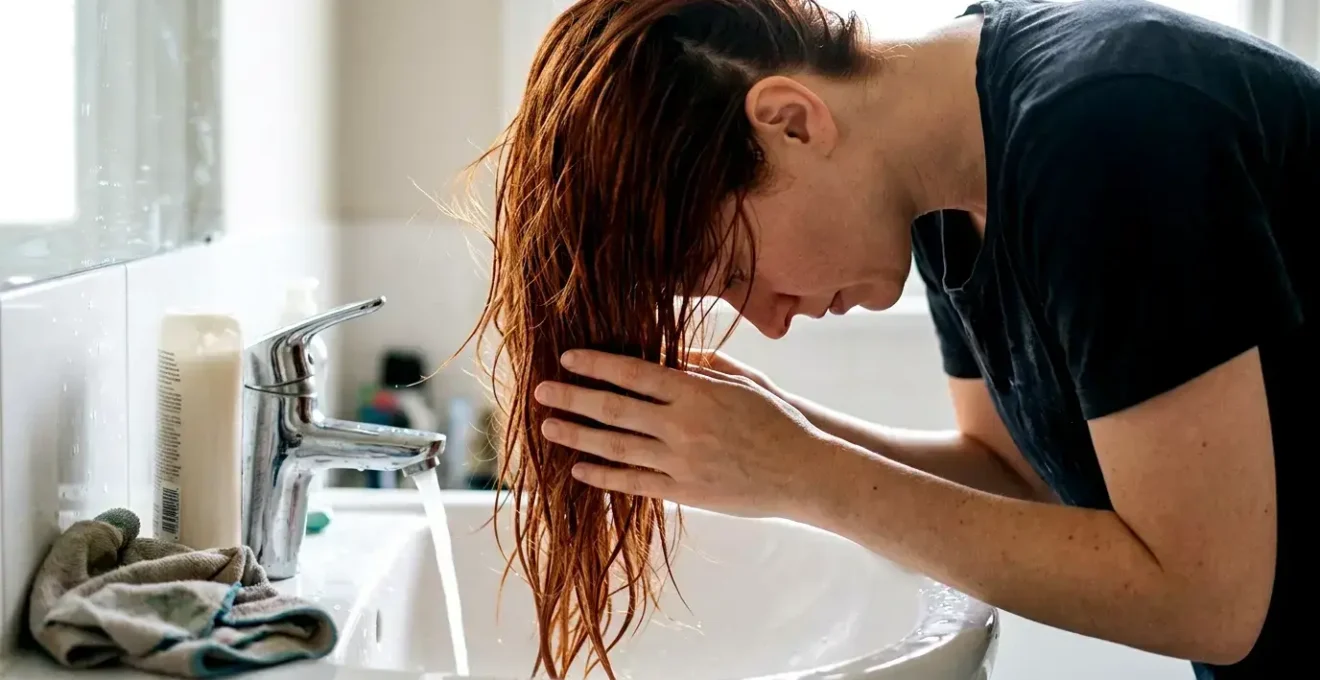
Newly dyed hair should be washed using gentle movements that concentrate cleansing on the scalp rather than the lengths. Apply shampoo to the roots, massage with the fingertips and allow the diluted lather to travel through the hair during rinsing. Avoid rubbing the lengths between the palms, using very hot water or pulling a comb through tangled strands without sufficient conditioning slip.
The main objective is to remove scalp oil, sweat and product residue without creating unnecessary friction between fibres. Shampooing already exposes the hair to mechanical movement, while highly cleansing surfactants can contribute to the removal of structural lipids. This is particularly relevant when the cuticle has already been affected by permanent colouring or bleaching.
A low-friction washing routine starts before the water is turned on. If the lengths contain tangles, loosen them carefully while the hair is dry, provided they can be handled without pulling. During washing, concentrate shampoo on the scalp and avoid piling the lengths on top of the head. Let the lather rinse through naturally rather than scrubbing the ends.
After shampooing, apply conditioner through the mid-lengths and ends. Allow the product to provide sufficient slip before gently separating remaining knots. When rinsing, use lukewarm water and avoid aggressive rubbing. The goal is to leave the hair manageable without making the scalp or lengths feel coated.
Drying technique is equally important. Instead of twisting the hair or rubbing it with a conventional towel, press it gently with a microfibre towel or another soft, absorbent fabric. Excess water should be removed through pressure rather than repeated friction.
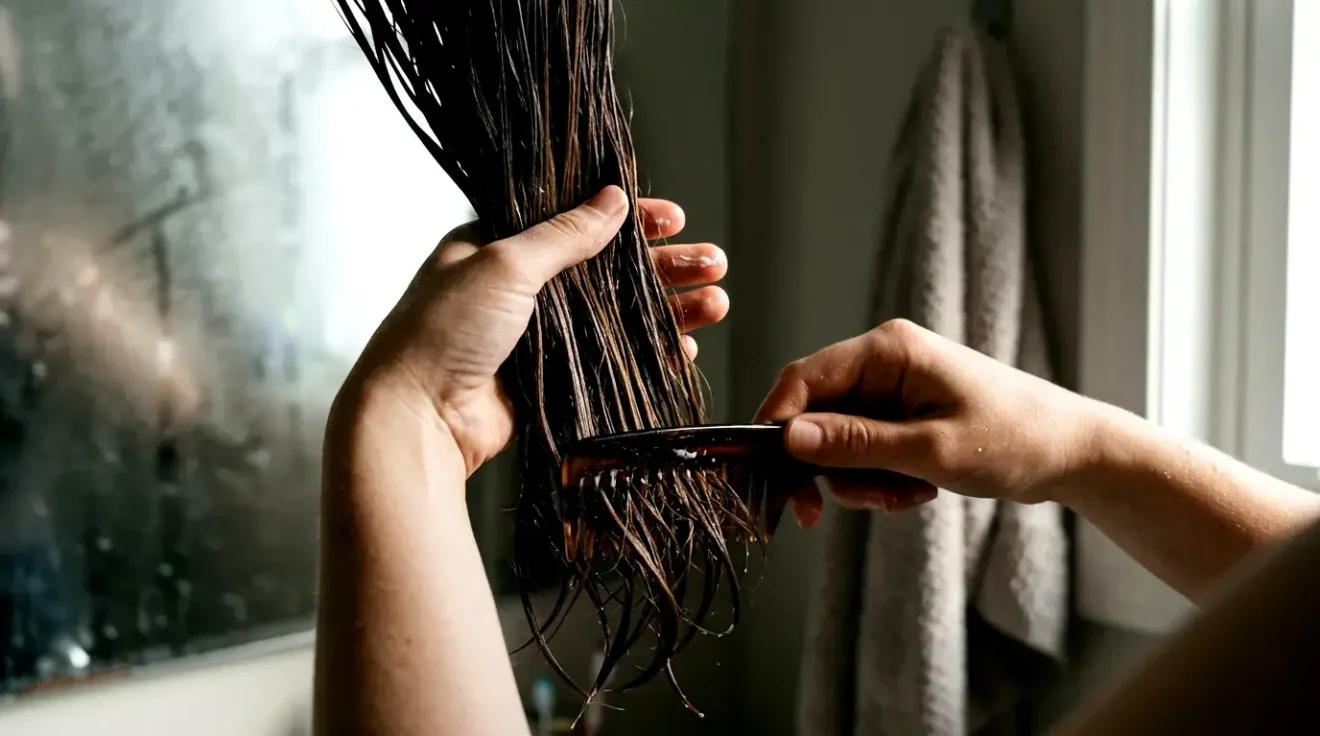
When detangling wet hair, use a wide-tooth comb and begin at the ends. Work upwards in small sections, holding the hair above the area being combed to reduce tension near the roots. If a knot resists, add conditioner or a suitable leave-in product rather than forcing the comb through it.
Washing frequency should reflect scalp needs, hair texture and colour retention. Every wash can contribute to the gradual loss of colour, particularly when the hair is freshly coloured or the formulation is susceptible to washing. However, avoiding shampoo indefinitely is not a reliable solution: an uncomfortable or excessively oily scalp still needs appropriate cleansing.
There is also no universal reason to assume that every sulfate-free shampoo is automatically better. Sulfate-free formulas may offer a gentler cleansing experience for some people, while other formulations may not remove accumulated styling products effectively enough. A suitable shampoo is one that cleans the scalp without leaving the lengths excessively stripped or coated.
Your Low-Friction Washing Checklist
- Assess the hair before washing and gently loosen manageable knots. Deliverable: a section of hair without obvious tension-heavy tangles.
- Apply shampoo to the scalp and massage with fingertips rather than rubbing the lengths. Deliverable: a clean scalp without aggressively worked mid-lengths and ends.
- Rinse with lukewarm water and apply conditioner through the lengths. Deliverable: hair that feels slippery enough for gentle detangling.
- Comb from the ends upwards using a wide-tooth comb and minimal tension. Deliverable: separated sections without forced combing.
- Press out excess water with a soft towel rather than rubbing. Deliverable: damp lengths without unnecessary towel friction.
After cleansing, the next decision concerns the type of conditioning the hair actually needs. A conditioner designed to improve the cuticle surface and a deeper mask do not perform identical functions, even when both promise softness and shine.
Hair Mask or Acidic Conditioner: Which Suits Rough, Newly Coloured Hair?
An acidic conditioner is generally the better starting point when newly coloured hair feels rough mainly because of surface friction and cuticle disruption. A richer hair mask is more appropriate when the lengths remain dry, difficult to manage and lacking softness even after regular conditioning. The two products can complement each other, but their functions and application should not be confused.
Conditioners work primarily by depositing conditioning agents on the hair surface. Ingredients such as cationic conditioning agents and certain silicones help reduce friction, improve combability and make damaged cuticle surfaces feel smoother. An appropriately formulated acidic conditioner can also help reduce hair-fibre permeability, although this does not mean that it completely closes the cuticle or reverses chemical damage.
A deep-conditioning mask is generally more concentrated than an instant conditioner. Its purpose is to provide more substantial conditioning to dry or damaged lengths. Depending on its formulation, it may contain emollients, conditioning polymers, oils, proteins or other ingredients intended to improve the feel and manageability of the fibre.
The choice can be guided by how the hair behaves after ordinary conditioning:
- Prioritise an acidic conditioner when the hair feels rough, catches during combing and becomes noticeably smoother after conditioning.
- Prioritise a richer mask when the hair remains dry, coarse or difficult to style despite improved surface smoothness.
- Consider both when the hair has a rough surface and persistent dryness, provided the products are compatible with the hair’s needs and instructions.
When using both, apply the mask after shampooing and follow its recommended contact time. Rinse thoroughly, then use an acidic conditioner if the product instructions and the hair’s response support an additional conditioning step. There is no need to assume that a longer application always produces better results.
The distinction between instant and deep conditioners is also relevant to application time. A scientific review of hair conditioning describes instant conditioners as commonly applied for approximately five minutes, while deep conditioners are often used for around 20–30 minutes. These are general product-category descriptions, not mandatory post-colouring schedules. The manufacturer’s instructions remain the appropriate guide.
20–30 minutes
A commonly described application period for deep conditioners in the reviewed literature. This is not a universal requirement or proof that longer exposure repairs more damage.
Review of hair-care physicochemistry and conditioning agents, Polymers.
Immediately after colouring, heavily concentrated treatments may not always produce the expected result, particularly if the fibre is already severely porous. A damaged surface can interact unpredictably with conditioning ingredients, and products that feel excessively rich may leave fine hair flat or difficult to style.
More product does not automatically mean more repair. Excessive use of rich masks can create a coated feeling, reduce volume and make the colour appear less vibrant because the hair loses its natural movement and light reflection. A balanced routine alternates appropriate cleansing and conditioning rather than continuously layering products.
Conditioning can improve manageability, but it cannot make repeated chemical services harmless. This becomes especially important when permanent colouring is combined with bleaching or chemical texture treatments.
Why Bleaching and Perming Too Close Together Can Severely Weaken Hair
Bleaching and perming too close together can severely weaken hair because they affect different parts of its chemical structure. Bleaching uses oxidising chemistry to degrade natural pigments and can also damage cuticle proteins, cortical proteins and disulfide bonds. Permanent waving deliberately modifies disulfide bonds to reshape the fibre. Combining these processes on already weakened hair increases the risk of severe damage and breakage.
Bleaching commonly uses alkaline peroxide-based formulations, sometimes combined with persulfates. The alkaline environment helps the treatment penetrate the fibre, while oxidising agents break down melanin. However, the effects are not limited to natural pigment removal.
Experimental research published in the International Journal of Cosmetic Science examined human hair subjected to progressively stronger alkaline peroxide-persulfate bleaching treatments. Using transmission electron microscopy and redox proteomics, the researchers identified damage to both the cuticle and cortex. Protein loss increased with bleaching severity, and oxidation affected sulphur-containing amino acids, including cystine disulfide bonds.
Permanent waving involves a different chemical sequence. Reducing agents break disulfide bonds in hair proteins, allowing the fibre to be reshaped. An oxidising neutraliser then helps reform bonds in the new configuration. This process can produce the desired curl pattern, but it also places additional chemical stress on the hair.
The combined risk is not simply a matter of adding two treatments together. Bleached hair may already have reduced structural integrity, increased porosity and diminished resistance to mechanical stress. Applying a permanent-wave formulation to this fibre can create an unpredictable result.
One problem is uneven chemical absorption. Highly damaged or porous areas may absorb treatment differently from less affected sections. This can lead to inconsistent curl formation, uneven results or a style that does not hold as expected. Breakage is an additional concern.
There is no scientifically established universal waiting period that guarantees safety between bleaching and perming. The interval alone cannot determine whether the hair is ready for another chemical service. Previous treatments, bleaching severity, current elasticity, breakage and the condition of the lengths all matter.
Before combining services, a qualified hair professional should assess the fibre and consider whether a strand test is appropriate. If the hair already feels excessively elastic, brittle or visibly weakened, postponing further chemical processing is generally the more cautious decision.
Alternatives may include choosing a less aggressive colour service, maintaining the existing shade while improving the condition of the lengths, or using temporary heat styling when appropriate. These approaches avoid immediately exposing compromised fibres to another permanent chemical transformation.
Even when only permanent colouring is involved, the hair needs an appropriate conditioning strategy after the salon appointment. The timing and intensity of that routine should be guided by the actual condition of the fibre rather than a rigid waiting period.
When Should You Resume Intensive Conditioning After a Permanent Dye Service?
Conditioning can begin during the initial post-colouring rinse when the dye-service instructions call for it, but richer treatments should be reintroduced according to the hair’s condition and the manufacturer’s guidance. There is no established universal waiting period before intensive conditioning. The priority is to support manageability progressively without assuming that every newly coloured fibre needs the same treatment schedule.
Permanent oxidative colour services are designed to create coloured molecules inside the hair cortex. The chemical reaction involves alkaline and oxidising agents, and the hair may remain more vulnerable to friction and dryness after the service. A suitable post-colour conditioner can help improve the surface feel and reduce friction during subsequent grooming.
However, the idea that rich conditioning products must always be avoided immediately after colouring is not supported by the available scientific review. There is no established evidence in the supplied research that a rich mask necessarily interferes with colour fixation or traps alkaline residues. The specific salon procedure and product instructions should take precedence over general assumptions.
A progressive approach is more practical than following an arbitrary number of days.
- During the initial rinse: follow the colour-service instructions and use the recommended post-colour conditioner where specified.
- During routine washing: use a suitable conditioner after shampooing to support smoothness and reduce tangling.
- When dryness persists: introduce a richer mask or targeted treatment at an appropriate frequency.
- During ongoing maintenance: adjust product richness and frequency according to how the hair responds after washing and styling.
The best indicator is the condition of the fibre. Hair that detangles easily, dries without becoming excessively stiff and retains a manageable texture may not require an intensive mask at every wash. Hair that remains rough, feels brittle or becomes difficult to style may benefit from more substantial conditioning.
There is also a risk in waiting too long before providing appropriate care. Chemical treatment can leave the surface more vulnerable to friction, and repeated rough handling can contribute to further mechanical damage. Conditioning should therefore be considered part of normal maintenance, not a special treatment reserved for visibly damaged hair.
One important distinction is that conditioning and structural repair are not interchangeable. A mask may make hair softer and easier to comb without restoring the internal protein structure. Similarly, a product that improves the surface feel does not necessarily reverse oxidative damage.
If the hair breaks extensively, feels unusually elastic when wet or develops severe tangling despite careful handling, further chemical services should be postponed. A professional assessment is preferable to continuously increasing the number of treatments at home.
Once regular conditioning is established, the next question is whether the hair also needs targeted protein support or a bond-building treatment. This distinction is particularly important for people who colour, bleach or chemically reshape their hair repeatedly.
Hydrolysed Protein or Bond-Building Treatment: Which Suits Damaged Hair?
Hydrolysed protein and bond-building treatments serve different purposes in damaged-hair care. Hydrolysed proteins are smaller protein-derived ingredients that can deposit on or interact with damaged hair surfaces, improving conditioning and feel. Bond-building products are formulated to target aspects of internal structural damage, particularly chemical changes associated with protein bonds. Neither category should be assumed to permanently restore severely damaged hair.
Hydrolysed proteins are produced by breaking larger proteins into smaller fragments. Depending on their molecular size and formulation, these ingredients may interact with damaged regions of the hair fibre or form conditioning films. Their practical benefits can include improved texture, reduced roughness and better manageability.
Bond-building treatments are marketed around the preservation or support of hair’s internal bonding structure. Some formulations are designed to interact with chemical features associated with the protein network, including disulfide bonds. However, commercial products do not all use the same chemistry, and their mechanisms and performance cannot be treated as interchangeable.
Choosing between the two requires observing how the hair behaves. No simple home test can reliably identify the exact molecular damage within a strand, but certain symptoms can help guide product selection.
- Soft, excessively stretchy hair: hair that stretches unusually when wet and does not recover its shape may indicate compromised structural integrity. A professional assessment and a carefully selected repair routine are advisable.
- Dry, brittle hair that breaks: this can reflect extensive chemical or mechanical damage, although it does not prove that disulfide bonds alone are responsible.
- Rough hair with poor manageability: surface conditioning may be an important first priority, especially when the hair improves after using a conditioner.
- Several symptoms together: a combination of conditioning, targeted repair and reduced chemical exposure may be more appropriate than relying on one product category.
Protein treatments also require moderation. Applying multiple protein-rich products without assessing the result can leave some hair feeling stiff, rough or less flexible. This is not proof of a universal condition called protein overload, but it is a practical reason to monitor how the fibre responds.
A balanced routine alternates products according to their purpose. A protein-containing treatment may be used when the hair benefits from it, while regular conditioning supports softness and combability. If the hair becomes increasingly rigid after protein applications, reduce their frequency and reassess the formulation.
Bond-building products can be useful components of a chemical-damage maintenance routine, particularly when introduced around services according to the product instructions. Nevertheless, they should not be described as guaranteed replacements for lost proteins or as a reason to undertake additional bleaching or perming.
The experimental bleaching research discussed earlier demonstrates that chemical bleaching can cause protein loss and oxidation of sulphur-containing amino acids. It does not, however, establish that every commercial protein treatment restores those losses or that all bond-building products reverse the same molecular changes.
For significantly damaged hair, reducing additional chemical stress is often more important than selecting increasingly complex repair products. Conditioning, careful detangling and realistic styling expectations help maintain the hair while damaged lengths gradually grow out and are trimmed when appropriate.
Internal and surface care are only part of long-term colour maintenance. Even hair that is washed carefully and conditioned consistently can lose its intended shade when exposed repeatedly to sunlight.
Key Points Before Protecting Coloured Hair Outdoors
- Colour fading is not solely a washing issue: sunlight can chemically alter artificial colourants.
- Photodegradation depends on the dye formulation, shade and exposure conditions, so fading rates cannot be predicted from colour alone.
- Protective habits should address both ultraviolet exposure and mechanical or chemical stresses encountered during everyday activities.
Why Does Dyed Hair Change Shade After Repeated Sun Exposure?
Dyed hair can change shade after repeated sun exposure because ultraviolet radiation contributes to the photodegradation of artificial colourants. Sunlight can alter the chemical structures responsible for colour, gradually changing how the dye absorbs and reflects light. The speed and appearance of fading depend on the colourant, formulation and exposure conditions, so no single fading timeline applies to every dyed shade.
Artificial hair colourants are chemical compounds designed to produce a particular visual result. Permanent and semi-permanent dyes use different formulations and colouring mechanisms, but both can be affected by environmental exposure.
When sunlight reaches the hair, its energy can contribute to chemical reactions that alter colourant molecules. This process is known as photodegradation. The resulting changes may make a shade appear lighter, duller or noticeably different from its original salon result.
Experimental research published in Scientific Reports examined selected black and blue permanent and semi-permanent hair colourants exposed to sunlight over a ten-week period. The researchers used surface-enhanced Raman spectroscopy (SERS) to monitor changes in the colourants and reported substantial photodegradation by week seven.
These findings demonstrate that sunlight can alter artificial hair colourants, but their scope is specific. The study investigated selected black and blue dyes under defined experimental conditions. It does not establish that all shades fade at the same rate or that seven weeks represents a universal deadline for noticeable colour changes.
Red, copper, blonde and cool-toned shades may also appear to change differently depending on their underlying pigments, formulation and starting colour. However, the available experiment does not establish a reliable ranking in which red or copper dyes always fade faster than other colours.
Exposure patterns matter as well. Hair regularly worn outdoors may experience repeated sunlight exposure, whereas hair protected by hats, shade or indoor routines may experience less direct exposure. The difference can become visible through gradual changes in brightness, saturation or tonal balance.
A simple way to monitor colour stability is to compare the lengths with the roots under similar lighting. Newly grown hair provides a useful visual reference for the original shade, although natural regrowth and differences in previous colouring must also be considered. A consistent comparison can help identify whether the lengths are becoming noticeably lighter or warmer.
Sun exposure should therefore be treated as a maintenance factor rather than an occasional cosmetic concern. Combining physical protection with appropriate hair-care products can help reduce unnecessary exposure and preserve the appearance of coloured lengths.
Because sunlight is only one environmental factor, colour maintenance should also account for swimming pools, seawater, repeated wetting and everyday mechanical friction. A layered protection routine is more practical than relying on a single leave-in product.
How to Protect Dyed Hair From Sun, Swimming Pools, and Everyday Exposure?
Protecting dyed hair requires a combination of physical coverage, suitable leave-in protection and careful rinsing before and after swimming. A hat or scarf reduces direct exposure, while an appropriate UV-protection product provides an additional layer of care. Rinsing hair with fresh water before and after pool or sea exposure also helps limit contact with environmental residues and reduces the need for aggressive cleansing afterwards.
The first layer is physical protection. A wide-brimmed hat, scarf or other suitable covering can reduce direct sunlight reaching the hair. This is particularly useful during prolonged outdoor activities when exposure cannot easily be avoided.
The second layer is a leave-in product designed for colour-treated hair. Some sprays and creams contain UV filters or ingredients intended to help protect the hair surface against environmental exposure. Their actual performance depends on formulation, application and conditions, so they should be treated as supportive care rather than complete protection.
Sprays are often convenient for distributing lightweight products through the lengths. However, exposure to swimming, sweating or repeated handling may reduce the amount remaining on the hair. Follow the product instructions and reapply when recommended.
Oils and richer creams can provide conditioning and help reduce friction, but they may weigh down fine hair. The most suitable format depends on hair density, texture, porosity and styling preferences. A lightweight spray may be easier for fine lengths, while a cream or richer leave-in may suit thicker, drier hair.
Swimming introduces a separate set of challenges. Pool water contains disinfectants, including chlorine-based compounds, which can interact with hair and contribute to chemical stress. Combined with sunlight and repeated wetting, swimming can make maintaining the appearance and condition of coloured hair more difficult.
Blonde hair can sometimes develop a greenish appearance after swimming. This effect is commonly associated with copper-containing deposits rather than chlorine alone. Pool-water chemistry and the condition of the hair can influence the result, so green discolouration should not automatically be attributed to one chemical mechanism.
Before entering a swimming pool or the sea, wet the hair with clean tap water. This helps reduce the amount of pool or seawater that the hair absorbs immediately. After swimming, rinse thoroughly with fresh water to remove residual salts, disinfectants and other deposits.
For frequent swimmers, a suitable swimming cap can provide an additional physical barrier. It may not prevent all water contact, but it can reduce direct exposure and help keep hair more manageable between swimming sessions.
Everyday mechanical exposure also matters. Repeated friction against clothing, rough towel drying, tight elastics and poorly controlled detangling can gradually worsen the condition of fragile coloured lengths.
Useful daily habits include:
- Using satin or similarly smooth pillowcases to reduce friction during sleep.
- Choosing soft hair ties without exposed metal components.
- Avoiding unnecessarily tight hairstyles that place repeated tension on the same sections.
- Using leave-in conditioner when the lengths become difficult to comb.
- Avoiding prolonged exposure of wet hair to intense sunlight when practical.
- Reducing excessive heat styling, especially on bleached or repeatedly coloured lengths.
Hair protection should remain proportionate to the situation. Light daily exposure does not require the same approach as a full day outdoors or repeated swimming sessions. A combination of sensible physical protection, appropriate conditioning and thorough rinsing is generally more manageable than accumulating numerous products.
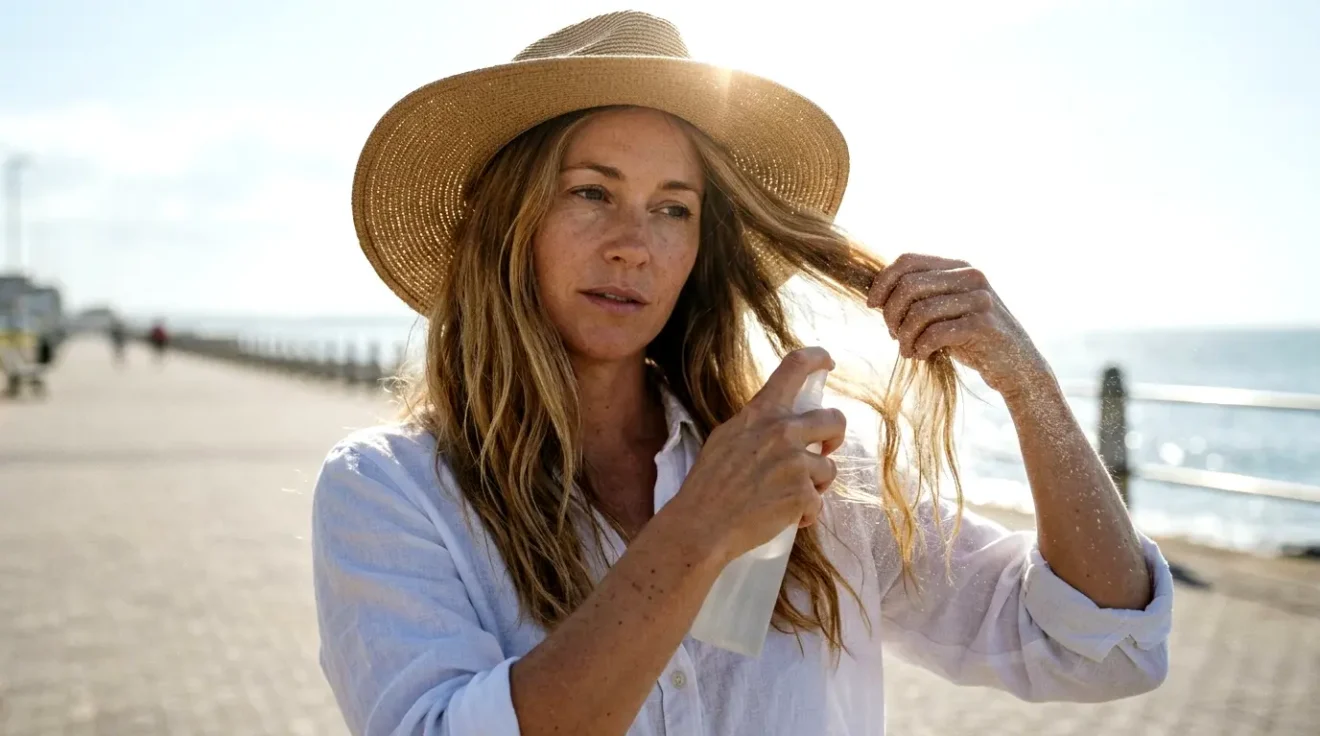
A practical outdoor routine can therefore be kept simple: cover the hair when exposure is prolonged, use a suitable protective leave-in product and rinse after swimming. The objective is not to eliminate every environmental interaction but to reduce repeated stresses that accelerate visible fading and make already damaged hair harder to manage.
For adults who regularly colour their hair, the most reliable strategy is to combine gentle washing, targeted conditioning, careful chemical-service planning and realistic environmental protection. When roughness or breakage persists despite these measures, a professional assessment can help determine whether the hair needs a different treatment approach before further colouring or styling.
How often should colour-treated hair be washed?
There is no universal washing frequency for colour-treated hair. It depends on scalp oil production, physical activity, hair texture and the type of colour service. Washing when necessary with a suitable shampoo, concentrating on the scalp and using lukewarm water, helps balance scalp cleanliness with colour maintenance. Avoiding excessive friction is generally more useful than following an unnecessarily strict washing schedule.
Can conditioner repair hair damaged by permanent colouring?
Conditioner can improve softness, smoothness and manageability by depositing conditioning agents on the hair surface and reducing friction. However, it cannot fully reverse structural damage to the cortex or replace proteins lost through severe chemical processing. For substantially damaged hair, conditioning should be combined with appropriate repair treatments and reduced chemical exposure.
Is sulfate-free shampoo always better for coloured hair?
No. Sulfate-free shampoos can offer a gentler cleansing option for some colour-treated hair, but the absence of sulfates does not automatically guarantee better results. The overall formulation, cleansing strength and compatibility with the scalp and hair matter more than one ingredient category. Choose a shampoo that cleans effectively without leaving the lengths excessively dry or coated.
Can a hair mask be used after every colour treatment?
A hair mask can be used after colouring when appropriate for the hair’s condition and the product instructions. However, an intensive mask is not necessary after every service. A regular conditioner may be sufficient when the hair remains manageable, while a richer treatment can be introduced when persistent dryness or roughness justifies additional conditioning.
Can coloured hair be bleached and permed safely?
Combining bleaching and perming carries a significant risk of damage, particularly when the hair has already lost structural integrity. There is no universal waiting period that guarantees a safe combination. A qualified professional should assess the hair’s condition, treatment history and suitability before another chemical service. If the fibre is brittle, excessively elastic or breaking, further processing should be postponed.