
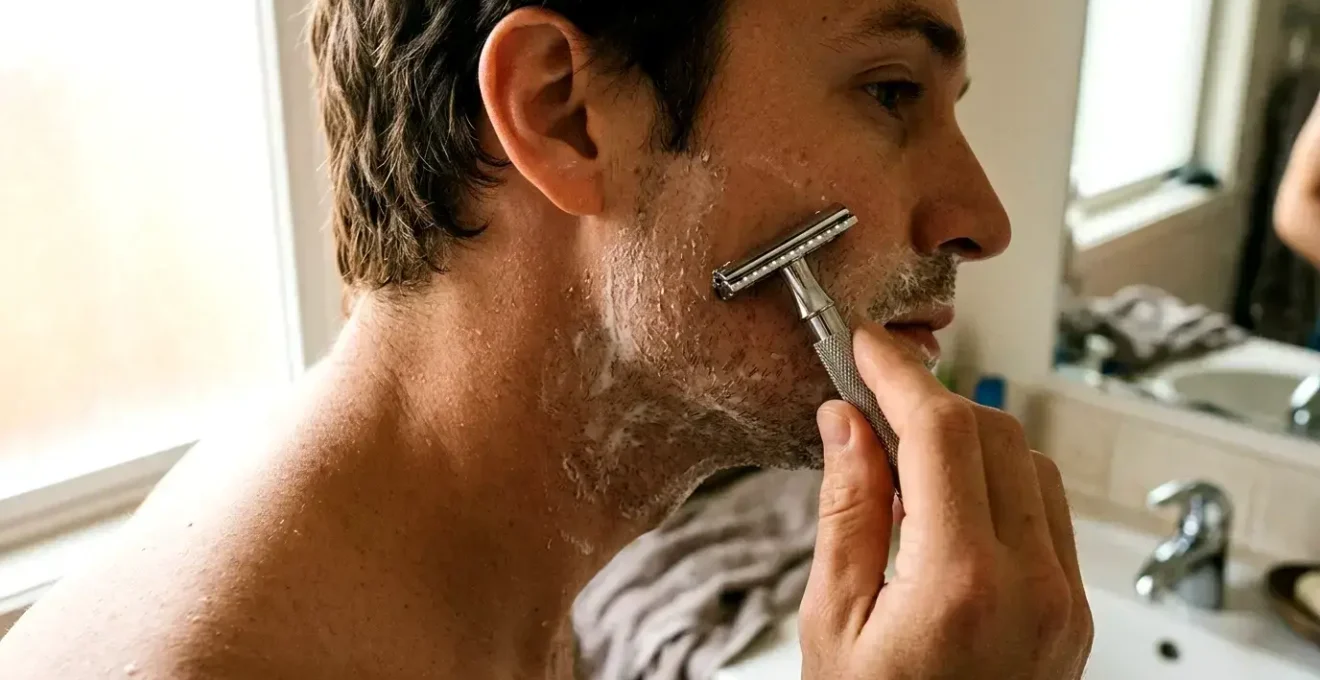
A close shave should leave facial hair neatly cut, not the skin feeling scraped. Yet the pursuit of a perfectly smooth jawline often encourages excessive pressure, repeated strokes and shaving against the grain. These habits can produce an initially polished finish followed by redness, burning or stubborn razor bumps.
The most reliable approach is to improve cutting accuracy rather than cutting intensity. That means understanding how facial hair grows, preparing the beard properly, choosing a suitable razor and knowing when an area has been shaved closely enough.
Precision also depends on treating different parts of the face differently. The cheeks are relatively straightforward, while the chin, jawline and neck demand more deliberate movements because their contours and growth patterns change.
With the right technique, a clean-looking shave does not have to mean removing every detectable trace of stubble. For irritation-prone skin, leaving a barely visible amount of hair can be the better long-term decision.
The essentials of a precise, low-irritation shave
- Map beard growth before shaving and make the first pass in the direction each section naturally grows.
- Use a sharp blade, hydrated lather and minimal pressure. Avoid repeatedly shaving an area to correct tiny imperfections.
- Prioritize skin comfort over an extremely close finish, particularly around the neck and jawline where ingrown hairs develop easily.
- Why Does Shaving Against the Grain Cause More Razor Bumps?
- How to Shave Along the Jawline Without Repeatedly Passing Over the Same Skin?
- Safety Razor or Cartridge Razor: Which Handles Coarse Beard Hair Better?
- Why Pressing Harder With a Razor Can Increase Cuts Without Improving the Shave
- When Should You Trim Longer Facial Hair Before a Close Wet Shave?
- Why Does Thick Shaving Foam Sometimes Provide Poor Razor Glide?
- Razor Burn or Ingrown Hairs: Which Is Causing Red Bumps After Shaving?
- How to Care for Freshly Shaved Skin Without Alcohol-Based Aftershave?
Why Does Shaving Against the Grain Cause More Razor Bumps?
Shaving against the grain can increase razor bumps because it cuts facial hair extremely close to the skin and may encourage newly growing hairs to penetrate the surrounding tissue. The risk is especially relevant for coarse or tightly curled beards. Shaving with the grain generally reduces this problem, although it may leave slightly more detectable stubble.
Every beard hair grows through a follicular opening at a particular angle. When the razor moves against that direction, it can lift or deflect the hair before cutting. If the remaining sharpened tip retracts beneath the skin surface, its subsequent growth may carry it into nearby tissue instead of outward through the opening.
This is one mechanism behind pseudofolliculitis barbae, commonly called razor bumps. The Mayo Clinic‘s explanation of ingrown hairs identifies tightly curled hair as an important risk factor and explains how shaving creates hair tips capable of piercing the skin.
Not every against-the-grain stroke creates an ingrown hair. The outcome depends on hair curvature, cutting closeness, skin characteristics and shaving technique. Nevertheless, someone who repeatedly develops bumps after very close shaving has good reason to reconsider the direction of the blade.
Map the beard instead of assuming every hair grows downward
Facial hair growth is rarely uniform. Cheek hair may travel downward, while hairs beneath the jaw can grow sideways or upward. The neck frequently contains swirls and small areas where neighbouring hairs point in different directions.
Before applying lather, examine short stubble in a mirror and lightly move a clean fingertip over each area. The smoother direction generally follows hair growth; greater resistance often indicates movement against it. A small comb can help reveal direction when the beard is longer.
Mentally divide the face into cheeks, moustache, chin, jawline and neck sections. Each section may require a different shaving direction.
Choose closeness according to irritation risk
For a beard that rarely develops bumps, an additional cross-grain pass may provide a smoother finish. This means moving approximately across the growth direction rather than directly against it. It remains an optional technique, not a clinically established guarantee against ingrown hairs.
For a tightly curled beard or recurring razor bumps, a single with-the-grain pass may be preferable. In particularly vulnerable areas, leaving visible or palpable stubble can help avoid an excessively close cut.
Once each growth direction is identified, accurate blade placement becomes easier. This is particularly valuable at the jawline, where the changing contour makes unnecessary strokes tempting.
How to Shave Along the Jawline Without Repeatedly Passing Over the Same Skin?
To shave the jawline precisely, divide its contour into short sections, follow each section’s hair-growth direction and use controlled strokes with minimal pressure. Complete the first pass before deciding whether another is necessary. Avoid stretching the skin tightly or repeatedly shaving an area simply because it still feels slightly rough.
The jawline is challenging because the razor must travel from the relatively flat cheek onto a curved surface and then toward the neck. Maintaining the same blade orientation across this transition can cause uneven cutting, especially with a rigid safety razor head.
The beard itself complicates matters. Hairs immediately beneath the jaw may grow in a different direction from those above it. A stroke that follows the grain on the cheek can become an against-the-grain stroke once it crosses the jaw.
Repeated correction is often the real problem. Each additional pass places another moving cutting edge against skin that has already experienced mechanical contact. The resulting burning sensation may appear later, even when there are no visible cuts.

When mapping the jawline, a small change in head position can make the contour easier to see. However, avoid pulling the skin taut during shaving: stretching it can contribute to hairs being cut too closely and retracting beneath the surface.
A controlled jawline shaving routine
- Identify the growth direction above, directly on and below the jawline before applying lather.
- Keep the head in a comfortable, neutral position and work on one small section at a time.
- Place the razor gently against the skin, establish the appropriate cutting angle and make a short with-the-grain stroke.
- Rinse the blade before continuing into the next section, adjusting the handle as the surface changes.
- After completing the first pass, inspect the finish before deciding whether any additional shaving is warranted.
A practical upper limit for someone with reasonably tolerant skin is one initial pass followed, if necessary, by one carefully lubricated cross-grain pass. This is a conservative technique guideline, not a validated universal threshold. If irritation is common, stopping after the first pass is often wiser.
Check the result using fingertips with almost no pressure. Moving gently against the growth direction may reveal remaining stubble, but the purpose is to assess the finish, not to demand total smoothness.
Five-point jawline precision checklist
- Identify beard direction in three jawline zones. Result: a clear growth direction for each zone.
- Apply an even, hydrated shaving layer. Result: every area to be shaved has visible lubrication.
- Complete one light with-the-grain pass. Result: each section has been covered once without deliberate retracing.
- Check the contour without pressing or scraping. Result: any genuinely missed patch is identified separately from acceptable stubble.
- Record which areas become red or uncomfortable afterward. Result: a simple irritation map to guide the next shave.
Once stroke control becomes consistent, the remaining choice is whether the razor itself suits the beard. Coarse hair can magnify differences in blade condition and handling.
Safety Razor or Cartridge Razor: Which Handles Coarse Beard Hair Better?
Neither a safety razor nor a cartridge razor is universally better for coarse facial hair. A traditional single-blade safety razor offers direct control over cutting angle and may help people prone to ingrown hairs avoid excessively close shaving. A cartridge razor is usually easier to handle around facial contours, but certain multi-blade designs can cause difficulties for irritation-prone skin.
Coarse beard hair presents significant resistance to a cutting edge. Successful shaving therefore depends on blade sharpness, hydration, correct angle and avoiding unnecessary contact with the skin.
A safety razor normally holds a replaceable double-edged blade in a relatively rigid head. The user controls the angle by changing the handle’s position. This can provide predictable cutting once the technique is learned, although incorrect positioning can cause dragging or nicks.
A cartridge often incorporates several blades and a pivoting head. Its flexible geometry simplifies navigation around the chin and jaw. Some multi-blade systems are designed to cut successive hairs increasingly close, which can be undesirable when ingrown hairs are a recurring problem.
The American Academy of Dermatology skin-care recommendations for men advise considering a single- or double-blade razor when razor bumps, razor burn or ingrown hairs occur frequently. This does not establish that every safety razor performs better than every cartridge.
The relevant differences are easier to evaluate side by side.
| Decision factor | Single-blade safety razor | Multi-blade cartridge razor |
|---|---|---|
| Blade control | User controls the cutting angle directly | Pivoting designs can adapt more readily to contours |
| Learning curve | Requires careful angle and pressure control | Generally easier for beginners |
| Ingrown-hair concerns | Can help avoid excessively close multi-blade cutting | Very close cutting may be unsuitable for some bump-prone users |
| Coarse-hair performance | Depends on blade sharpness and technique | Depends on blade design, condition and hair preparation |
| Maintenance | Individual blade replacement and careful cleaning | Cartridge replacement and rinsing between strokes |
For someone with a coarse beard, recurring bumps and willingness to learn precise handling, a mild or moderately efficient safety razor may be worth trying. Someone prioritizing speed and simplicity may prefer a well-maintained cartridge, ideally avoiding more blades than their skin tolerates comfortably.
There is no reliable basis for claiming that one system always removes coarse hair in fewer strokes. Technique and individual hair characteristics matter too much.
Blade condition is the common deciding factor. If either razor begins tugging, skipping or demanding pressure, inspect and replace its blade or cartridge. General replacement schedules are useful references, but noticeable deterioration should not be ignored.
Regardless of which razor is selected, forcing the cutting edge against the face undermines its advantages. Pressure control matters more than the number of blades alone.
Why Pressing Harder With a Razor Can Increase Cuts Without Improving the Shave
Pressing harder with a razor increases mechanical stress on the skin without reliably improving hair removal. Excessive force can compress or deform the skin around the cutting edge, making irritation and small cuts more likely. A close shave comes primarily from a sharp blade, suitable cutting angle, softened hair and controlled strokes rather than muscular pressure.
A razor is designed to sever hair as its edge moves across the surface. Increasing downward force is not equivalent to increasing cutting efficiency. Instead, it changes the interaction between the razor head, guard and skin.
With a safety razor, excessive pressure may increase the likelihood that the blade contacts uneven skin or catches a raised area. With a cartridge, pushing firmly into the face can compress the skin beneath the shaving head and increase irritation.
The problem frequently originates elsewhere. A shaver senses that the blade is not cutting effectively and instinctively presses harder. The actual cause might be poor hydration, an incorrect blade angle, a clogged head or a dull cutting edge.
Use the razor’s movement as feedback
For a traditional safety razor, establish blade contact gently and allow the razor’s weight to do most of the work. Adjust the handle angle gradually until the cutting action feels smooth rather than scraping.
For a cartridge razor, maintain just enough contact for the head to follow the contour. The skin should not appear noticeably compressed beneath it.
If the blade catches or pulls, stop and identify the reason rather than increasing force. Rinsing the head, rehydrating the lather or changing the blade may solve the problem.
Chronic overpressure tends to affect difficult areas such as the chin, lower jaw and neck. Repeated friction can contribute to persistent tenderness and inflammation. In some individuals, shaving-related inflammation may also leave darkened patches, although pigmentation alone cannot identify the precise cause.
A useful personal test is to observe whether discomfort consistently develops in the same locations after shaving. If it does, inspect the pressure, stroke direction and number of passes in those areas before assuming the shaving product is responsible.
Even a properly handled sharp razor can struggle when facial hair is too long. In those situations, shortening the beard before wet shaving may be the simplest way to reduce unnecessary strokes.
When Should You Trim Longer Facial Hair Before a Close Wet Shave?
Trim facial hair before wet shaving when its length makes the razor pull, clog or require repeated strokes to cut through the beard. This is particularly useful after several days of growth or when removing an established beard. For ordinary short stubble, preliminary trimming is usually unnecessary unless the razor is struggling.
Longer facial hairs behave differently from short stubble. They can bend or move under the razor before reaching the cutting edge, particularly when the hair is dense and the shaving head has limited clearance.
Long hair can also accumulate between blades, reducing effective contact with the remaining beard. The temptation is then to push harder or repeatedly shave the same area, increasing friction.
Pre-trimming addresses this problem by reducing the quantity and length of hair the wet razor must manage.
Prepare longer facial hair without unnecessary skin contact
- Inspect the beard and identify whether long hairs are likely to obstruct the razor or produce tugging.
- Use a beard trimmer with a short guard, or an appropriate close-trimming setting, to shorten the hair evenly without scraping the skin.
- Move the trimmer gently with or across the growth direction, following its operating instructions.
- Rinse away loose clippings and thoroughly wet the remaining beard with comfortably warm water.
- Apply lubricating shaving cream or hydrated lather before beginning the wet shave.
Using a trimmer without a guard is not essential. A short guard can be preferable when the skin is sensitive or when a bare cutting head might cause irritation. Likewise, pre-shave oil is optional rather than necessary; it should not replace water-based hydration and adequate shaving lubrication.
The decision should be based on cutting behaviour rather than an arbitrary millimetre threshold. If the razor already moves smoothly through short stubble without clogging, an extra trimming stage adds little practical value.
When removing an established beard, shortening it first also makes it easier to see the underlying facial contours. This supports more accurate strokes around the moustache, chin and jawline.
After the beard reaches a manageable length, the next priority is lubrication. Even short hair can resist a razor if the shaving product looks rich but lacks sufficient moisture and glide.
Why Does Thick Shaving Foam Sometimes Provide Poor Razor Glide?
Thick shaving foam can provide disappointing razor glide when its apparent volume does not translate into an adequately hydrated lubricating layer. A dense or drying product may look protective while allowing the blade to drag. Effective lubrication depends on the formulation, water content and how evenly the product coats the beard, not simply how much foam is visible.
Aerosol shaving foams contain dispersed gas bubbles supported by a formulated liquid phase. Their thickness alone does not reveal how much friction they will generate. Some provide excellent lubrication, while others may feel dry or lose their protective consistency during use.
Traditional shaving creams and soaps also vary in performance. A poorly hydrated soap lather can become stiff and pasty, making it no better than an unsuitable aerosol foam.
The useful distinction is between visible foam volume and actual blade slip.
Build a workable shaving layer
First, thoroughly wet the beard with comfortably warm water. Moisture helps soften facial hair, reducing the resistance encountered by the cutting edge.
Next, apply shaving cream or build lather from soap using sufficient water. A workable lather should feel wet, smooth and cohesive. A creamy, yogurt-like appearance is a practical texture reference, not a clinically validated requirement.
Distribute the product over the beard with gentle movements. The objective is to coat the hair and create a consistent lubricating film rather than construct the thickest possible layer.
If the razor drags, check whether the lather has dried. Adding a little water or applying fresh product may improve movement. If tugging persists, the blade itself may be dull or clogged.
There is also a visibility trade-off. Excessive foam can conceal the boundary between shaved and unshaved areas, especially when defining cheek lines or the moustache. A controlled layer can make precision easier by allowing a clearer view of the razor’s path.
Do not repeatedly scrape away lather to check the result. If a second pass is genuinely required, restore lubrication before bringing the blade into contact with the skin again.
Good preparation reduces avoidable friction, but it cannot eliminate every skin reaction. When redness or bumps appear, their pattern and timing help determine whether the issue is irritation or ingrown hair.
Razor Burn or Ingrown Hairs: Which Is Causing Red Bumps After Shaving?
Razor burn usually causes widespread redness, stinging or tenderness shortly after shaving, while ingrown hairs tend to produce more localized bumps that may persist as hairs grow into the surrounding skin. Timing, appearance and location can help distinguish them, although the symptoms can overlap and some bumps may require professional examination.
Razor burn results from irritation associated with shaving. Friction, repeated strokes, dry shaving and dull blades can disrupt the outer skin surface. The reaction may begin within minutes and last from several hours to several days.
Ingrown hairs develop when growing hair penetrates or becomes trapped within the surrounding skin. They may appear as small inflamed papules or pustules, sometimes with an identifiable curled hair. Coarse, tightly curled facial hair is particularly susceptible.
The Cleveland Clinic‘s medical overview of razor burn distinguishes the diffuse irritation of razor burn from the more localized bumps associated with ingrown hairs.
The comparison below helps identify which shaving habit deserves attention first.
| Characteristic | Razor burn | Ingrown hairs |
|---|---|---|
| Typical appearance | Diffuse redness, blotchy irritation or irritated patches | Individual raised bumps, sometimes pustules |
| Onset | Usually shortly after shaving | Often develops as hair regrows |
| Common sensation | Burning, stinging or tenderness | Localized tenderness, itching or inflammation |
| Common location | Areas exposed to excessive shaving friction | Areas with curved hair growth or very close cutting |
| Initial response | Reduce friction and allow the skin to recover | Avoid excessively close shaving and further irritation |
Consider the distribution of the reaction. Broad redness across freshly shaved cheeks points toward friction irritation. Recurrent individual bumps beneath the jaw, particularly where hair direction changes, may suggest ingrown hairs.
These are clues rather than a definitive diagnosis. Razor burn and ingrown hairs can occur together, and folliculitis or other inflammatory conditions may resemble either problem.
For razor burn, pause shaving the irritated area, apply a cool compress and use a gentle moisturizer. When shaving resumes, prioritize light strokes, adequate lubrication and fewer passes.
For suspected ingrown hairs, avoid picking, squeezing or digging into the skin. A warm compress may help with discomfort. Gentle exfoliation can sometimes help release trapped hairs, but scrubbing actively inflamed or broken skin may make irritation worse.
A visible superficial hair loop should not be forcibly extracted. Deeply embedded hairs, increasing pain or suspected infection require appropriate medical assessment rather than home probing.
Seek professional evaluation for severe pain, warmth, spreading redness, substantial swelling, pus-filled lesions that worsen, fever or frequently recurring bumps. Persistent symptoms may require treatment beyond changes in shaving technique.
Whether the irritation comes from friction or a tendency toward ingrown hairs, post-shave care should support recovery without introducing additional irritants.
What matters before the next shave
- Allow irritated skin to recover rather than pursuing another close shave immediately.
- Choose aftercare for barrier comfort and ingredient tolerance, not the intense sensation traditionally associated with aftershave.
- Observe the next shave’s skin response to judge whether changing technique, frequency or razor type is necessary.
How to Care for Freshly Shaved Skin Without Alcohol-Based Aftershave?
Care for freshly shaved skin by rinsing away shaving residue, soothing any irritation and applying a gentle moisturizer while the skin remains slightly damp. Alcohol-based aftershave is not necessary for routine skin recovery. Fragrance-free, non-irritating formulations are generally more suitable when the face feels tight, dry or sensitive after shaving.
Wet shaving exposes the skin to mechanical contact from a cutting edge. Even without visible injury, that contact can temporarily disturb the outermost skin surface and increase sensitivity.
Traditional alcohol-containing aftershave splashes may produce a strong cooling or stinging sensation. Although the effect is sometimes interpreted as proof of effectiveness, stinging is not a reliable indicator that the skin is receiving beneficial care.
Alcohol-containing products are not universally harmful. Their effects depend on formulation, concentration and individual tolerance. Nevertheless, products containing substantial amounts of drying alcohol may be poorly suited to skin already irritated by shaving.
A simple three-step post-shave routine
Step 1: Rinse gently. Use cool or lukewarm water to remove remaining shaving cream, loose hair and product residue. Avoid hot water and vigorous rubbing. Gently pat the face with a clean towel, leaving the skin slightly damp.
Step 2: Soothe when needed. If the skin feels warm or irritated, apply a clean cool compress briefly. A simple fragrance-free aloe vera gel may be comfortable for some people, although individual tolerance varies. Botanical ingredients are not automatically safer than conventional formulations.
Alcohol-free witch hazel preparations or chamomile hydrosols are optional rather than essential. They can still cause sensitivity, and their use is not supported by evidence showing that they are consistently superior to a basic bland moisturizer.
Step 3: Moisturize. Apply a lightweight, fragrance-free moisturizer to help retain water in the skin. An uncomplicated balm may be particularly useful when the face feels dry or tight.
Products containing emollients such as squalane or jojoba oil may help soften the skin, but they should be selected according to individual tolerance. A few drops of oil alone do not necessarily provide the same hydration benefits as a well-formulated moisturizer.
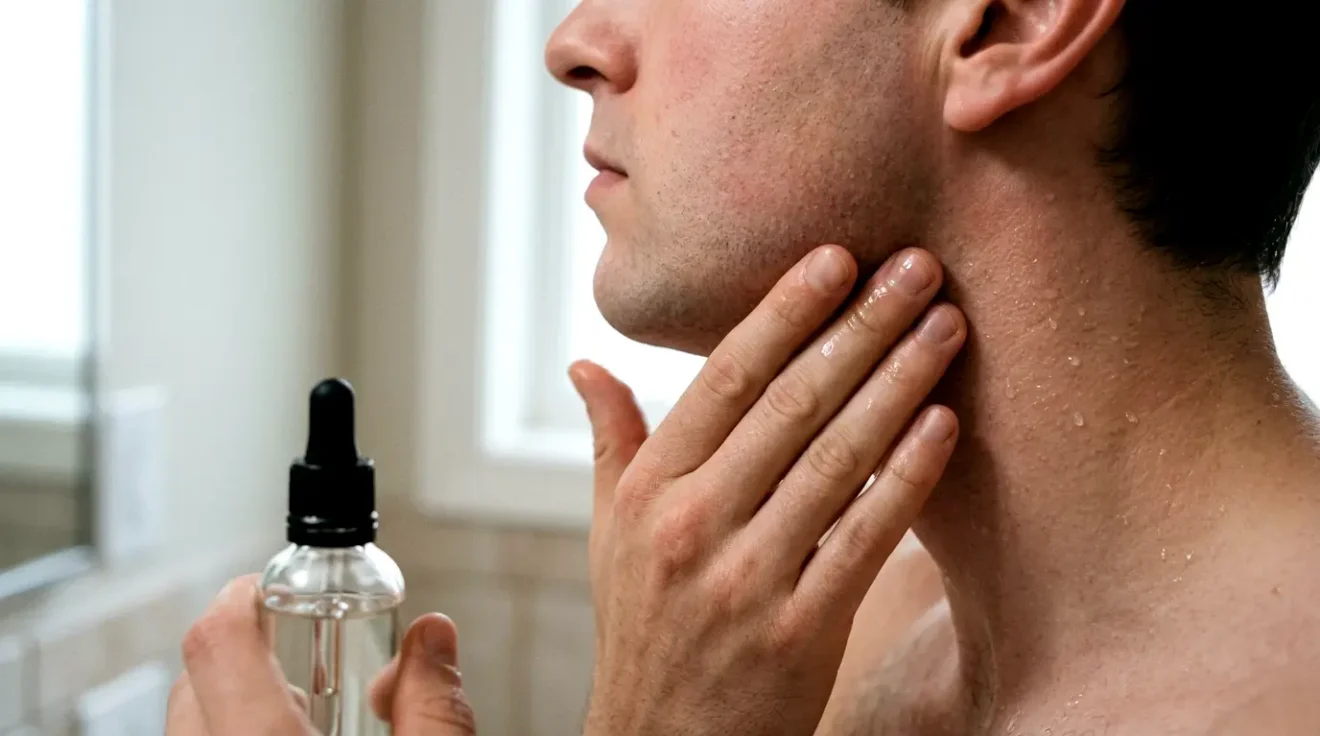
Fragrance deserves particular attention. Essential oils, perfume blends and heavily scented botanical extracts may irritate freshly shaved skin. Even a product described as natural or unscented can contain ingredients that sensitive individuals react to.
A short ingredient list does not guarantee safety, but avoiding known irritants and unnecessarily complex fragranced products is a sensible starting point.
Aftercare also influences the comfort of the overall shaving routine. Regular moisturizing supports the skin barrier, while repeatedly exposing already irritated skin to a razor can prolong discomfort. There is no need to claim that one particular oil or botanical extract prevents future razor burn.
For men prone to persistent irritation, the more meaningful intervention may be changing how often they shave, reducing closeness or switching to an electric trimmer that leaves a small amount of stubble.
At your next shave, focus on three observable improvements: a blade that cuts without tugging, fewer strokes over sensitive areas and skin that remains comfortable afterward. A precise finish is successful when it looks clean without creating a cycle of redness, bumps and repeated correction.
Can you achieve a clean-looking shave without removing every trace of stubble?
Yes. A clean-looking shave depends on even hair removal, tidy facial contours and consistent cutting direction. Skin does not need to feel completely smooth against the grain. For people susceptible to ingrown hairs, retaining a small amount of stubble may be preferable to cutting hair extremely close to the surface.
Should you shave every day if your neck develops razor bumps?
Daily shaving may aggravate an already irritated neck. Reducing shaving frequency, using a single-blade razor or choosing an electric trimmer that leaves short stubble may help. The appropriate schedule depends on how quickly the skin recovers and whether bumps continue developing. Recurrent or painful lesions deserve professional assessment.
Is an electric foil shaver less irritating than a traditional wet razor?
It can be for some individuals, but the result depends on the device, its cutting closeness and the user’s technique. An electric shaver used without an extremely close setting may reduce ingrown-hair problems. However, applying excessive pressure or repeatedly moving the head over the same area can still irritate the skin.
Does shaving after a warm shower improve the closeness of the shave?
Shaving after a warm shower can make beard preparation easier because the facial hair has been thoroughly wetted and softened. This may reduce cutting resistance, especially with coarse hair. The benefit comes from adequate hydration rather than heat alone, so extremely hot water is unnecessary and may irritate sensitive skin.
What should you do if a sharp razor still pulls on your beard?
Stop rather than increasing pressure. Check that the blade is correctly fitted, rinse accumulated hair from the head and ensure the beard and shaving product are adequately hydrated. Review the cutting angle and direction. If tugging continues despite these adjustments, replace the blade or consider whether the razor design suits your facial hair.