

Finding a facial moisturiser that hydrates without leaving a shiny film is particularly important for men with combination or oily skin. A rich cream may feel comfortable initially but leave the forehead, nose and cheeks looking unnecessarily glossy. The alternative is not to skip moisturiser altogether: skin still needs hydration, even when it naturally produces plenty of sebum.
The most practical choice is usually a lightweight gel, gel-cream or oil-free lotion labelled non-comedogenic. These formulations can provide hydration without the heavier after-feel associated with some richer creams. However, texture, ingredient combinations and application quantity all influence the final result. An oil-free label alone does not guarantee a completely matte appearance.
The right formula should leave skin feeling comfortable rather than tight, slippery or coated. Understanding why moisturisers sometimes look greasy, how to apply them around facial hair and how to combine them with sunscreen makes choosing a suitable daily product considerably easier.
Quick guide to lightweight men’s moisturisers
- Choose an oil-free, non-comedogenic gel, gel-cream or lightweight lotion if your skin becomes shiny easily.
- Apply a modest amount to clean skin and adjust the texture according to the different needs of your T-zone and cheeks.
- Keep moisturiser and sunscreen as separate steps when necessary, applying broad-spectrum SPF 30 or higher as the final morning skincare layer.
- Why Does Your Face Look Greasy Soon After Applying Moisturiser?
- How to Apply Lightweight Moisturiser Around Stubble Without Leaving White Residue?
- Niacinamide Gel or Squalane Lotion: Which Suits Men’s Combination Skin?
- Why a Lightweight Moisturiser Without SPF Cannot Replace Sunscreen
- When Should Men Apply Moisturiser Before Sunscreen in the Morning?
- Gel Cream or Oil-Free Lotion: Which Feels Better on Oily Skin in Summer?
- Aftershave Balm or Gel: Which Feels Better on Dry, Freshly Shaved Skin?
- Which Grooming Essentials Do Men Actually Need for a Simple Daily Routine?
Why Does Your Face Look Greasy Soon After Applying Moisturiser?
A face that looks greasy shortly after moisturising does not necessarily indicate that the product is unsuitable. The appearance can result from applying too much, choosing a formula that leaves a noticeable surface film or having natural sebum mix with skincare residue, particularly across the forehead and nose. Identifying where the shine appears and how long it lasts helps distinguish a product-related finish from normal skin oiliness.
Three factors are worth investigating. First, richer formulations containing substantial amounts of occlusive or emollient ingredients can leave a more noticeable surface feel. Petrolatum, for example, is an effective occlusive ingredient, but its heavier texture may not suit someone who prefers an almost invisible finish. Silicones also deserve a more nuanced assessment: they are not automatically greasy, and their sensory effects depend on the specific silicone and overall formulation.
Second, excessive application can leave more product on the surface than the skin needs. Even a lightweight gel can feel sticky or slippery when used too generously. Third, natural sebum can combine with residual moisturiser on oilier facial areas, making the forehead and nose appear shinier than the cheeks.
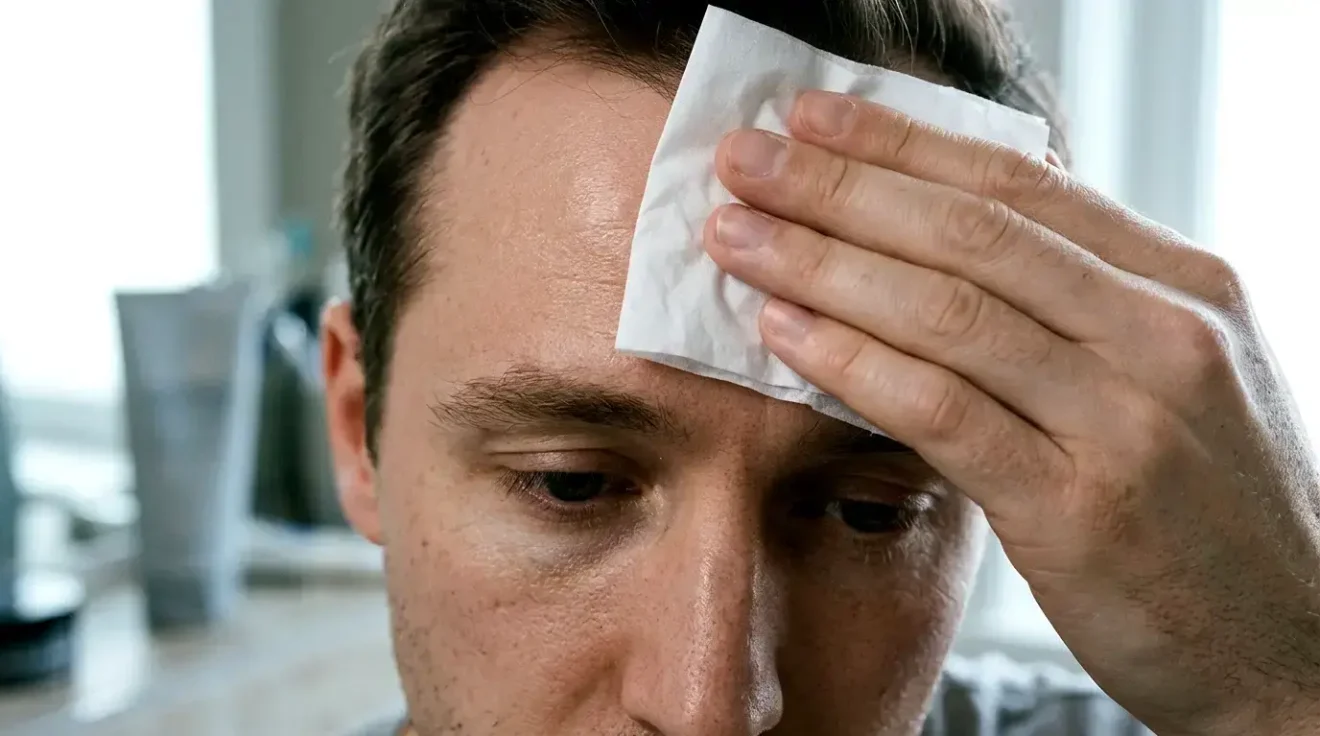
A simple tissue test can help identify the source of the problem. Wait approximately one hour after applying moisturiser, then gently press a clean tissue against the forehead and nose. Repeat on the cheeks if necessary. Observe the distribution of oil and the sensation of the skin rather than relying on one mark alone.
- Shine mainly on the forehead and nose: natural sebum production may be contributing significantly.
- Shine across the entire face: the product may be leaving too noticeable a surface film, or too much may have been applied.
- Comfortable cheeks but slippery forehead: combination skin may benefit from different application amounts across facial zones.
- Tightness despite visible shine: the skin may be both oily and insufficiently hydrated.
It is also important to distinguish a temporary dewy finish from persistent greasiness. A slight satin appearance immediately after application is not necessarily a problem. A product that remains slippery, feels coated and attracts visible residue may simply be too rich for the desired finish.
Skipping moisturiser is not a proven solution to excess sebum. In fact, the American Academy of Dermatology explains that harsh cleansing can irritate skin and contribute to increased oil production. Its recommendations support choosing oil-free, non-comedogenic products while continuing to moisturise after cleansing. The American Academy of Dermatology guidance on oily skin provides a useful starting point for selecting products.
Once the source of the shine is clearer, the next consideration is how much product actually reaches the skin, especially when short facial hair makes application less straightforward.
How to Apply Lightweight Moisturiser Around Stubble Without Leaving White Residue?
Moisturiser should reach the skin beneath stubble rather than simply coating the visible hairs. When a product is too thick or applied too generously, it can collect around short beard hairs and become more noticeable. A lightweight gel or gel-cream, combined with controlled application, makes daily hydration easier without leaving an obvious layer on facial hair.
The distinction matters because facial hair changes how skincare spreads. A conventional cream may distribute evenly across a clean-shaven cheek but catch on coarse stubble. The resulting residue can become especially visible against darker beard growth.
Start with a small quantity. Warm the product briefly between your palms, then use your fingertips to press it into the skin beneath and between the hairs. Avoid repeatedly dragging a thick layer across the beard surface. Work in small sections, paying attention to the jawline, cheeks and areas where regrowth is denser.

Texture selection also makes a difference. Water-based gels and gel-creams are often easier to distribute through short facial hair because they tend to feel less substantial than rich creams. However, no texture guarantees completely invisible application. The formulation, quantity and beard density all influence the result.
Some matte lotions contain silicones or mineral powders to modify their finish. These ingredients are not inherently unsuitable for bearded skin, but a product that dries into a noticeable film may highlight residue when it accumulates on hair. Test the actual formulation rather than rejecting an ingredient category automatically.
Two-day stubble deserves particular attention. Very short regrowth can catch product differently from a full beard, especially around the jaw and upper lip. Reduce the quantity in these areas, press the product into the skin and allow it to settle before adding more.
The American Academy of Dermatology recommends adapting moisturiser to skin type and beard length. It also explains that insufficient moisturising can contribute to dry, flaky and itchy skin beneath facial hair. Its American Academy of Dermatology advice on beard care supports using suitable products sparingly rather than abandoning skincare because of facial hair.
A practical application sequence is:
- Cleanse the face with a gentle facial cleanser.
- Pat the skin until it is no longer dripping wet.
- Warm a small quantity of moisturiser between the palms.
- Press it gently into the skin beneath the stubble.
- Check for visible accumulation and remove excess product if necessary.
Once application is under control, ingredient selection becomes the next decision. For combination skin, niacinamide and squalane offer different potential benefits, making the choice more about the dominant skin concern than a universal winner.
Niacinamide Gel or Squalane Lotion: Which Suits Men’s Combination Skin?
Niacinamide gel is worth considering when excess shine and uneven-looking skin texture are the main concerns. A squalane-containing lotion may be more suitable when the cheeks feel dry or uncomfortable despite an oily forehead and nose. Neither ingredient is automatically better for combination skin: the overall formulation, concentration, texture and individual tolerance matter more than the ingredient name on the front of the packaging.
Niacinamide, also known as vitamin B3, has been investigated for its potential influence on facial sebum production. A clinical study published in 2006 examined a 2% niacinamide moisturiser in two populations. The Japanese trial enrolled 100 participants and reported significantly lower sebum excretion rates after two and four weeks. A separate United States trial involving 30 participants reported a reduction in casual sebum levels after six weeks but did not find a significant reduction in sebum excretion rate.
2% niacinamide
The concentration investigated in the clinical research. Results differed between the Japanese and United States trials, so the findings should not be interpreted as proof that every niacinamide product controls facial oiliness.
Draelos, Matsubara and Smiles, 2006, clinical research on topical niacinamide and facial sebum production.
This research provides a reason to consider niacinamide in products designed for oily skin, but it does not establish that gels are more effective than lotions. It also does not directly compare niacinamide with squalane.
Squalane is an emollient ingredient used to improve softness and reduce the feeling of dryness. In a lightweight lotion, it can help support comfort in areas where the skin feels less supple. The final finish still depends on the complete formulation, including its emollients, humectants and other ingredients.
The two ingredients are not mutually exclusive. A moisturiser may contain both niacinamide and squalane, combining different formulation functions. Concentration and the rest of the ingredient list determine whether the finished product feels appropriate for oily or combination skin.
| Selection criterion | Niacinamide gel | Squalane lotion |
|---|---|---|
| Primary consideration | Oily zones and uneven-looking texture | Dryness and skin softness |
| Typical sensory preference | Lightweight, water-based feel | More emollient, cushioning feel |
| Potential advantage | Niacinamide has clinical research investigating facial sebum production | Squalane can improve skin softness |
| Possible limitation | Results depend on concentration, formulation and tolerance | Some formulations may feel too rich for an oily T-zone |
| Best selection approach | Choose a well-tolerated lightweight formula | Choose a light lotion that does not leave a persistent film |
Men with combination skin can also consider applying different products to different facial zones. For example, a lightweight niacinamide gel could be used on the forehead and nose, while a more emollient squalane lotion could be reserved for drier cheeks. This is a practical approach rather than a clinically validated treatment protocol.
Introduce new products individually and monitor the skin’s response. Men with sensitive or freshly shaved skin should prioritise tolerance over high ingredient percentages. The available 2% study does not establish that higher concentrations are more effective or that they necessarily cause irritation.
For a research-based assessment, consult the original clinical research on 2% niacinamide and facial sebum. Its findings are useful but limited to the specific formulations, participants and treatment periods investigated.
Ingredient selection addresses daytime comfort, but it does not automatically provide ultraviolet protection. A moisturiser that feels light and absorbs quickly still needs to be considered separately from sunscreen.
Why a Lightweight Moisturiser Without SPF Cannot Replace Sunscreen
A lightweight moisturiser without SPF cannot replace sunscreen because it does not provide the tested level of ultraviolet protection associated with a labelled sunscreen product. Hydration and sun protection are separate functions. Men who want to maintain a simple routine should therefore moisturise first and apply an appropriate broad-spectrum sunscreen as the final morning skincare step.
SPF is a measure associated with protection against UVB-induced sunburn under specified testing conditions. Broad-spectrum sunscreen also provides UVA protection. A regular moisturiser without sunscreen filters cannot be assumed to deliver either level of protection simply because it leaves a protective-feeling film on the skin.
There is also an important distinction between a product’s labelled SPF and the protection achieved in everyday use. Sunscreen testing uses a specified application quantity. Applying considerably less product than the tested amount can reduce the protection actually obtained.
This is particularly relevant for men who dislike heavy skincare. A lightweight moisturiser is often applied sparingly to avoid shine, but using a similarly small quantity of an SPF product may mean the protection falls short of its labelled performance.
A moisturiser containing SPF can serve both functions if it provides broad-spectrum protection and is applied in an adequate amount. However, combining moisturiser and sunscreen in one product does not remove the need to apply enough of it. A dedicated sunscreen can make the protection step easier to manage when the preferred moisturiser has no SPF.
The American Academy of Dermatology recommends a broad-spectrum sunscreen with 30 SPF or higher. Its facial application guidance specifies at least one teaspoon for the face. This is a practical recommendation rather than a universal measurement for every face size or formulation.
SPF 30 or higher
The American Academy of Dermatology’s recommended minimum for broad-spectrum sunscreen. The labelled protection depends on applying an adequate quantity and following the product’s directions.
American Academy of Dermatology, sunscreen selection and application recommendations.
Indoor routines also deserve consideration. Being inside for most of the day does not automatically eliminate all ultraviolet exposure, particularly when spending time near windows or going outdoors during short breaks. The amount of exposure depends on the environment, glazing and individual circumstances, but daily sun protection remains a sensible habit.
The choice of sunscreen does not have to undermine the lightweight finish. Fluid and gel-based sunscreen formulations can feel less substantial than richer creams. Look for products labelled non-comedogenic when clogged pores are a concern, and test the finish on your own skin rather than relying exclusively on marketing terms such as invisible or matte.
With the correct products selected, the remaining challenge is applying them in the right order. This is especially important when a morning routine needs to be quick without compromising the sunscreen layer.
When Should Men Apply Moisturiser Before Sunscreen in the Morning?
Apply moisturiser before sunscreen, allowing the moisturiser to settle before adding the sun-protection layer. Sunscreen should be the final step in the morning skincare routine because it needs to form an even film across exposed skin. Applying both products simultaneously can make the finish less predictable and may interfere with an even application.
The practical order is straightforward: cleanse, apply any suitable treatment, moisturise and finish with sunscreen. If shaving is part of the routine, address irritation with an appropriate soothing product before moisturising.
The waiting time between moisturiser and sunscreen does not have one universally established duration in the supplied dermatological guidance. A useful practical rule is to wait until the moisturiser no longer feels wet or noticeably tacky. This allows the first layer to settle and reduces the likelihood of excessive rubbing or product pilling when sunscreen is applied.
There is an important distinction between this practical pause and the sunscreen waiting time recommended before going outdoors. The American Academy of Dermatology advises allowing approximately 15 minutes for sunscreen preparation before sun exposure. That recommendation concerns outdoor exposure, not a proven mandatory interval between moisturiser and sunscreen.
Rushing the two steps together can produce several cosmetic problems:
- Moisturiser and sunscreen may mix during application, making the final finish uneven.
- Repeated rubbing can encourage product pilling, particularly when the formulations are not compatible.
- Using too little sunscreen to avoid a heavy feeling can compromise the protection achieved.
- Applying multiple layers without allowing them to settle can make residue more noticeable around facial hair.
For a simple routine, keep the application controlled. Use a modest amount of moisturiser, spread it evenly and let it settle. Apply sunscreen generously according to its directions, covering the exposed facial areas without forgetting the ears and neck.
After shaving, avoid treating every aftershave as a necessary additional step. Alcohol-based splashes may sting freshly shaved skin, particularly when the barrier feels irritated. A gentle, fragrance-free moisturiser or suitable soothing balm is often a more comfortable choice.
The key distinction is that no particular waiting interval between moisturiser and sunscreen should be presented as a guaranteed dermatological requirement. Product instructions, compatibility and the ability to create an even sunscreen film matter more than following an arbitrary timer.
A five-step morning skincare routine
- Cleanse: Wash the face with a gentle cleanser. Deliverable: clean skin without an uncomfortable tight feeling.
- Treat if necessary: Apply any established treatment appropriate to your skin concerns. Deliverable: treatment applied according to its product instructions.
- Moisturise: Apply a thin, even layer of lightweight moisturiser. Deliverable: comfortable skin without an obvious slippery film.
- Allow the moisturiser to settle: Wait until the surface no longer feels wet or tacky. Deliverable: a settled base without visible pilling.
- Protect: Apply broad-spectrum SPF 30 or higher sunscreen according to its directions. Deliverable: an even layer covering exposed facial skin.
Once this order becomes habitual, texture selection can be adjusted according to the weather. Heat and humidity often make a lighter-feeling gel more appealing, while air-conditioned environments can increase the preference for a slightly more emollient lotion.
Gel Cream or Oil-Free Lotion: Which Feels Better on Oily Skin in Summer?
Gel creams generally suit men who want an immediate lightweight, water-rich feel, while oil-free lotions may be more comfortable when oily skin also experiences dryness or tightness. In summer, a gel cream is often the more appealing starting point for a quick-absorbing finish. However, the best choice depends on humidity, air conditioning, skin hydration and the complete formulation.
Gel creams typically have a water-rich consistency that spreads easily and often leaves less of a substantial surface feel. This makes them attractive for men who dislike the sensation of conventional moisturising creams, especially during hot weather.
Oil-free lotions offer another approach. Their texture may be slightly more substantial while still avoiding the heavier feel associated with some traditional creams. Depending on the humectants and emollients included, they can provide a more sustained feeling of comfort when the skin is exposed to dry indoor air.
Summer conditions can also change how a product feels. Sweat and surface moisture may make an already rich cream feel more noticeable. A lighter texture can therefore improve cosmetic comfort, although this does not mean that every cream absorbs poorly in warm weather or that every gel is automatically suitable for oily skin.
The following comparison helps narrow the options:
| Feature | Gel cream | Oil-free lotion |
|---|---|---|
| Texture | Water-rich and lightweight | Fluid and slightly more substantial |
| Initial feel | Often cooling and refreshing | Usually more cushioning |
| Preferred situation | Hot weather and a preference for minimal residue | Oily skin with dry or tight areas |
| Potential drawback | May not provide enough lasting comfort for some dehydrated skin | May feel too substantial for very oily areas |
| Selection priority | Fast absorption and a light finish | Hydration without persistent surface heaviness |

One frequently overlooked issue is oily but dehydrated skin. A man may naturally produce considerable sebum while still experiencing tightness, particularly after cleansing or spending long periods in air-conditioned environments. Choosing the lightest possible gel may initially feel pleasant but fail to provide enough lasting comfort.
In this situation, an oil-free lotion containing suitable humectants can offer a better balance. Ingredients such as glycerin and hyaluronic acid are commonly used to attract and retain water in the skin’s outer layers. The presence of these ingredients does not automatically guarantee a particular finish, so the finished formulation remains important.
A practical comparison can help. Apply a small amount of each texture to separate areas of clean skin. Observe how each spreads and how the skin feels after approximately 30 minutes. Look for comfortable hydration without persistent slipperiness, excessive tackiness or tightness.
Do not judge a moisturiser exclusively by its immediate cooling sensation. The more useful question is whether the skin remains comfortable throughout the day. If a gel feels excellent initially but leaves the cheeks tight later, a slightly more emollient lotion may be the better everyday choice.
Texture is only one part of daily grooming, however. Men who shave regularly also need to consider whether their aftershave is helping the skin recover or simply adding another potentially irritating layer.
Aftershave Balm or Gel: Which Feels Better on Dry, Freshly Shaved Skin?
Aftershave gel is generally a convenient option for men who prefer a cooling, lightweight finish, while an aftershave balm is often more suitable when freshly shaved skin feels dry or uncomfortable. The deciding factor should be the skin’s condition rather than the traditional idea that every man needs an alcohol-based aftershave. A gentle, soothing formulation is usually the more sensible choice for irritated skin.
Shaving removes hair close to the skin’s surface and can leave behind temporary irritation. Repeated blade contact, friction and unsuitable shaving products may contribute to redness, dryness and discomfort. The immediate priority is therefore to avoid adding unnecessary irritation.
Look for formulations containing soothing and hydrating ingredients. Glycerin, panthenol and other well-tolerated moisturising ingredients can help improve skin comfort. Fragrance-free options may be preferable for men who regularly experience sensitivity after shaving.
The two formats have different sensory characteristics:
| Consideration | Aftershave balm | Aftershave gel |
|---|---|---|
| Texture | Creamy or lotion-like | Lightweight and often water-based |
| Skin feel | More cushioning and emollient | Cooling and less substantial |
| Best suited to | Dry or uncomfortable freshly shaved skin | Oily skin and preference for a lighter finish |
| Potential drawback | Some formulas may feel too rich | Some formulas may not provide enough lasting comfort |
Traditional aftershave splashes deserve particular caution. Many contain alcohol, which can produce an immediate stinging sensation on freshly shaved skin. That sensation should not be confused with effective soothing or improved hydration. Men who experience persistent dryness or irritation should consider replacing these products with a gentler alternative.
Another practical consideration is product overlap. A suitable moisturising aftershave balm can perform much of the same everyday hydration function as a facial moisturiser. On freshly shaved days, using one well-formulated balm may be more comfortable than layering several products unnecessarily.
For oily skin, a lightweight gel can be followed by the usual moisturiser if additional hydration is needed. For dry skin, a suitable balm may be sufficient on its own. There is no requirement to use both products when one already provides the comfort and hydration needed.
Freshly shaved skin also needs sun protection during the day. Once the soothing product or moisturiser has settled, apply sunscreen as the final morning skincare step.
When the individual products are chosen carefully, the entire routine can remain remarkably simple. The final decision is not how many grooming products to buy, but which few products consistently address the skin’s actual needs.
What matters before building a simple routine
- Oily skin still benefits from regular moisturising, provided the formula and application amount suit its needs.
- A lightweight finish depends on texture, formulation and quantity, not simply whether a product carries an oil-free label.
- Daily sun protection is a separate requirement that should be integrated without making the morning routine unnecessarily complicated.
Which Grooming Essentials Do Men Actually Need for a Simple Daily Routine?
Most men can build an effective basic facial skincare routine around three essentials: a gentle cleanser, a lightweight moisturiser and a broad-spectrum sunscreen. These products address cleansing, hydration and daily ultraviolet protection without requiring a crowded bathroom shelf. Additional treatments can be useful for specific concerns, but they are not automatically necessary for healthy-looking, comfortable skin.
The first essential is a gentle cleanser. Its job is to remove accumulated dirt, excess oil and everyday impurities without leaving the face feeling stripped. Men with oily skin sometimes assume that stronger cleansers will produce a better result. However, aggressive cleansing can irritate the skin, and the American Academy of Dermatology warns that irritation may contribute to increased oil production.
The second essential is a suitable moisturiser. For combination and oily skin, an oil-free, non-comedogenic gel, gel-cream or lightweight lotion is a sensible starting point. The goal is to maintain hydration while avoiding a finish that feels unnecessarily rich. Men with different facial zones may also benefit from adjusting the quantity rather than applying an identical amount everywhere.
The third essential is sunscreen. A broad-spectrum SPF 30 or higher product protects exposed skin against ultraviolet radiation when used as directed. A lightweight fluid or gel sunscreen can make this step more comfortable for men who dislike heavy skincare finishes.
Other grooming products should be selected according to a specific need rather than included automatically.
- Eye cream: optional for most men who already tolerate a suitable facial moisturiser around the eye area.
- Toner: unnecessary for many basic routines, particularly when cleansing and moisturising are already effective.
- Exfoliant: potentially useful for particular concerns, but excessive exfoliation can irritate skin.
- Targeted treatment: worth considering when a persistent concern such as acne or uneven pigmentation requires a more specific approach.
- Aftershave balm: useful when shaving regularly causes dryness or discomfort, although it may overlap with the moisturiser step.
The most important factor is consistency. A simple routine followed regularly is generally more practical than an elaborate collection of products used inconsistently. Give a newly established routine enough time to assess comfort and compatibility, changing one product at a time when necessary.
For men who want to avoid unnecessary purchases, the decision to introduce another product should be based on an identifiable concern. If cleansing, moisturising and sunscreen already provide comfortable skin without persistent problems, adding several additional steps may offer little practical benefit.
The final morning sequence can therefore remain straightforward: cleanse, apply any necessary treatment or soothing post-shave product, moisturise and protect. At night, cleanse and moisturise according to the skin’s needs.
For men with combination or oily skin, the best lightweight moisturiser is ultimately the one that maintains comfort without leaving a persistent greasy film. Start with a non-comedogenic gel, gel-cream or oil-free lotion, adjust the quantity to facial hair and skin zones, and keep sunscreen as a separate priority when needed. A consistent three-product routine is a sensible foundation for comfortable, discreet everyday skincare.
Can men with oily skin use moisturiser every day?
Yes. Oily skin still benefits from regular hydration. The American Academy of Dermatology recommends moisturising after cleansing and choosing oil-free, non-comedogenic products for oily skin. A lightweight gel or lotion can provide everyday comfort without the heavier finish of some richer creams.
Is an oil-free moisturiser always better for combination skin?
Not necessarily. Oil-free products can be a useful starting point for men concerned about shine, but the complete formulation determines how a moisturiser feels. Combination skin may need more emollient hydration on the cheeks and a lighter texture across the forehead and nose. Non-comedogenic labelling is another useful selection criterion.
Should men apply moisturiser to a wet or dry face?
Apply moisturiser after cleansing, while the skin is slightly damp or after gently patting it dry. The American Academy of Dermatology recommends moisturising after cleansing. The important consideration is that the skin should not be dripping wet, particularly when applying a lightweight product that needs to settle evenly.
Can niacinamide and squalane be used together?
Yes. Niacinamide and squalane can appear together in the same moisturiser because they serve different formulation purposes. Niacinamide has been investigated for its potential influence on facial sebum production, while squalane is an emollient used to improve softness. Individual tolerance and the finished product’s texture remain important.
Does a lightweight moisturiser with SPF replace dedicated sunscreen?
It can provide both hydration and sun protection if it offers broad-spectrum SPF 30 or higher and is applied in an adequate quantity according to its instructions. However, men who apply only a small amount to avoid shine may not achieve the labelled protection. A separate sunscreen can make it easier to maintain the required application while keeping the preferred moisturiser lightweight.