

Eau de Cologne can be an excellent choice for hot weather and everyday wear, particularly if a fragrance that feels fresh, unobtrusive and easy to reapply is more appealing than a dense, long-lasting scent. Its traditional character is built around bright citrus notes, aromatic herbs and a relatively delicate fragrance trail. These qualities make it especially comfortable in warm conditions, where powerful compositions can become overwhelming.
However, choosing a cologne involves understanding a few important distinctions. The traditional Eau de Cologne style is not necessarily the same as every modern fragrance marketed as a cologne. Concentration labels also do not guarantee a precise number of hours on the skin. Ingredients, formulation, application and environmental conditions all influence performance.
For fragrance beginners, the most useful approach is to consider how a scent develops throughout the day, how much presence it creates and how easily it can be refreshed. A light cologne is not simply a weaker version of a stronger perfume: it offers a different balance between freshness, intensity and convenience.
Understanding Eau de Cologne at a glance
- Eau de Cologne traditionally combines citrus, aromatic herbs and a light fragrance concentration, making it particularly appealing in warm weather.
- Its bright opening often fades relatively quickly because many citrus materials are volatile, although the actual longevity depends on the complete formulation.
- Its subtle character makes it suitable for everyday activities and shared spaces when applied moderately, with occasional reapplication if needed.
- 17: Why Do Citrus Fragrances Feel So Refreshing During the Day?
- 17.1: Why Does Bergamot Smell Bright at First but Fade Quickly on Skin?
- 18.1: Why Does Eau de Cologne Fade Faster Than Eau de Parfum?
- 18.2: How to Apply Eau de Cologne for a Subtle Office-Friendly Fragrance?
- 18.3: Traditional Eau de Cologne or Modern Cologne: Which Fragrance Style Are You Buying?
- 18.4: Why Leaving Eau de Cologne in a Hot Car Can Change Its Smell
- 18.5: When to Refresh Eau de Cologne Before an Outdoor Summer Event?
- 15.4: Why Applying More Luxury Perfume Can Make the Scent Less Enjoyable
17: Why Do Citrus Fragrances Feel So Refreshing During the Day?
Citrus fragrances feel refreshing because their bright, sparkling aromas create a strong sensory association with freshness, cleanliness and coolness. Materials such as lemon, bergamot and neroli provide an immediate impression of brightness that can make a fragrance particularly pleasant during warm weather. This is a sensory and psychological effect, not an actual reduction in skin temperature.
The impression begins with the fragrance’s opening notes. Citrus ingredients often contain relatively volatile aromatic molecules that become noticeable soon after application. Their lively character creates an immediate contrast with heavier compositions built around dense woods, resins or sweet amber accords.
There are several familiar ingredients behind this effect:
- Lemon: Crisp, sharp and sparkling, lemon gives a fragrance an immediately recognisable fresh character.
- Bergamot: More nuanced than straightforward lemon, bergamot combines citrus brightness with delicate floral and slightly bitter facets.
- Neroli: Obtained from bitter orange blossoms, neroli introduces a floral freshness that softens a purely zesty composition.
- Petitgrain: Distilled from bitter orange leaves and twigs, petitgrain offers a green, woody and slightly bitter interpretation of citrus.
These ingredients do not all behave identically on the skin. Their aromatic profiles and chemical compositions differ, as do their evaporation characteristics. A lemon-led opening can feel particularly immediate, while petitgrain may contribute a greener aromatic dimension that helps the fragrance retain some character beyond its initial citrus impression.
The refreshing effect should also be distinguished from a measurable physiological response. Smelling a cool, sparkling fragrance may change how the surrounding environment feels, but applying Eau de Cologne does not physically lower body temperature. Its appeal in summer comes from the way the fragrance is perceived, rather than from a cooling action.
There is also a practical trade-off. The same volatility that helps citrus materials create an energetic opening can make that impression relatively short-lived. A fragrance may therefore smell particularly fresh immediately after application without maintaining the same brightness throughout the afternoon.
A scientific review published in the International Journal of Cosmetic Science examines how molecular properties and formulation influence fragrance release. Its discussion of limonene and other fragrance molecules helps explain why a lively citrus opening does not automatically translate into prolonged skin wear. The findings concern specific experimental systems rather than every finished commercial perfume. See the scientific review of fragrance release and skin application for further context.
Among the different citrus ingredients, bergamot deserves particular attention because it combines sparkling freshness with a more complex aromatic character. Its development on the skin illustrates why the first impression of a cologne is not always representative of its later scent.
17.1: Why Does Bergamot Smell Bright at First but Fade Quickly on Skin?
Bergamot often smells exceptionally bright at first because its aromatic profile contains volatile compounds that become noticeable soon after application. As these compounds evaporate, the fragrance loses some of its sparkling citrus character and reveals its quieter heart and base notes. This transition explains why a bergamot-led cologne can smell radiant immediately after spraying but considerably softer later.
Bergamot is particularly valued in perfumery because it offers more complexity than a simple sharp citrus accord. Its scent can combine fresh, slightly bitter, floral and subtly green impressions, making it useful in traditional colognes as well as contemporary fragrances.
Its opening is nevertheless subject to evaporation. Limonene and other volatile compounds contribute to the initial aromatic impression, while less volatile materials can remain perceptible for longer. The precise evolution depends on the oil’s composition and the other ingredients in the fragrance.
This explains an important difference between testing a fragrance on paper and wearing it on the skin. A blotter is useful for discovering the initial character, but it does not reproduce the complete interaction between a fragrance and the wearer’s skin. Temperature, skin condition and the formulation all influence the result.
A practical test is more useful than judging a cologne from its first spray:
- Apply a small amount to clean skin and note the immediate opening.
- Return to the fragrance after approximately 30 minutes to observe its developing character.
- Check again after two hours to determine which notes remain perceptible.
- Compare the result with the original impression and decide whether the later scent is still appealing.
There is also a safety consideration when choosing bergamot-based fragrances for daytime wear. Conventionally expressed bergamot oil can contain bergapten, a furocoumarin associated with phototoxicity. When certain ingredients are applied to skin exposed to ultraviolet radiation, they can contribute to adverse light-related skin reactions.
Distilled and furanocoumarin-free (FCF) bergamot oils are distinct materials. FCF processing reduces the relevant furanocoumarin content, but the overall safety of a finished fragrance still depends on its complete formulation and intended use. Consumers should follow the manufacturer’s application instructions rather than assume that every citrus perfume is automatically suitable for unrestricted sun exposure.
IFRA’s technical standards address expressed bergamot oil because of its phototoxic potential and specify restrictions according to ingredient and product category. Its January 2022 compilation includes technical information concerning bergapten and products applied to UV-exposed skin. The IFRA technical standards on citrus oil phototoxicity provide the relevant technical context.
Perfumers can also support bergamot with other materials. Aromatic herbs, floral heart notes, musks and suitable base ingredients can give a composition more continuity after the initial citrus impression has softened. This is why two colognes with similar bergamot openings can develop quite differently.
Once the distinction between opening and drydown is understood, the next question becomes practical: how much of the fragrance remains noticeable, and what does its concentration actually tell the wearer?
18.1: Why Does Eau de Cologne Fade Faster Than Eau de Parfum?
Eau de Cologne often fades faster than Eau de Parfum because traditional colognes generally contain a lower proportion of fragrance concentrate and frequently rely on volatile citrus and aromatic ingredients. These characteristics tend to produce a lighter fragrance trail and shorter-lasting opening. However, concentration alone cannot guarantee how long a particular perfume will remain noticeable on the skin.
Fragrance concentration describes the proportion of aromatic concentrate in the finished product, usually diluted in an alcohol-based solution. Eau de Cologne, Eau de Toilette and Eau de Parfum are familiar commercial categories, but they are not universally fixed technical specifications.
IFRA provides indicative industry concentration ranges for ethanol-based fragrances:
3–8%
Typical fragrance concentration range for Eau de Cologne, with approximately 5% given as a common reference. This is an industry convention, not a mandatory international definition.
International Fragrance Association (IFRA), Using the IFRA Standards.
For comparison, the typical ranges identified by IFRA are 5–15% for Eau de Toilette, with approximately 10% as a reference, and 10–20% for Eau de Parfum, with approximately 15% as a reference. The ranges overlap, which is an important reason not to interpret the label as an absolute measurement of fragrance strength.
IFRA explicitly explains that these terms are not strictly defined by international standards. They describe general commercial practices rather than universally binding categories. Its explanation of fragrance concentration standards helps clarify why a product’s label should be treated as an indication rather than a guarantee.
Several other factors influence longevity:
- Ingredient volatility: Bright citrus materials can evaporate relatively quickly, whereas some woody, musky and resinous ingredients are less volatile.
- Formulation: The balance between top, heart and base notes affects how the fragrance develops.
- Skin condition: Skin hydration and individual characteristics influence how a fragrance is perceived and retained.
- Climate: Temperature and environmental conditions can alter evaporation and fragrance perception.
- Application: Spray quantity, placement and the use of moisturiser can influence the wearing experience.
A lighter concentration should therefore be understood as a particular wearing style rather than an inferior product. In hot weather, a fragrance that remains relatively close to the skin can be more comfortable than a dense composition that creates a strong scent trail in a warm, crowded environment.
The decision is straightforward. Choose Eau de Cologne if a delicate fragrance that can be refreshed during the day is appealing. Choose Eau de Parfum if fewer applications and a more substantial fragrance presence are priorities. Neither choice is universally better; each suits a different approach to everyday wear.
For someone who spends much of the day outdoors, frequent refreshment may be perfectly practical. For someone who prefers to apply fragrance once before leaving home, a composition with more persistent materials may be a better fit.
Once a lighter fragrance has been selected, careful application becomes especially important. A cologne should create a pleasant personal impression without requiring excessive spraying to compensate for its more delicate character.
18.2: How to Apply Eau de Cologne for a Subtle Office-Friendly Fragrance?
To wear Eau de Cologne comfortably in an office, start with a restrained application and allow the fragrance to develop before adding more. Applying a small amount to the chest or forearms can help keep the scent within the wearer’s personal space. The aim is to create a subtle impression at close range rather than a fragrance trail that follows someone through shared work areas.
One of the most common mistakes with light fragrances is overspraying. Because the wearer notices that a cologne has become less perceptible, it can be tempting to apply several additional sprays. However, the nose adapts to familiar smells, and a fragrance that seems faint to its wearer may remain noticeable to nearby colleagues.
A more effective approach is to begin with one or two modest applications, depending on the atomizer and the strength of the composition. Wear the fragrance for several occasions before adjusting the amount. This allows the wearer to understand its projection and development without changing the application routine every few minutes.
Placement also matters. Applying fragrance to the chest beneath clothing can help soften its immediate projection. The fabric acts as a partial barrier, while the fragrance remains close to the body. A small amount on the forearms is another practical option, particularly when the wearer wants to experience the scent without creating a strong surrounding aura.

Another useful consideration is the difference between skin and fabric application. Fabric can retain fragrance differently from skin, sometimes extending the time during which it remains perceptible. However, the result depends on the material and formulation. Delicate fabrics can also stain, so spraying directly onto clothing should always be approached cautiously and according to the manufacturer’s guidance.
A practical office self-check is to assess the fragrance after approximately one hour. If it remains clearly noticeable to the wearer at close range, there may be little reason to add another application. If the wearer cannot detect it, a brief break from the scent or feedback from someone nearby can help distinguish genuine fading from olfactory adaptation.
Reapplication is best reserved for a moment when it is genuinely needed. A small atomizer makes this easier than carrying a large splash bottle. Splash bottles can be convenient at home, but an atomizer generally allows more controlled and discreet application during a working day.
For shared environments, the following habits are particularly useful:
- Apply fragrance before arriving at the office rather than spraying it repeatedly at a shared desk.
- Begin with a modest quantity and assess the result after the fragrance has settled.
- Avoid spraying directly into the air around colleagues or in enclosed shared spaces.
- Keep a travel-size atomizer available if a refresh is genuinely necessary.
Office suitability also depends on workplace culture. A fragrance that feels discreet in a spacious private office may be more noticeable in a small meeting room, shared vehicle or densely occupied workspace. Sensitivity to fragrance among colleagues is another reason to favour restraint.
Application habits can make a considerable difference, but the fragrance’s underlying style matters just as much. The word cologne appears on many modern perfume labels, even when the composition differs considerably from the traditional citrus-based interpretation.
18.3: Traditional Eau de Cologne or Modern Cologne: Which Fragrance Style Are You Buying?
Traditional Eau de Cologne and modern cologne-style fragrances are not necessarily the same type of perfume. Traditional colognes generally emphasise citrus, aromatic herbs and a light, transparent structure. Modern products marketed as colognes may instead include woods, musks, amber or other persistent materials to create a more substantial fragrance character.
The terminology can be confusing because the word cologne has two common uses. Historically, Eau de Cologne refers to a recognisable fragrance style associated with the classic citrus-and-aromatic tradition. In contemporary retail, particularly in some English-speaking markets, cologne can also be used as a broad product designation or as a masculine fragrance category.
Traditional Eau de Cologne is associated with the European perfumery tradition and the early citrus compositions popularised by makers such as Farina. The classic style is often built around lemon, bergamot, orange, neroli, petitgrain and aromatic herbs.
Its defining qualities include:
- A bright and immediate citrus opening.
- Aromatic and sometimes floral heart notes.
- A relatively transparent structure rather than a heavy base.
- A fresh, clean character that can be worn generously when the formulation and application instructions allow.
- A fragrance trail that is often more delicate than that of richer perfume compositions.
Modern cologne-style fragrances can preserve some of these qualities while introducing materials designed to provide greater depth. Woods may create a drier character, musks can give a soft skin-like impression, and amber accords can add warmth and body.
The following comparison helps clarify what to expect:
| Characteristic | Traditional Eau de Cologne | Modern Cologne |
|---|---|---|
| Typical fragrance profile | Citrus, aromatic herbs and light floral facets | Citrus combined with woods, musks, amber or other accords |
| Overall impression | Bright, transparent and refreshing | Fresh but potentially deeper and more rounded |
| Base structure | Often relatively delicate | May include more substantial base materials |
| Expected wearing experience | Often requires more frequent refreshing | Can offer a more persistent character, depending on formulation |
| Warm-weather suitability | Particularly appealing for a light, airy effect | Depends on the balance of fresh and heavier materials |
Neither category automatically offers better quality. A traditional cologne can be beautifully balanced and complex despite its lightness. Equally, a modern composition can offer an interesting interpretation of freshness without losing its connection to the original cologne tradition.
The best way to identify what a bottle contains is to examine its note description, ingredient positioning and overall fragrance profile. A product described with bergamot, lemon, neroli and petitgrain suggests a more traditional direction. A fragrance centred on citrus, cedarwood, musk and amber points towards a more contemporary interpretation.
Concentration terminology should also be treated carefully. As the IFRA guidance explains, commercial fragrance categories do not have universally fixed concentration definitions. Two products bearing similar labels can therefore differ in formulation and performance.
For hot-weather wear, the choice comes down to the desired experience. Traditional Eau de Cologne is appealing when immediate freshness and a light fragrance trail matter most. Modern cologne-style compositions may be more suitable when a fresh opening is wanted alongside a somewhat fuller drydown.
Whichever style is selected, its delicate aromatic character deserves appropriate storage. Citrus-led compositions are particularly dependent on preserving their bright opening notes, which makes exposure to excessive heat an important practical concern.
18.4: Why Leaving Eau de Cologne in a Hot Car Can Change Its Smell
Leaving Eau de Cologne in a hot car can compromise its smell because elevated temperatures accelerate chemical and physical processes that affect fragrance ingredients. Delicate citrus materials may lose their original balance, while oxidation can gradually change the character of susceptible aromatic compounds. The result may be a cologne that smells flatter, less sparkling or noticeably different from when it was first purchased.
Temperature is particularly relevant to citrus-led fragrances because much of their appeal comes from their bright top notes. A composition that initially smells fresh and lively may lose some of that character when exposed repeatedly to excessive heat.
Oxidation is another important mechanism. Citrus essential oils can contain compounds such as limonene that are susceptible to oxidation when exposed to environmental conditions such as air, light and heat. The scientific literature on citrus essential oils discusses these stability concerns and recommends appropriate storage practices for the oils themselves.
These findings should not be interpreted as a precise prediction of how quickly a finished cologne will deteriorate inside a particular vehicle. A commercial perfume is a complete formulation containing several ingredients, and its stability depends on the bottle, packaging and storage conditions.
Nevertheless, a parked car during summer is an unsuitable storage location. The interior can become considerably hotter than the surrounding environment, and repeated temperature fluctuations can create unnecessary stress for a fragrance.
There are several warning signs worth noticing:
- Colour changes: A liquid that becomes noticeably darker may indicate changes in the formulation, although colour alone cannot confirm deterioration.
- Cloudiness: An unusual change in clarity may warrant further inspection, particularly if it was not present originally.
- Altered opening: A citrus fragrance that has lost its characteristic brightness may have changed during storage.
- Unpleasant odour: A sour, stale or otherwise unfamiliar smell can indicate that the fragrance no longer retains its original character.
A comparison with a fresh sample of the same fragrance can be useful when assessing a suspected change. The comparison should be made under similar conditions, ideally using the same amount on comparable testing surfaces.
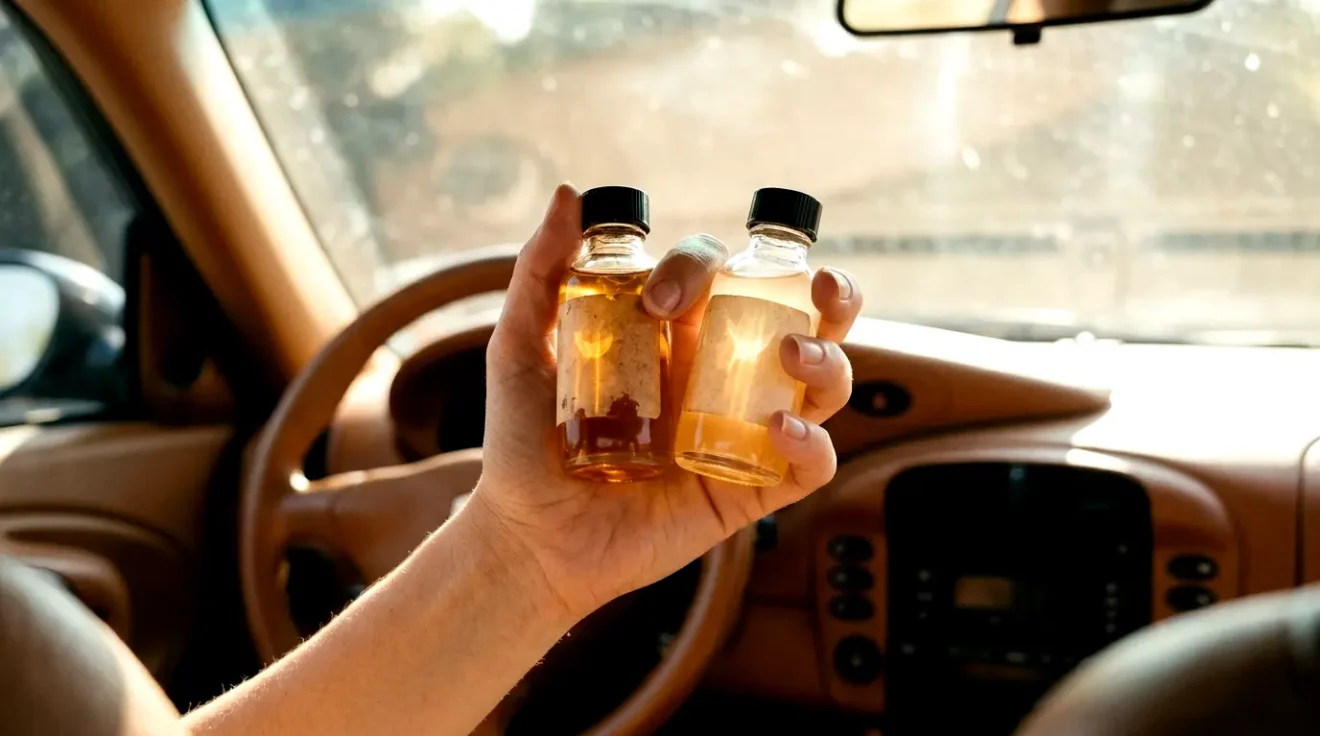
Good storage habits are simple and do not require specialist equipment. Keep the bottle in its original packaging or another suitable protective location, away from direct sunlight and unnecessary temperature fluctuations. A cool, dark drawer or shaded cabinet is generally more appropriate than a car dashboard, windowsill or frequently heated bathroom.
The same principle applies when carrying fragrance in a bag during summer. A small atomizer is convenient, but it should not be left for extended periods in a hot vehicle or another location exposed to excessive heat. When travelling, a protected place away from direct sunlight is preferable.
Good storage preserves the original composition, but it cannot prevent the fragrance from gradually becoming less noticeable during normal wear. For outdoor summer activities, knowing when to refresh a cologne is therefore just as important as knowing how to store it.
Key considerations before refreshing Eau de Cologne
- Assess the fragrance on your skin rather than relying exclusively on the original spray or blotter impression.
- Remember that hot conditions can shorten the perceived life of a fresh citrus opening while increasing the projection of the fragrance that remains.
- Prepare the skin appropriately and use a small atomizer when a discreet refresh is needed during an outdoor event.
18.5: When to Refresh Eau de Cologne Before an Outdoor Summer Event?
The best time to refresh Eau de Cologne before an outdoor summer event depends on how the fragrance is developing on the skin, the temperature and the structure of the occasion. Rather than following a universal reapplication interval, look for signs that the fragrance has become difficult to detect at close range. A light application shortly before an important social moment can restore its fresh impression without creating an overwhelming scent trail.
Heat makes fragrance performance more complicated than simply causing a scent to disappear faster. Higher temperatures can accelerate evaporation, but they can also increase the perception of the materials that remain. A fragrance that seems relatively quiet in the morning may become more noticeable when the wearer moves into a warm outdoor environment.
This is why applying a large amount immediately before leaving home is not always the most effective strategy. A restrained initial application provides a foundation, while a carefully timed refresh can restore the opening shortly before arrival or the main social part of the event.
Skin preparation also influences the result. Dry skin may provide a different wearing experience from well-moisturised skin. Applying an unscented moisturiser before fragrance can help create a more comfortable application surface and may improve the perceived persistence of the scent. However, it does not guarantee a particular duration.
Sunscreen is another consideration. Outdoor events often involve regular sunscreen application, and its texture and fragrance can influence how a perfume smells on the skin. It is sensible to allow skincare products to settle according to their instructions before applying fragrance, while avoiding the assumption that perfume can replace or interfere with the protection provided by sunscreen.
Perspiration can also change the wearing experience. Sweat, friction and environmental exposure may affect how a fragrance is perceived. Applying cologne to freshly washed, dry skin is generally preferable to repeatedly spraying it over perspiration.
A practical event-day routine can follow three stages:
- Before leaving: Apply a light amount to clean, dry skin and allow the fragrance to settle.
- During the day: Assess whether the scent is still noticeable at close range rather than automatically reapplying at fixed intervals.
- Before the main social moment: If the fragrance has genuinely faded, use a small, controlled refresh shortly before arriving.
A compact atomizer is particularly useful for this purpose. It makes it possible to carry a familiar fragrance without bringing a full-size bottle and allows a more controlled application than repeatedly using a large splash bottle.
The amount should remain proportionate to the setting. A relaxed outdoor lunch, an open-air celebration and a crowded evening gathering do not necessarily require the same fragrance presence. The surrounding environment and the proximity of other people should influence the decision.
There is no need to refresh simply because a certain amount of time has passed. If the fragrance remains pleasant and perceptible, another application may add little value. Conversely, if its initial citrus brightness has disappeared and the wearer wants that fresh impression for an upcoming event, a modest refresh can be appropriate.
This approach also explains an important principle of fragrance wearing: adding more perfume does not necessarily make the experience better. In warm weather, and particularly with compositions that already contain rich base notes, excessive application can undermine the freshness that the wearer originally wanted.
15.4: Why Applying More Luxury Perfume Can Make the Scent Less Enjoyable
Applying more luxury perfume can make a fragrance less enjoyable because excessive spraying can create scent saturation and olfactory fatigue. The wearer gradually becomes less sensitive to a familiar smell, even while people nearby continue to perceive it strongly. In warm weather, excessive fragrance can also become cloying, especially when a composition contains dense woods, sweet accords or heavy base notes.
Olfactory fatigue is a natural adaptation process. When someone is exposed to the same smell continuously, the brain becomes less responsive to it. This explains why a fragrance can seem to disappear to the person wearing it even though it remains noticeable to others.
The resulting behaviour is familiar: the wearer applies another spray because the perfume seems weak, then another because the scent still appears faint. In reality, the fragrance may already be more prominent than intended.
It is important to distinguish two different situations:
- Genuine fragrance fading: The composition has become less perceptible because its more volatile materials have evaporated and the remaining notes are relatively subtle.
- Olfactory adaptation: The fragrance remains present, but the wearer has become less sensitive to its familiar smell.
A simple way to distinguish between them is to take a break from the fragrance and assess it again later. Another option is to ask someone nearby whether the scent remains noticeable at normal conversational distance. This should be done discreetly rather than turning fragrance application into a continuous exercise in checking projection.
Warm weather makes moderation particularly important. Dense perfume compositions can feel heavier when temperatures rise, and excessive application can create a scent trail that is uncomfortable in enclosed or crowded environments.
This does not mean that luxury fragrances should always be applied sparingly or that stronger compositions are unsuitable for summer. The appropriate amount depends on the formula, its concentration, the environment and the intended effect. A fresh, transparent composition may tolerate a different application routine from a rich oriental or woody fragrance.
The same principle applies to Eau de Cologne. A light composition does not need to be treated as though it must compete with a stronger perfume. Its value often lies in its immediacy, subtlety and ease of use. Frequent, controlled refreshment can be more satisfying than attempting to make a delicate fragrance project continuously throughout the day.
For everyday wear, a useful final check is to consider three questions:
- Does the fragrance remain pleasant after its opening notes have faded?
- Is its presence appropriate for the temperature and the people nearby?
- Is another application genuinely necessary, or has the wearer simply become accustomed to the smell?
These questions help prevent a common mistake: confusing fragrance intensity with fragrance quality. A well-balanced perfume does not need to dominate a room to be appreciated, and a subtle cologne can be just as appropriate for daily use as a more concentrated composition.
Ultimately, Eau de Cologne is a particularly practical option for people who value freshness, moderate projection and flexibility. Its suitability for hot weather and everyday wear depends less on a concentration label than on the fragrance’s ingredients, its development on the skin and the way it is applied. Testing the complete composition, choosing an appropriate style and refreshing only when necessary provide a reliable starting point for finding a personal fragrance routine.
Is Eau de Cologne better than Eau de Parfum for hot weather?
Eau de Cologne can be more comfortable in hot weather because traditional compositions often combine bright citrus ingredients with a relatively light fragrance structure. They generally create a more delicate fragrance trail than richer perfumes. However, Eau de Parfum can also work well in summer when its ingredients and application are suitably balanced. The best choice depends on personal preference, the composition and the environment.
How many hours does Eau de Cologne last on the skin?
There is no universal duration for Eau de Cologne. Traditional citrus-led compositions often lose their brightest opening relatively quickly, but the complete fragrance may remain perceptible for longer depending on its ingredients, formulation, skin condition and environment. The most reliable method is to test the fragrance on skin and revisit it after approximately 30 minutes and two hours rather than relying on its concentration label.
Can Eau de Cologne be worn every day?
Yes. Eau de Cologne is particularly suitable for everyday wear because its fresh, relatively subtle character can work well in professional, casual and outdoor settings. Applying a moderate amount and adjusting the routine to the environment helps maintain a pleasant fragrance presence. People who are sensitive to fragrances should also consider the preferences and comfort of those around them.
Should Eau de Cologne be applied to clothes or directly to the skin?
Both approaches are possible, depending on the fragrance manufacturer’s instructions and the wearer’s preferences. Skin application allows the composition to develop in contact with the skin, while fabric may retain some fragrances for longer. However, certain materials can stain or react with fragrance ingredients. For a cautious approach, apply a small amount to clean skin and avoid spraying delicate fabrics directly.
Does Eau de Cologne need to be stored in the refrigerator?
Refrigeration is not universally necessary. The most important storage principles are protection from direct sunlight, excessive heat and unnecessary temperature fluctuations. A cool, dark cupboard or drawer is generally a practical choice. Always follow the manufacturer’s storage recommendations, and avoid leaving fragrance bottles in parked cars during hot weather.