
A refined fragrance is not necessarily the strongest, longest-lasting or most concentrated perfume. Its appeal comes from the relationship between composition, development, concentration and projection: the way its opening gives way to a distinctive heart, how its deeper materials settle on the skin, and how much of that experience reaches the people nearby. A sophisticated perfume can be perceptible without dominating a room.
Understanding this distinction makes it easier to evaluate luxury fragrances beyond their first impression. Eau de Parfum and perfume extract, for example, are different concentration categories, but neither automatically guarantees superior quality or a more elegant result. The balance between volatile and persistent materials, the wearer’s skin characteristics and the amount applied all influence the final experience.
For fragrance enthusiasts, the most useful approach is therefore to assess a perfume as a composition evolving over time. Testing on skin, observing the dry-down, choosing an appropriate concentration for the occasion and resisting unnecessary reapplication are more reliable ways to appreciate refinement than simply seeking maximum intensity.
What Defines a Refined Fragrance?
- Concentration describes the proportion of fragrance concentrate, not an automatic measure of quality, projection or elegance.
- A perfume’s character develops through its opening, heart and base, while skin hydration and molecular properties influence evaporation.
- Controlled application, thoughtful skin testing and an appropriate fragrance family create a more comfortable and sophisticated scent experience.
- Why Does an Expensive Perfume Smell Different After an Hour on Skin?
- How to Test a Fine Fragrance on Skin Without Relying Only on the First Spray?
- Eau de Parfum or Parfum Extract: Which Suits Formal Evening Wear?
- Why Applying More Luxury Perfume Can Make the Scent Less Enjoyable
- When Should You Buy a Full Bottle After Testing a Fragrance Sample?
- Why Does Jasmine Become More Noticeable Several Minutes After Perfume Application?
- Why Does Eau de Cologne Fade Faster Than Eau de Parfum?
- Which Floral Eau de Parfum Suits Someone Who Dislikes Heavy, Powdery Scents?
Why Does an Expensive Perfume Smell Different After an Hour on Skin?
An expensive perfume can smell noticeably different after an hour because its ingredients evaporate at different rates, gradually changing the balance between its opening, heart and base notes. The first spray reveals only the initial stage of the composition. As more volatile materials dissipate, other facets become easier to perceive, while the remaining fragrance may settle closer to the skin.
This development is commonly described through three olfactory stages. Top notes create the opening impression, often using citrus, herbs and fresh aromatic materials. They are generally the most immediately noticeable but also among the quickest to diminish.
Heart notes emerge more clearly as the opening recedes. Floral materials such as jasmine, rose and ylang-ylang frequently contribute to this central character. Finally, base notes, including musk, sandalwood, vanilla, patchouli and oakmoss, help establish the fragrance’s deeper and more persistent impression.
These stages are a useful descriptive framework rather than a strict timetable. Some fragrances develop gradually, while others are deliberately linear, maintaining a relatively consistent character throughout wear. Neither structure is inherently more sophisticated. The distinction lies in the intended composition and the experience it creates.
Skin also changes the way fragrance develops. A 2025 study published in the International Journal of Cosmetic Science investigated fragrance evaporation on the skin of ten volunteers and compared it with evaporation from an inert surface. The researchers identified skin hydration, surface roughness and transepidermal water loss as important variables affecting evaporation. The study also found that different fragrance molecules behaved differently according to their physicochemical properties.
This is an important qualification when assessing a perfume’s performance. The study did not establish that every fragrance behaves identically on every person, nor did it demonstrate that skin pH or sebum are the principal determinants of fragrance longevity. Its findings instead support a more precise conclusion: fragrance development depends on an interaction between the molecules and the characteristics of the skin.
Consequently, a fragrance that seems subdued after an hour has not necessarily disappeared. Its more volatile facets may have faded, leaving a quieter composition closer to the wearer. The reverse can also happen: a composition that initially seems delicate may become warmer, sweeter or more prominent as its heart and base emerge.
Price alone cannot explain this development. Natural absolutes, iris materials and oud can contribute distinctive olfactory characteristics, but natural origin does not automatically mean greater complexity. Synthetic ingredients can provide precision, consistency and valuable compositional effects. A refined perfume may combine both, with the overall architecture mattering more than the prestige of an individual ingredient.
To understand this evolution, compare the fragrance on a paper blotter and on skin. Record your impressions immediately after application, then after 30 minutes, one hour and four hours. These intervals are a practical observation method rather than a scientifically validated universal testing schedule.
The 2025 International Journal of Cosmetic Science study on fragrance evaporation offers scientific support for distinguishing skin testing from testing on an inert surface. Its small volunteer sample and focus on selected molecules mean that its findings should not be treated as a universal prediction of how a finished commercial perfume will smell.
Ultimately, an expensive fragrance earns appreciation through the quality and coherence of its entire olfactory journey, not simply through its first few seconds of impact. That journey is best understood through a considered testing process.
How to Test a Fine Fragrance on Skin Without Relying Only on the First Spray?
The best way to test a fine fragrance is to wear it on clean skin and evaluate it at several points throughout the day. A blotter can help identify promising compositions, but it cannot reproduce the interaction between fragrance molecules and the skin. A meaningful assessment therefore considers the opening, the developing heart, the dry-down and the scent perceived by other people.
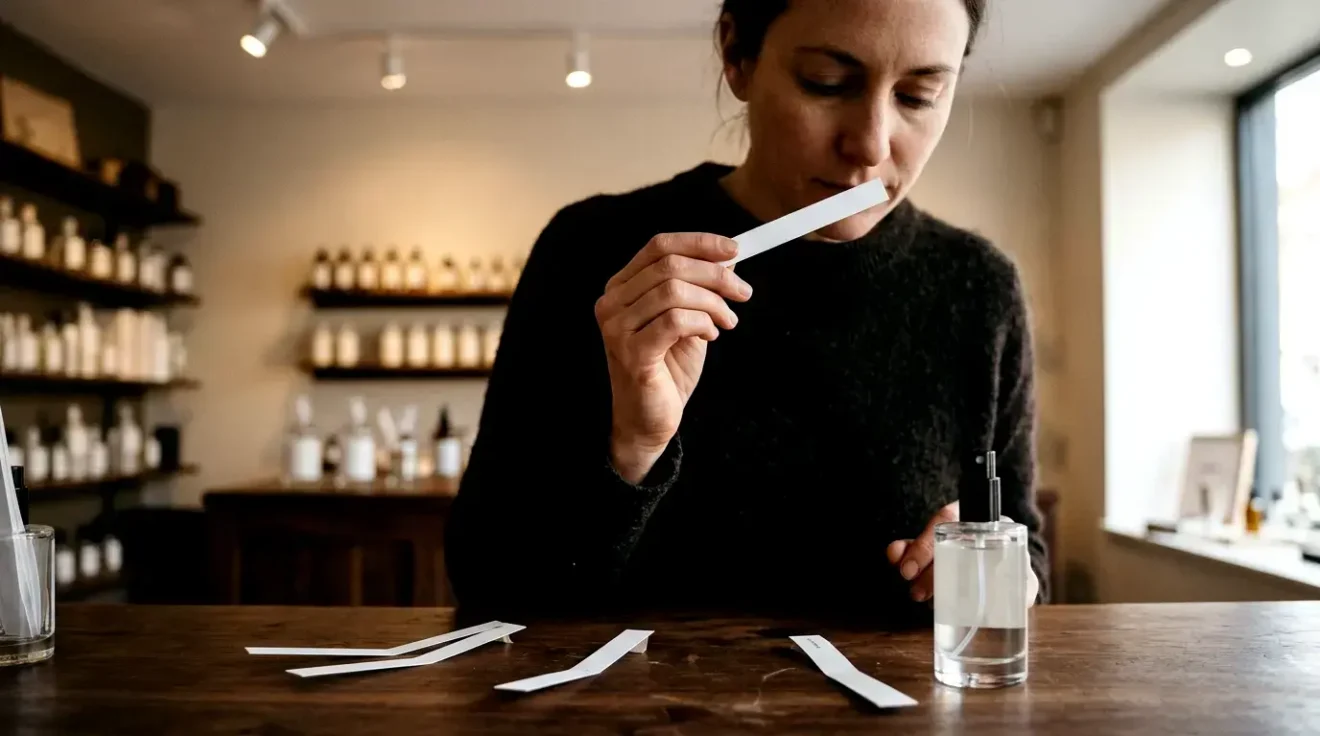
Start with paper testing when exploring a fragrance counter. A blotter is useful for eliminating compositions that immediately feel unpleasant and narrowing down a larger selection. It also allows an initial comparison without applying numerous perfumes to the body.
However, paper testing is a preliminary screening method, not a final purchasing decision. The evaporation characteristics of an inert surface differ from those of human skin. Hydration, surface roughness and transepidermal water loss can influence how fragrance materials evaporate, as demonstrated by the 2025 research discussed above.
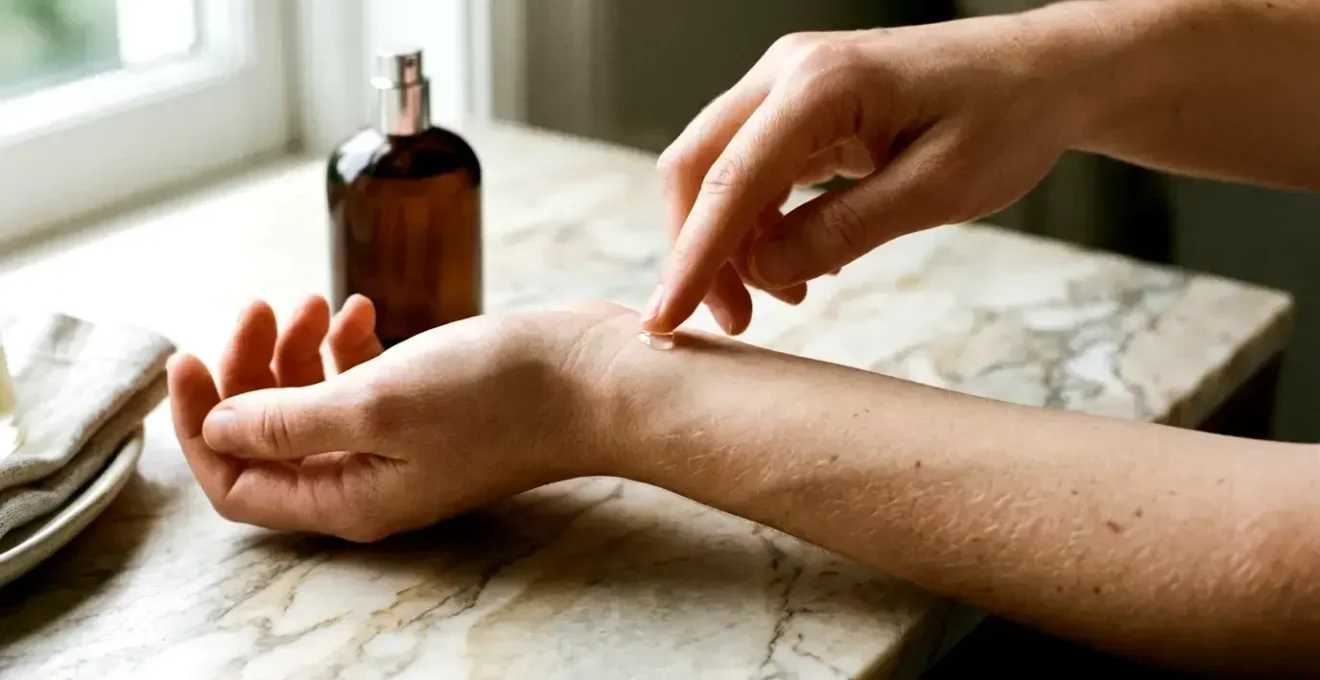
Once a promising fragrance has been identified, apply it to the inner forearm or wrist. Testing one fragrance at a time makes it easier to identify the individual composition and reduces confusion between overlapping scents. The Perfume Society recommends ideally testing one fragrance at a time and not exceeding three fragrances on the body during a testing session.
Allow the fragrance to settle naturally. Avoid rubbing the wrists together after application. Although rubbing is commonly discouraged in fragrance guidance, it is more accurate to say that it can interfere with a consistent evaluation of the application than to claim that it necessarily destroys fragrance molecules.
The Perfume Society recommends ideally testing one fragrance at a time and not exceeding three fragrances on the body during a testing session.
Observe the fragrance at several intervals:
- Immediately after spraying: Identify the opening, including fresh, citrus, aromatic or aldehydic impressions.
- After 30 minutes: Notice which facets remain and whether floral, fruity or spicy elements become more apparent.
- After one hour: Assess the developing heart and the relationship between its different materials.
- After four hours: Evaluate the dry-down, including woods, musks, resins and other persistent facets.
- Later in the day: Determine whether the fragrance remains pleasant and perceptible at a comfortable distance.
These observation points are practical rather than mandatory. Some fragrances reveal their character quickly, while others require longer wear. The important consideration is to avoid making a purchasing decision based exclusively on the first spray.
Another complication is temporary olfactory adaptation. After prolonged exposure, the wearer may become less conscious of a fragrance even though other people can still detect it. This can create the misleading impression that the perfume has disappeared and encourage unnecessary reapplication.
Repeatedly smelling coffee beans is not a scientifically established solution to this problem. A more useful approach is to take breaks, move into fresh air and avoid continuously smelling several competing fragrances. Giving the nose time away from the scent environment makes subsequent observations more meaningful.
There is also a difference between the fragrance perceived by its wearer and its projection to other people. The wearer experiences the scent at very close range, while colleagues, friends or dinner companions encounter it from a distance. This distinction can be described as the fragrance’s social presence: its perceptibility within ordinary conversational space.
A trusted person’s opinion can therefore complement personal testing. Ask whether the fragrance is noticeable at a normal conversation distance and whether its intensity feels comfortable. This feedback is more useful than repeatedly spraying simply because the wearer has become accustomed to the smell.
A Five-Step Fine Fragrance Testing Checklist
- Shortlist on paper: Record the names of the fragrances that remain appealing after the initial blotter evaluation.
- Choose one skin test: Apply one shortlisted fragrance to the forearm or wrist and record the application time.
- Document its evolution: Create a written observation sheet covering the opening, 30-minute stage, one-hour development and four-hour dry-down.
- Evaluate its social presence: Ask a trusted person for feedback on how noticeable the fragrance is at conversational distance.
- Record the final verdict: Note the overall comfort, preferred stage, persistence and any unpleasant development before considering a purchase.
The Perfume Society’s fragrance testing and application FAQ supports the distinction between preliminary blotter selection and subsequent skin evaluation. Its advice also emphasizes living with a fragrance before committing to a full bottle.
Once the complete composition has been assessed, the next decision is how its concentration and projection suit the occasion. This becomes particularly important for formal evening wear, where discretion can be more desirable than maximum diffusion.
Eau de Parfum or Parfum Extract: Which Suits Formal Evening Wear?
For formal evening wear, Eau de Parfum is often a versatile starting point because it can provide a balance between perceptibility and persistence. Parfum extract may be preferable when a closer, more intimate fragrance experience is desired. However, neither category guarantees a particular projection level: the composition, application and environment remain decisive.
The first distinction concerns concentration. Eau de Parfum and perfume extract describe customary categories based on the proportion of fragrance concentrate in the finished product. They do not represent a universal ranking of quality, sophistication or suitability for a particular occasion.
The International Fragrance Association identifies the following customary ranges:
| Fragrance category | Typical concentrate range | Approximate typical level |
|---|---|---|
| Eau de Cologne | 3–8% | 5% |
| Eau de Parfum | 10–20% | 15% |
| Perfume Extract | 15–40% | 20% |
These ranges are customary industry classifications rather than strict regulatory definitions. Their overlap is particularly important: an Eau de Parfum and an extract can have different concentrations without necessarily following a predictable hierarchy of projection or longevity.
10–20% versus 15–40%
These are the typical concentration ranges identified for Eau de Parfum and perfume extract respectively. The figures describe fragrance concentrate proportions, not guaranteed wear time, quality or projection.
International Fragrance Association, guidance on customary fragrance classifications.
For a formal dinner, theatre performance or other enclosed event, the relevant consideration is how the fragrance behaves in close company. A composition with controlled projection can feel more appropriate than one that continuously announces its presence across a room.
Parfum extract can be a compelling choice when its composition suits the wearer and a discreet application is sufficient. However, it is inaccurate to assume that every extract stays close to the skin. Some extracts are powerful and perceptible at a considerable distance, while some Eau de Parfum formulations remain relatively restrained.
Equally, a well-composed Eau de Parfum can be suitable for an elegant evening. Its customary concentration range offers a broad variety of olfactory styles, from transparent florals to woody, musky and amber compositions. The actual formula matters more than the category printed on the bottle.
Formal settings also change the practical balance. In a restaurant, fragrance is experienced alongside food, wine and the scents of other guests. In a theatre, prolonged proximity makes excessive projection especially noticeable. A fragrance that remains enjoyable at close range is generally a more considerate choice.
Temperature and ventilation influence the experience too. Cooler environments may make a fragrance seem less expressive, while warm surroundings can increase the perception of some compositions. Air conditioning, room size, clothing and the number of people present also affect how a scent is experienced.
Rather than automatically switching to a more concentrated product when a fragrance seems subdued, adjust the number and placement of applications conservatively. Test the result in comparable conditions before wearing it to an important event.
The International Fragrance Association’s guidance on fragrance concentrations explains that these classifications reflect common industry practice rather than strict regulatory definitions. It does not establish that a higher concentration necessarily produces greater projection or a more refined perfume.
For an evening event, the most elegant choice is the fragrance that remains comfortable throughout the occasion. Controlled projection, appropriate application and consideration for others are more meaningful indicators of refinement than concentration alone.
Why Applying More Luxury Perfume Can Make the Scent Less Enjoyable
Applying more luxury perfume can make it less enjoyable because excessive fragrance increases the intensity of the scent environment without necessarily improving the composition. The wearer may also become less aware of a familiar fragrance through olfactory adaptation, while people nearby continue to perceive it. The result can be an unnecessarily dominant scent that obscures the details of the perfume.
Olfactory adaptation is one of the main reasons people sometimes overapply fragrance. When the nose is exposed to the same scent repeatedly, its perceived intensity may diminish. The wearer can consequently believe that the fragrance has faded even when it remains noticeable to others.
This creates a familiar cycle: the perfume seems quieter, another spray is applied, and the resulting scent becomes stronger for everyone else. Repeating this process can produce a fragrance cloud that is disproportionate to the setting.
Overapplication can also change the way a composition is experienced. A carefully balanced perfume contains multiple materials with different olfactory characteristics. When too much is applied, its combined presence may become difficult to appreciate. Musky, woody, sweet or amber facets can dominate the experience, making the overall fragrance seem less nuanced.
This does not mean that the molecules have been chemically rearranged or that the fragrance’s original architecture has been destroyed. The issue is primarily one of perception and intensity. At excessive levels, the relationship between individual notes becomes less comfortable for the wearer and surrounding people.
Concentration should not be confused with dosage. A perfume extract applied sparingly may be less intrusive than a heavily applied Eau de Parfum. Conversely, a powerful composition can overwhelm a room even when the concentration category appears modest.
A useful calibration method is to start with fewer applications than instinct suggests. Select a small number of suitable application points, allow the fragrance to develop and evaluate its presence before considering additional sprays. The ideal amount depends on the formula, atomizer, setting and individual preferences; there is no universally correct spray count.
Clothing can also influence the experience. Fragrance applied to fabric may remain perceptible differently from fragrance applied to skin. However, delicate textiles, light-coloured materials and sensitive finishes require caution because certain formulations can leave marks or cause damage.
Consideration for other people is another important part of fragrance etiquette. Colleagues may prefer a restrained fragrance environment, while people sharing a small room or travelling in close proximity may find an intense scent uncomfortable. Fragrance allergy is a separate medical issue: it should not be confused with simply disliking a strong perfume.
DermNet explains that fragrance allergy is a form of allergic contact dermatitis involving delayed hypersensitivity to fragrance chemicals. Both naturally derived and synthetic materials can be responsible. The condition is different from temporary olfactory adaptation or ordinary sensitivity to an overpowering smell. People experiencing suspected allergic contact dermatitis may need medical assessment and appropriate patch testing.
Fragrance sensitivity and allergy also deserve careful distinction when considering others. Not every unpleasant reaction to a strong perfume is an allergy, and the presence of a strong scent does not establish that someone nearby has developed allergic contact dermatitis. Nevertheless, restrained application is a considerate practice in shared spaces.
The same principle applies in professional environments. A sophisticated perfume should complement the wearer rather than compete with conversations, meetings or the atmosphere of a shared office. Its presence can be subtle without becoming imperceptible.
Ultimately, restraint is not a compromise in fine perfumery. It is a way of allowing a well-balanced fragrance to remain distinctive without making its intensity the defining feature of the experience.
When Should You Buy a Full Bottle After Testing a Fragrance Sample?
A full bottle is worth buying when a fragrance remains appealing across several separate wearings, develops attractively on the skin and fits naturally into the situations in which it will be used. A single enthusiastic first impression is not enough. Repeated satisfaction with the dry-down, comfort and overall versatility provides a more dependable basis for a purchase.
Samples are valuable because they allow a fragrance to be experienced outside the controlled environment of a boutique. A perfume that seems captivating under store lighting and after a brief spray may feel different during an ordinary working day or a long evening.
One wearing also provides limited information about how a fragrance performs in different circumstances. Temperature, skin hydration, clothing and the amount applied can influence its perceived character. Repeated testing helps reveal whether the fragrance remains comfortable and attractive beyond its initial novelty.
A useful approach is to wear the sample on different occasions. Consider a normal daytime routine, an evening setting and, where practical, different ambient temperatures. Observe whether the fragrance becomes too sweet in warmth, feels insufficiently expressive in cooler conditions or maintains the character that initially attracted you.
Pay particular attention to the dry-down. The opening can be immediately appealing because of its fresh citrus, bright fruit or aromatic character. However, the deeper materials determine whether the composition remains enjoyable several hours later. If the base becomes excessively sweet, heavy or musky for your preferences, a full bottle may not deliver lasting satisfaction.
Another important consideration is whether the perfume adds something distinctive to an existing fragrance wardrobe. A composition can be beautiful yet redundant if several bottles already provide a very similar olfactory experience.
Compare its role with the perfumes already owned. Does it provide a different floral profile, a more transparent daytime option or a suitable fragrance for formal occasions? A clear purpose makes it more likely that the bottle will be used regularly rather than remaining an occasional novelty.
There is also a difference between enjoying a perfume and wanting to wear it repeatedly. A fragrance may be fascinating as an olfactory experience but less appealing as a personal signature. A reliable indication of genuine preference is the desire to reach for the sample again on a day when there is no particular reason to wear it.
Before buying, consider the following distinctions:
- Initial attraction: An appealing opening creates interest but does not establish long-term compatibility.
- Repeated satisfaction: Consistent enjoyment across multiple wearings indicates that the fragrance suits personal preferences.
- Dry-down compatibility: The later stages remain pleasant rather than becoming tiring or excessively intense.
- Practical versatility: The perfume has a clear role in everyday, social or formal settings.
- Wardrobe balance: The fragrance contributes something distinctive instead of duplicating several existing bottles.
There is no universally validated minimum number of sample applications that guarantees a good purchase decision. The number of wearings required depends on the complexity of the fragrance, the available sample quantity and the contexts in which it is tested.
It is also sensible to consider the practical commitment involved in a full bottle. A smaller sample or travel-size format may remain the more appropriate choice when the fragrance is attractive but likely to be worn only occasionally.
The strongest purchasing signal is not the excitement of discovering something new, but the consistent pleasure of wearing it. That distinction becomes particularly useful when exploring individual floral materials and their changing prominence on skin.
Key Takeaways Before Choosing a Floral Fragrance
- Floral fragrances do not all share the same intensity: fresh, green, transparent and solar compositions can feel very different from powdery or amber-heavy styles.
- Jasmine and other white flowers can become more noticeable as the opening fades, so their full character should be assessed after application.
- A fragrance that feels light in one environment may become more enveloping in warmer conditions, making seasonal skin testing valuable.
Why Does Jasmine Become More Noticeable Several Minutes After Perfume Application?
Jasmine often becomes more noticeable several minutes after perfume application because the more volatile opening materials gradually recede, allowing the floral heart to emerge. Citrus, fresh aromatic notes and some aldehydic facets can initially dominate the composition. As their intensity changes, jasmine becomes easier to recognise and may appear warmer, rounder or more prominent.
This is a natural aspect of fragrance development rather than evidence that the perfume has changed or deteriorated. Many traditional compositions are designed to create a progression from an immediately noticeable opening towards a more sustained floral, woody or musky character.
Jasmine is particularly interesting because its olfactory profile can combine luminous floral facets with warmer, more animalic nuances. Materials associated with jasmine include benzyl acetate and indolic compounds, which contribute to the complexity of certain jasmine accords.
Indolic nuances are particularly important in the perception of white flowers. Depending on the composition and concentration of the relevant materials, they can contribute a soft, rich or animalic dimension rather than a purely fresh floral impression. This is one reason jasmine can smell delicate in one perfume and more sensual or enveloping in another.
Skin temperature and the surrounding environment may also influence the way fragrance is perceived. However, it would be too simplistic to attribute every increase in jasmine intensity directly to body heat. The changing balance of the composition, the volatility of individual molecules and the characteristics of the skin all contribute to the experience.
The distinction between opening and heart notes is particularly useful for people who are uncertain about white florals. A fragrance that initially seems too bright or sharp may become more rounded as its floral materials take prominence. Conversely, someone who dislikes rich jasmine may find that an initially understated composition becomes too enveloping after the opening fades.
This makes the timing of fragrance evaluation important. Testing only during the first few minutes can produce an inaccurate impression of the perfume’s central character. A fragrance described as a jasmine Eau de Parfum should be evaluated at the stage when the jasmine accord is genuinely perceptible, not simply when the initial citrus or aromatic notes are strongest.
Application intensity also deserves attention. If jasmine is already prominent in the heart, applying more perfume to make the opening noticeable can produce excessive floral intensity later. A restrained first application gives the composition room to develop without creating an unnecessarily powerful result.
For someone who appreciates delicate florals but dislikes strong white-flower compositions, it can be helpful to distinguish between jasmine styles. Green, airy or fresh floral accords may feel more comfortable than rich, creamy or strongly indolic interpretations. The name of the flower alone does not reveal the entire olfactory experience.
Jasmine also illustrates why refinement is not necessarily associated with immediate impact. A well-constructed fragrance can reveal its floral identity progressively, allowing different materials to become perceptible at different moments. The experience resembles a gradual unfolding rather than an uninterrupted burst of intensity.
For practical evaluation, smell the fragrance immediately after application and then return to it after 30 minutes and one hour. Record whether the jasmine becomes greener, sweeter, creamier or more animalic. This vocabulary creates a more useful personal reference than simply describing the fragrance as stronger or weaker.
Recognising this evolution also makes it easier to choose the right floral family. The same attention to composition explains why some lighter fragrance categories behave differently from richer Eau de Parfum formulations.
Why Does Eau de Cologne Fade Faster Than Eau de Parfum?
Eau de Cologne generally fades faster than Eau de Parfum because it usually contains a lower proportion of fragrance concentrate and often emphasizes relatively volatile materials such as citrus and fresh aromatics. Its shorter-lived character is not necessarily a sign of inferior quality. It reflects a different fragrance style, often intended to deliver freshness rather than prolonged olfactory presence.
The International Fragrance Association identifies Eau de Cologne as typically containing 3–8 % fragrance concentrate, compared with 10–20 % for Eau de Parfum. These customary categories provide useful context, although individual manufacturers may formulate products differently and the ranges are not universal regulatory definitions.
Concentration, however, is only one part of the explanation. The composition of the fragrance is equally important. A perfume containing a significant proportion of volatile citrus materials may become quieter relatively quickly, whereas a formula with persistent woods, musks, resins or other less volatile ingredients may retain a noticeable character for longer.
This is why the percentage of concentrate cannot be used as a reliable standalone predictor of longevity. Two fragrances within the same concentration category may behave quite differently on the skin. Their ingredient profiles, molecular properties and interactions with the wearer all influence the perceived result.
Traditional Eau de Cologne often emphasizes freshness through citrus, aromatic herbs and bright top notes. These materials can create an immediate sense of cleanliness and energy, particularly in warm weather. Their relatively quick evaporation is consistent with the intended character of many colognes.
Eau de Parfum frequently provides a different experience. Its composition may include a more substantial heart and base, allowing woody, floral, musky or amber facets to remain perceptible after the initial freshness has receded. Nevertheless, not every Eau de Parfum is long-lasting, and not every Cologne disappears quickly.
There are practical ways to make an Eau de Cologne experience more comfortable and persistent without changing its essential character. Applying fragrance to adequately moisturised skin can support its wear, particularly when dry skin is involved. The Perfume Society also recommends moisturizing before fragrance application.
Application to clothing may provide another option, but it requires caution. Test first on an inconspicuous area, avoid delicate fabrics and check whether the formulation is suitable for the material. Fragrance can stain certain textiles, and not every product is designed for fabric application.
Reapplication can also be treated as part of the ritual. A refreshing Cologne in the morning may be intended to offer a short-lived burst of freshness rather than a continuous scent throughout the day. Reapplying when appropriate is not necessarily a correction for poor quality; it may simply reflect the intended use of the product.
This distinction becomes especially useful in summer. An Eau de Cologne can feel particularly appropriate after a shower, during a warm morning or when a heavy fragrance would seem excessive. Its appeal lies in its freshness and relative lightness, not in competing with the persistence of a richer evening perfume.
Choosing between Cologne and Eau de Parfum is therefore a question of purpose. A fresh, fleeting fragrance can be more appropriate than a persistent composition when the desired effect is clean, immediate and uncomplicated.
A lighter fragrance can be an expression of sophistication in its own right. The same principle applies to floral compositions: selecting a suitable style is more important than assuming that every floral perfume must be rich, powdery or intense.
Which Floral Eau de Parfum Suits Someone Who Dislikes Heavy, Powdery Scents?
Someone who dislikes heavy, powdery scents may prefer a transparent floral Eau de Parfum built around fresh, green, solar or lightly musky facets. The floral family includes many different olfactory styles, so rejecting powdery compositions does not mean rejecting flowers altogether. The most useful approach is to identify the specific notes and textures that create an uncomfortable impression.
Powderiness is a particular olfactory characteristic rather than an essential feature of floral perfumery. Some compositions use iris, heliotrope or soft cosmetic-style accords to create a dry, velvety or powder-like impression. When combined with vanilla, amber and rich musks, these materials can produce a particularly enveloping effect.
For someone who prefers lighter fragrances, these characteristics may be less appealing than fresh, luminous floral compositions. However, it is important not to assume that every iris or vanilla perfume is necessarily heavy. Their overall impression depends on the surrounding ingredients, proportions and formulation.
Several floral directions are worth exploring:
- Green florals: Fresh leaves, green stems and crisp botanical impressions can create an airy floral character rather than a soft cosmetic effect.
- Solar florals: These compositions often emphasize luminous, warm floral impressions without necessarily relying on dense powdery accords.
- Fresh white florals: Jasmine and other white flowers can appear bright and transparent, although some formulations become creamy or intense during the dry-down.
- Fruity florals: Fresh fruit facets can add brightness and a more playful character to floral compositions.
- Clean musky florals: Soft musks can create a close-to-skin impression when the overall formula remains restrained.
Fragrance descriptions can help narrow down the selection, but they should be treated as preliminary indicators rather than guarantees. Words such as transparent, green, fresh, solar and clean musky may suggest a direction worth exploring.
By contrast, descriptions emphasizing opulence, dense amber, strong powdery facets or rich vanilla may be less promising starting points for someone who dislikes heavy fragrances. Nevertheless, these terms are subjective and do not replace testing the actual composition.
The distinction between a floral family and a specific floral style is particularly important. Someone who believes they dislike florals may simply dislike a traditional powdery interpretation. A fresh green floral or a transparent jasmine composition can create an entirely different experience.
Seasonal testing is equally valuable. Warm conditions may make some white florals feel more enveloping, while cooler weather can change the way certain compositions are perceived. A fragrance that seems restrained in winter may feel substantially more prominent during a warm afternoon.
This is especially relevant for jasmine and tuberose. Both can appear luminous and fresh in certain compositions, but they can also be creamy, rich or intense. Their presence in the note list does not reveal how dominant they will become after application.
Skin testing is therefore essential. Apply the perfume sparingly, allow its opening to settle and evaluate its heart and base. If the composition becomes too powdery or enveloping after an hour, a different floral direction may be more suitable.
A useful selection strategy is to begin with several fragrance descriptions that emphasize fresh or transparent floral characteristics. Narrow the options with blotter testing, then evaluate the most promising compositions on skin over several hours. The goal is not to find a perfume with the fewest notes, but one whose materials create the desired balance.
It is also worth considering projection. A floral fragrance may have a light olfactory profile while still projecting strongly. Conversely, a richer floral perfume can be worn discreetly when its application is restrained. Scent family and projection are related aspects of the experience, but they are not interchangeable.
For those who prefer a subtle floral signature, the most suitable Eau de Parfum is often one that remains pleasant at close range without creating an excessive scent cloud. This is a matter of personal preference rather than a universal rule about which floral materials are inherently more refined.
The most satisfying floral fragrance is ultimately the one that suits the wearer’s preferences throughout its development, not simply the one with the most appealing description. Comparing its opening, heart, dry-down and projection on skin provides a more informed basis for choosing a fragrance that feels genuinely refined rather than overpowering.
Does a higher perfume concentration always mean better longevity?
No. A higher concentration indicates a greater proportion of fragrance concentrate, but it does not automatically guarantee longer wear. Longevity also depends on the composition, the volatility of its ingredients, skin characteristics and application. An Eau de Parfum with persistent base materials may last longer than a more concentrated fragrance built around relatively volatile ingredients.
Why can a luxury perfume become less noticeable to its wearer?
Repeated exposure can lead to olfactory adaptation, making the wearer less conscious of a familiar scent. Other people may continue to perceive it clearly. This is why asking a trusted person for feedback is often more useful than repeatedly applying additional sprays.
Should perfume be applied to moisturised skin?
Moisturising dry skin before fragrance application can support a more consistent wearing experience. Skin hydration is also relevant to fragrance evaporation, although its precise influence varies with the molecules and formulation. An unscented moisturiser is a practical choice when the aim is to avoid introducing competing aromas.
Can natural fragrance ingredients be more refined than synthetic ingredients?
Not inherently. Natural materials can contribute distinctive olfactory characteristics, while synthetic ingredients offer precision, consistency and effects that may be difficult to achieve otherwise. Refinement depends on the quality and balance of the complete composition rather than whether its ingredients are natural or synthetic.
How can someone choose a floral perfume without a powdery finish?
Start by exploring fresh, green, solar, transparent or clean musky floral descriptions. Be more selective with compositions emphasizing dense powdery, amber or creamy facets if those are characteristics you dislike. Most importantly, test the fragrance on skin and assess its dry-down, since a fresh opening can develop into a richer floral composition.