
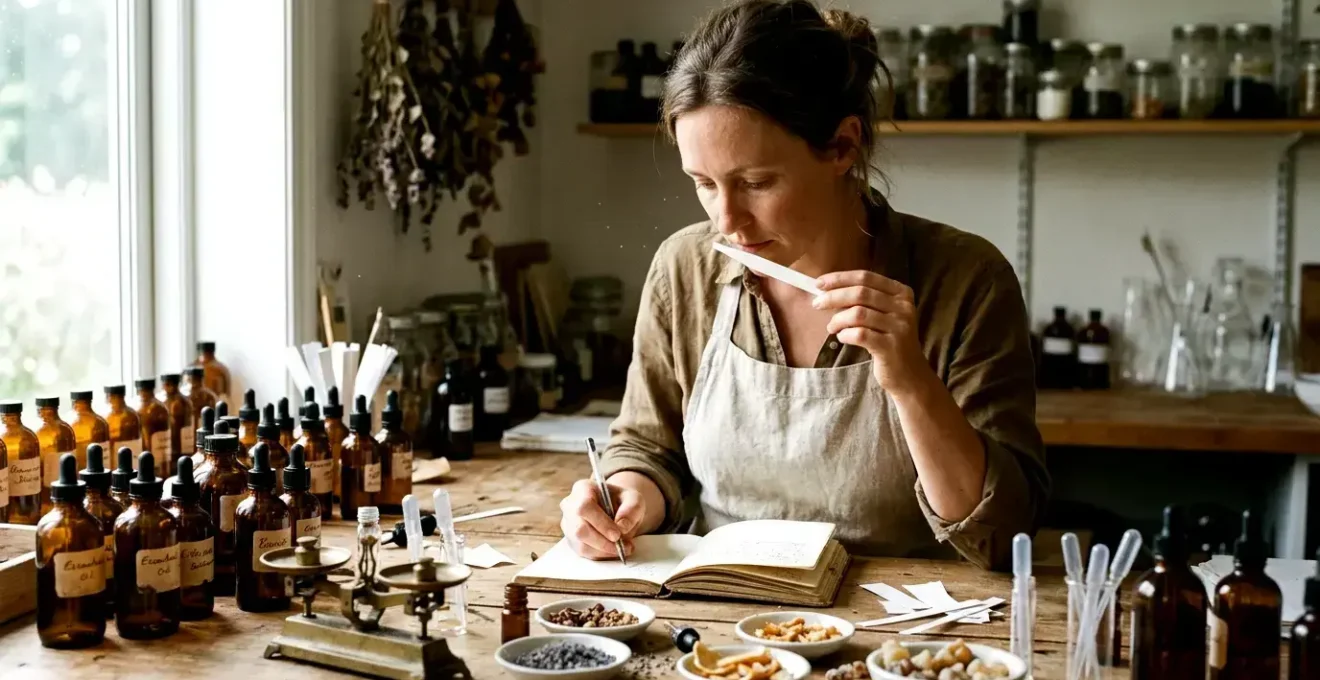
A distinctive botanical fragrance does not depend on synthetic aroma chemicals to achieve complexity, character or olfactory refinement. Essential oils, absolutes, resins, botanical extracts and aromatic woods offer an extensive palette of naturally occurring scent compounds that can be combined into expressive personal fragrances. Their individuality comes partly from their chemical complexity: a single plant extract may contain dozens or hundreds of volatile constituents that contribute different facets to its aroma.
The creative challenge is to build a coherent composition from materials that vary between harvests, behave differently during evaporation and may have different safety limitations. A successful botanical perfume therefore requires more than selecting ingredients that smell pleasant individually. It depends on understanding how they interact, how their scent develops over time and how extraction and formulation influence the finished result.
Without synthetic aroma chemicals, distinctive perfumery becomes an exercise in careful material selection, controlled experimentation and thoughtful composition. Natural variation is not necessarily an obstacle; when understood, it can become part of a fragrance’s identity.
Botanical Fragrance: The Essential Principles
- Plant-derived aromatic materials offer complex, naturally variable scent profiles that can create distinctive fragrance accords without synthetic aroma chemicals.
- Balanced compositions depend on thoughtful proportions, connecting materials and testing the fragrance at different stages of evaporation.
- Extraction methods, skin compatibility and responsible sourcing are essential considerations when selecting botanical fragrance ingredients.
- Why Does a Natural Perfume Smell Slightly Different From One Batch to Another?
- How to Build a Botanical Perfume Accord Without Overloading the Blend?
- Botanical Perfume Oil or Alcohol-Based Spray: Which Fits Your Daily Routine?
- Why Botanical Perfumes Can Still Cause Allergic Skin Reactions
- How to Improve the Balance Between Fresh and Resinous Notes in Natural Perfume?
- CO2 Extraction or Ethanol Extraction: Which Better Suits Delicate Botanicals?
- Why Can Wild-Harvested Sandalwood Create Serious Conservation Concerns?
- What Makes a Fine Fragrance Feel Refined Rather Than Overpowering?
Why Does a Natural Perfume Smell Slightly Different From One Batch to Another?
A natural perfume can smell slightly different from one batch to another because its botanical ingredients are agricultural materials rather than chemically identical manufactured substances. Growing conditions, harvest timing, plant maturity and extraction techniques can influence the proportions of aromatic compounds in an essential oil. These differences may affect freshness, sweetness, intensity and overall balance, even when the botanical species and supplier remain unchanged.
Plant chemistry responds to environmental conditions. Temperature, rainfall, soil characteristics and seasonal development can influence the production of volatile compounds. Harvesting the same aromatic plant at different growth stages may also produce different oil yields and chemical profiles.
A 2022 study published in Plants examined five aromatic species from the Lamiaceae family and identified changes in essential oil yield and composition across harvesting periods. The researchers used gas chromatography coupled with mass spectrometry (GC-MS) to analyse the volatile constituents. The findings support the importance of harvest timing, although they should not be generalized to every botanical species or commercial extraction process. The scientific study on seasonal variation in aromatic plant oils provides a useful reference for understanding this variability.
For a perfumer, the practical response is to compare the technical documentation accompanying each incoming batch. A GC-MS certificate of analysis can identify major constituents and reveal differences between lots. Comparing the relative proportions of key compounds helps determine whether a material remains suitable for its intended role in a formula. However, GC-MS data do not capture every aspect of odour perception, so analytical comparison should always be accompanied by smelling evaluations.
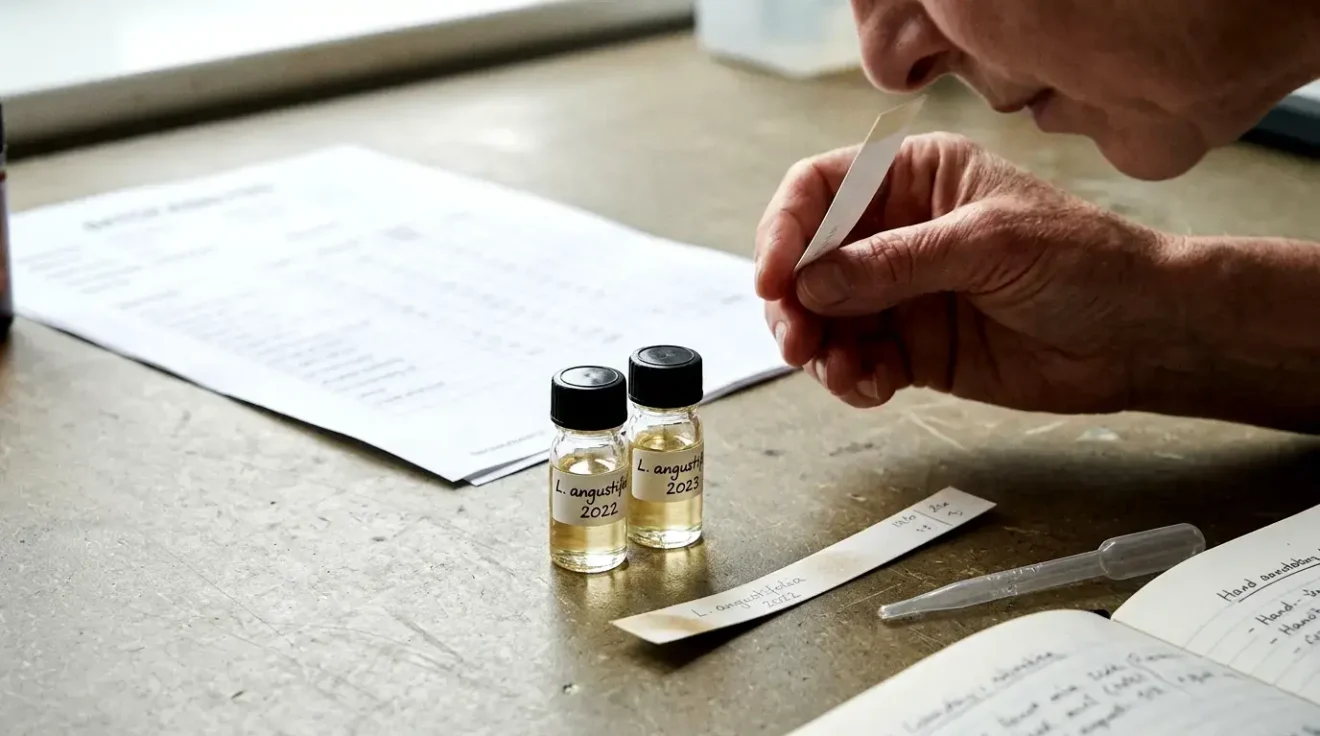
There is also a sensory distinction between unwanted inconsistency and useful natural variation. A small shift in a floral oil’s green or honeyed facets may enrich a composition, whereas a substantial change in a dominant constituent could disrupt the balance of an established accord. Working with complementary groups of ingredients rather than relying entirely on one essential oil can make a formula more adaptable.
Batch variation also has a safety dimension. The relative concentrations of naturally occurring fragrance allergens and other relevant constituents can change. A formulation that was assessed using one batch should not automatically be assumed to have identical exposure characteristics when a different batch is introduced. Reassessment may be necessary under the applicable cosmetic safety framework.
Once the characteristics of each material are understood, the next challenge is combining them without allowing individual ingredients to compete for attention.
How to Build a Botanical Perfume Accord Without Overloading the Blend?
A botanical perfume accord is best built by combining a small number of complementary materials and evaluating their interaction before introducing additional ingredients. Starting with a few foundational notes makes it easier to identify which materials contribute depth, continuity and character. The aim is not to maximize the ingredient count, but to create a coherent scent that develops naturally as its components evaporate.
A practical approach is to begin with two or three materials that establish the intended direction. For example, a woody-resinous foundation might combine a vetiver material with a carefully selected frankincense extract and a soft balsamic note. These ingredients create a starting structure without requiring an elaborate formula.
Heart materials can then be introduced individually. Lavender, geranium or other aromatic botanicals may add floral, herbal or fresh dimensions, depending on the desired character. Each addition should be evaluated on its own and within the complete accord. Natural materials can behave differently as their more volatile constituents evaporate, so the initial impression is not enough to establish whether an ingredient belongs in the final composition.
One useful concept is that of bridging materials. Certain botanical ingredients connect otherwise contrasting olfactory families. Lavender, for instance, can link aromatic herbs with floral and woody notes. Bergamot may introduce a fresh citrus dimension while helping a floral composition feel more open. Vetiver can connect earthy, woody and citrus-like facets in an accord.
These materials are valuable because they can improve continuity without requiring a growing list of corrective ingredients. Nevertheless, their effectiveness depends on the particular extract, its concentration and the surrounding composition.
Dilution also makes experimentation easier. Preparing working dilutions, such as 10% solutions in a compatible perfumer’s alcohol or suitable carrier, allows individual materials to be evaluated more precisely. The dilution must be appropriate to the material and its intended use; some ingredients require different concentrations or handling precautions. A working dilution is an evaluation tool, not a declaration that the material is safe for direct skin application.
When an accord feels heavy, adding another ingredient is not necessarily the answer. A better decision-making process considers whether one material is dominating the composition, whether its persistence is appropriate and whether its contribution justifies its cost and allergen profile.
Useful reasons to remove rather than add an ingredient include:
- Excessive olfactory weight: one material masks the other notes instead of supporting them.
- Unbalanced persistence: the ingredient remains dominant long after its intended role has ended.
- Unnecessary complexity: removing it produces a clearer and more recognizable accord.
- Cost considerations: its contribution does not justify its proportion in the formulation.
- Safety considerations: its allergen profile or use restrictions complicate the intended application.
Keeping a formulation notebook with ingredient identity, batch number, dilution, proportion and evaluation notes makes each experiment reproducible. It also helps distinguish a genuinely useful addition from an ingredient that merely makes the initial blend smell more intense.
A Practical Botanical Accord Development Checklist
- Choose two or three complementary foundational materials and record their botanical names, supplier details and batch numbers.
- Prepare appropriate working dilutions and document the concentration and dilution medium of each material.
- Introduce one heart ingredient at a time and record its contribution to the overall scent profile.
- Evaluate the accord immediately and after 24 and 48 hours, recording changes in balance, persistence and character.
- Review each ingredient’s olfactory contribution, cost and safety documentation, then produce a revised formula with a complete ingredient record.
Once an accord works on a blotter, its intended format becomes the next important decision: an oil and an alcohol-based spray can express the same ingredients quite differently.
Botanical Perfume Oil or Alcohol-Based Spray: Which Fits Your Daily Routine?
Botanical perfume oil is generally better suited to close-to-skin fragrance and discreet application, while an alcohol-based botanical spray usually offers a more immediate opening and broader initial diffusion. Neither format is universally superior. The right choice depends on the desired projection, skin compatibility, climate, portability and how often the wearer can comfortably reapply the fragrance.
The principal difference lies in the carrier. A perfume oil disperses aromatic ingredients through a suitable lipid-based medium, while an alcohol-based spray uses a volatile solvent system, commonly based on perfumer’s ethanol. These carriers influence how a fragrance is released and experienced.
| Criterion | Perfume oil | Alcohol-based spray |
|---|---|---|
| Initial projection | Usually closer to the skin | Often more noticeable immediately after application |
| Fragrance development | Can feel slower and more intimate | Often provides a more pronounced opening |
| Application | Small amounts applied to selected skin areas | Fine mist applied to suitable skin or clothing |
| Portability | Convenient in compact roller or dropper bottles | Available in travel-sized spray formats |
| Skin behaviour | Depends on the carrier oil and individual skin characteristics | Alcohol may feel drying or irritating on some skin |
| Storage | Carrier oils may oxidize and develop rancid odours | Suitable ethanol concentrations can inhibit microbial growth, but formulation stability still requires assessment |
Perfume oils are often appropriate in environments where subtle projection is preferable. Their more intimate diffusion can suit office settings, shared indoor spaces or situations where a strong scent trail would be unwelcome. However, their longevity is not guaranteed to exceed that of a spray. It depends on the aromatic materials, carrier, concentration and individual skin conditions.
Alcohol-based sprays often make citrus, herbal and other volatile notes more immediately perceptible. Their rapid evaporation can also help create a noticeable transition from the opening to the heart of the fragrance. On the other hand, the sensation of alcohol during application may not suit every wearer.
Storage is another important consideration. Vegetable carrier oils can undergo oxidation, particularly when exposed to oxygen, heat and light. Oxidation may alter their smell and the stability of the fragrance. Alcohol-based products can offer different preservation characteristics, but ethanol should not automatically be treated as a complete solution to formulation stability or product contamination.
Before choosing a format, consider the following:
- Whether close-to-skin wear or more noticeable projection is preferred.
- Whether the fragrance will be worn in warm, humid or cooler conditions.
- Whether the skin tolerates the selected carrier.
- Whether reapplication during the day is practical.
- Whether the fragrance will also be applied to clothing, taking account of possible staining or material damage.
Whatever the format, the ingredients must still be assessed for skin compatibility. Plant-derived fragrance materials can be potent sources of naturally occurring allergens.
Why Botanical Perfumes Can Still Cause Allergic Skin Reactions
Botanical perfumes can cause allergic skin reactions because natural aromatic extracts contain biologically active fragrance compounds, some of which are recognized contact allergens. Linalool, limonene, geraniol and eugenol are examples of naturally occurring substances that may cause allergic contact dermatitis in sensitized individuals. Their botanical origin does not remove their potential to trigger an immune response.
Allergic contact dermatitis is different from simple irritation. Irritant reactions can occur through direct damage or disruption of the skin barrier, whereas allergic contact dermatitis involves an immune response to a substance to which the individual has become sensitized. Symptoms may include itching, redness, swelling and an eczematous rash.
Some fragrance allergens occur naturally in essential oils and extracts, including citrus, floral and aromatic herb materials. Their presence does not mean that every botanical perfume is unsafe, but it does mean that ingredient selection and exposure levels matter.
The regulatory approach to fragrance allergen labelling also depends on the market. In the European Union, cosmetic ingredient declarations are governed by Regulation (EC) No 1223/2009 and its amendments. Under Commission Regulation (EU) 2023/1545, additional fragrance allergens were brought within individual declaration requirements.
From 31 July 2026, the applicable individual labelling thresholds for listed fragrance allergens are generally 0.001% in leave-on cosmetic products and 0.01% in rinse-off products. A transitional period ending on 31 July 2028 applies to qualifying products placed on the EU market before 31 July 2026. These thresholds concern declaration requirements, not universal safe-exposure limits.
The European Commission’s fragrance allergen labelling requirements are relevant to botanical as well as conventional fragrance ingredients. An allergen may therefore require individual declaration even when the product is marketed as entirely plant-derived.
0.001% and 0.01%
Under the applicable EU fragrance allergen declaration rules, these are the respective concentration thresholds for individual declaration in leave-on and rinse-off cosmetic products. They are labelling thresholds, not proof that lower concentrations cannot trigger an allergic reaction.
European Commission, Regulation (EU) 2023/1545.
In the United States, the FDA provides separate consumer guidance on allergens in cosmetics. Fragrance ingredients may sometimes appear collectively under terms such as fragrance or perfume rather than being individually identified on the ingredient list. This means that a consumer cannot necessarily determine every fragrance constituent from the label alone. The FDA information on allergens in cosmetics explains the distinction and discusses allergic contact dermatitis and medical allergy testing.
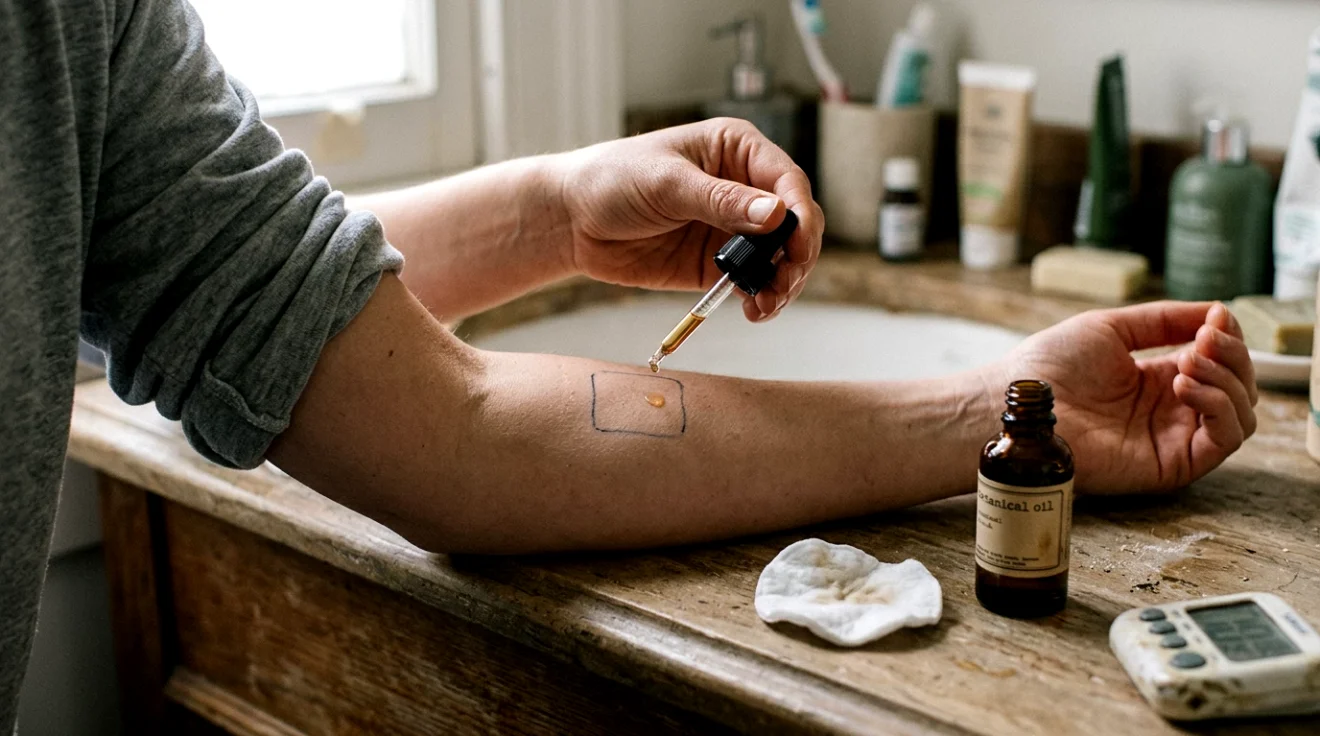
Skin testing also requires care. A casual application of diluted perfume to the inner elbow followed by observation for 24–48 hours is not a validated method for ruling out allergic sensitization. The absence of an immediate reaction does not establish that a product is safe for repeated use. The FDA describes professional patch testing as a medical diagnostic procedure, with controlled allergen application and subsequent clinical assessment. Anyone with a history of fragrance allergy or persistent skin reactions should seek advice from a dermatologist or qualified healthcare professional rather than experimenting with essential oils on the skin.
Photosensitivity is another consideration. Certain expressed citrus oils, particularly bergamot, can contain phototoxic constituents that increase the risk of skin reactions following ultraviolet exposure. The degree of risk depends on the specific oil, extraction method, composition and formulation. Phototoxicity should not be confused with allergic contact dermatitis: the mechanisms and precautions are different. Appropriate bergapten-reduced or otherwise suitable materials may be available, but their identity and safety documentation must be verified rather than assumed.
For botanical perfumers, the essential principle is to assess the finished formulation and its individual ingredients, not simply rely on the word natural as an indication of skin compatibility.
Once ingredient safety has been considered, attention can return to the sensory challenge of composition: creating a gradual transition between volatile fresh notes and persistent botanical resins.
How to Improve the Balance Between Fresh and Resinous Notes in Natural Perfume?
Balancing fresh and resinous notes in a botanical perfume requires managing their different evaporation characteristics and olfactory weight. Citrus and herbal materials often create a bright opening but can fade relatively quickly, while balsamic resins and aromatic woods may remain perceptible much longer. A successful composition connects these phases instead of allowing the fragrance to shift abruptly from fresh to overwhelmingly resinous.
Fresh botanical materials such as citrus oils, mint and aromatic herbs often contain relatively volatile constituents. Depending on their composition, they may lose much of their initial impact during the first stages of wear. Resinous materials such as frankincense, labdanum and benzoin often contribute deeper, persistent facets that become more prominent as the lighter notes recede.
The result can be a fragrance that seems bright and refreshing on application but becomes dense and balsamic later. This is not necessarily a flaw: it can be an intentional olfactory development. However, if the transition feels disconnected, the formula needs a more coherent middle structure.
One approach is to introduce materials with intermediate olfactory persistence. Petitgrain can connect citrus freshness with green and woody dimensions. Cypress can provide an aromatic bridge between herbal and woody families, while ginger can add a fresh, spicy dimension. The suitability of each material depends on the exact extract and its proportion.
It is also useful to evaluate the fragrance at several defined moments rather than relying on a single initial impression:
| Evaluation stage | What to observe | Possible formulation response |
|---|---|---|
| Immediately after application | Brightness, freshness and initial intensity | Review the proportion and character of the opening materials |
| After 1 hour | Whether the transition into the heart feels coherent | Assess bridging materials and the relative weight of the middle notes |
| After 4 hours | Whether the resinous foundation dominates excessively | Reassess persistent resins and the balance of the base accord |
These observation times are practical formulation checkpoints, not universal evaporation benchmarks. Different materials, concentrations, carriers and environmental conditions can produce different development patterns.
The carrier also changes the perceived balance. An alcohol-based spray may make the initial fresh notes more pronounced, while an oil-based format can create a softer opening and a different release profile. Consequently, a formula developed in alcohol should not automatically be transferred into a carrier oil without evaluation.
The character of those ingredients also depends on how their aromatic compounds are extracted, particularly when working with delicate flowers and spices.
Key Considerations Before Creating a Refined Botanical Fragrance
- Choose botanical extracts according to their actual chemical and olfactory profiles, rather than assuming that every extraction method produces an interchangeable material.
- Evaluate the origin and traceability of aromatic woods and other materials whose harvesting may create environmental pressure.
- Prioritize a coherent scent structure, appropriate concentration and controlled projection over maximum intensity or ingredient quantity.
CO2 Extraction or Ethanol Extraction: Which Better Suits Delicate Botanicals?
CO2 extraction is often useful when a perfumer wants an aromatic extract obtained under relatively low-temperature conditions without leaving a conventional organic extraction solvent in the finished extract. Ethanol extraction can be preferable when a broader range of soluble botanical constituents is desired or when an established absolute-production process is more accessible. The best method depends on the plant, the target aromatic profile and the intended formulation.
Supercritical carbon dioxide extraction uses carbon dioxide under controlled pressure and temperature conditions to dissolve selected plant constituents. When extraction is complete, reducing the pressure allows the carbon dioxide to separate from the extract. This process avoids the use of conventional organic extraction solvents in the extraction stage, although the quality and purity of the finished material still depend on the equipment, processing and supplier controls.
One attraction of CO2 extraction is its ability to capture aromatic profiles that may differ from those obtained through steam distillation. Depending on the plant and process, the extract may contain a broader selection of volatile and less volatile constituents. Its sensory profile can therefore feel more complete, rounded or materially different from the corresponding essential oil.
Ethanol extraction relies on the solvent’s ability to dissolve a range of botanical compounds. It is commonly associated with the production of fragrance absolutes and other extracts. Depending on the raw material and processing conditions, ethanol extraction may capture aromatic constituents alongside pigments, waxes and other less volatile substances.
| Criterion | CO2 extraction | Ethanol extraction |
|---|---|---|
| Extraction conditions | Controlled pressure and temperature | Solvent-based extraction with process-dependent temperature conditions |
| Solvent separation | Carbon dioxide separates through depressurization | Ethanol is removed through subsequent processing |
| Aromatic profile | Can capture a distinctive range of volatile and less volatile constituents | Can capture deeper aromatic and other solvent-soluble components |
| Potential formulation impact | May have a different intensity, texture and solubility from a distilled oil | May contain waxes, pigments and other extracted constituents |
| Commercial considerations | Equipment and extraction costs can influence availability | Established absolute-production processes may offer different sourcing options |
Ginger illustrates why extraction methods cannot be treated as interchangeable. A ginger CO2 extract may have a richer, more complete aromatic profile than a distilled ginger essential oil, depending on the extraction process and specification. Using the same proportion of both materials in a formula may therefore produce noticeably different results.
Delicate flowers also demonstrate the importance of extraction choice. Rose and jasmine materials can be available in different extract forms, each with its own aromatic characteristics, price and formulation requirements. A creator working on a small scale may need to balance the desired olfactory effect with the accessibility and cost of the selected material.
Before purchasing an extract, useful documentation includes:
- Botanical species and plant part used.
- Extraction method and relevant processing information.
- Batch-specific certificate of analysis.
- Solvent or carrier information, where applicable.
- Safety data and relevant allergen information.
- Recommended storage and formulation compatibility.
However, technical performance is only one part of responsible perfumery. The origin and harvesting practices behind certain aromatic woods can have equally important implications.
Why Can Wild-Harvested Sandalwood Create Serious Conservation Concerns?
Wild-harvested sandalwood can create conservation concerns because aromatic heartwood takes time to develop and harvesting mature trees can place pressure on naturally occurring populations. Demand for sandalwood oil and wood products creates an incentive to harvest valuable trees, making species identification, harvesting controls and supply-chain traceability important considerations for botanical perfumers.
Sandalwood is not a single interchangeable material. Different species, including Santalum album and Santalum spicatum, have distinct geographical origins, aromatic profiles and sourcing contexts. Their conservation and production conditions should therefore be evaluated individually rather than grouped under a generic sandalwood label.
Australia provides an informative example of how wild harvesting and plantation production can coexist. An Australian Government forest-sector report published in December 2025 describes sandalwood harvesting and plantation production, including Western Australian plantations managed by the Forest Products Commission.
The report indicates that these plantations were typically harvested at approximately 25–30 years to allow sufficient heartwood and oil development. It also reports an average annual harvest of 1,875 tonnes of Western Australian sandalwood from lands managed by the Forest Products Commission during 2016–17 to 2020–21.. These are historical reporting figures, not current annual production estimates.
The Australian Government report on sandalwood harvesting and plantations helps distinguish plantation production from wild harvesting, while illustrating the importance of long production cycles.
For an independent perfumer, responsible purchasing begins with asking precise questions about provenance. A supplier’s use of the word sustainable is not sufficient evidence of responsible sourcing. More useful information includes the botanical species, geographical origin, harvesting method and traceability documentation.
Several practical distinctions matter:
- Wild-harvested sandalwood: its sustainability depends on the species, location, harvesting rules, population condition and enforcement of those rules.
- Plantation-grown sandalwood: can offer a more traceable production model, but plantation origin alone does not establish independent certification or complete environmental sustainability.
- Regeneration and replanting initiatives: may support long-term supply, although their effectiveness depends on implementation, survival rates and management practices.
The same sourcing discipline applies beyond sandalwood. Agarwood or oud, rosewood and other valuable wild-harvested botanical materials may raise conservation or trade concerns. Some historical animal-derived fragrance materials, such as natural civet, also raise significant animal-welfare questions. Ambergris has a different biological and legal context and should not be treated as equivalent to cultivated plant materials or ordinary essential oils.
When ingredient identity, formulation safety and sourcing are considered together, the remaining challenge is to transform those choices into a fragrance that feels elegant, coherent and comfortable to wear.
What Makes a Fine Fragrance Feel Refined Rather Than Overpowering?
A fine fragrance feels refined when its ingredients create a coherent progression, its intensity suits the intended setting and its projection remains proportionate to the wearer and environment. Refinement does not necessarily require a large ingredient list, expensive raw materials or a low concentration. It depends more on the relationship between materials, the smoothness of transitions and the way the fragrance is experienced over time.
A botanical perfume can contain a relatively small number of carefully selected extracts and still develop considerable complexity. Conversely, a formula containing many individually attractive ingredients may feel crowded if their aromatic profiles compete rather than complement one another.
The distinction becomes particularly noticeable during fragrance development. A refined composition allows the opening to introduce its character, the heart to develop that identity and the base to provide continuity. The transition should feel intentional rather than like several unrelated materials appearing at different stages.
Density and projection are also separate characteristics. A fragrance may feel dense and textured close to the skin while producing a relatively discreet scent trail. Another composition may have a comparatively light structure but project sharply because of the volatility and diffusion characteristics of its ingredients.
Concentration alone therefore does not determine whether a fragrance feels overpowering. The aromatic profile, individual ingredient proportions, application quantity and environment all influence the perceived intensity.
For wearers who want to manage projection without changing a well-balanced formula, application technique can make a meaningful difference:
- Apply a modest amount to selected skin areas rather than repeatedly layering the fragrance.
- Consider how the chosen application area affects evaporation and diffusion.
- Use clothing or accessories cautiously, taking account of potential staining and material compatibility.
- Allow the fragrance to develop before deciding that another application is necessary.
- Consider the sensitivity of people sharing the same indoor environment.
Hair and fabrics can retain aromatic materials differently from skin, but they should not automatically be assumed to be safer application surfaces. Essential oils and concentrated perfume materials may irritate skin, damage some materials or cause staining. Application should follow the product’s intended use and safety instructions.
For creators, the most reliable route to refinement is repeated evaluation at different concentrations and on appropriate testing substrates. A formula should be assessed for its opening, heart, dry-down, persistence and overall coherence rather than judged exclusively by its first impression.
Botanical perfumery also benefits from respecting the distinctive character of its materials. Not every natural variation needs to be eliminated, and not every ingredient needs to be made louder to justify its place in a formula. The goal is a balanced composition in which each botanical component contributes something identifiable without overwhelming the others.
For enthusiasts exploring plant-based personal scents, the most productive next step is to experiment with a small, well-documented group of botanical materials, evaluate their development over time and select a formulation that reflects both the desired olfactory character and the practical requirements of safe, responsible wear.
Can a botanical perfume smell complex without synthetic fragrance ingredients?
Yes. Essential oils, absolutes, CO2 extracts, resins and aromatic woods contain naturally occurring mixtures of volatile and less volatile compounds. Combining materials with complementary profiles can create complex floral, woody, citrus, herbal and balsamic compositions. The quality of the result depends on ingredient selection, proportions and the way the accord develops over time.
Do botanical perfumes last as long as conventional perfumes?
Longevity depends on the aromatic ingredients, their concentration, the carrier and the conditions of wear. Some resinous and woody botanical materials can remain perceptible for extended periods, while many citrus and herbal notes are more volatile. A botanical perfume may have a different development pattern from a conventional fragrance, but natural origin alone does not determine its longevity.
Are essential oils safer than synthetic aroma chemicals?
No. Natural and synthetic fragrance substances can both cause irritation or allergic reactions. Certain essential oils contain recognized fragrance allergens, and some expressed citrus oils contain phototoxic constituents. Safety depends on the identity, concentration, purity, exposure and intended application of each ingredient, not simply whether it is natural or synthetic.
Which botanical ingredients are useful for creating a long-lasting perfume base?
Botanical perfumers commonly explore materials such as vetiver, frankincense, labdanum, benzoin and sandalwood for woody, earthy or balsamic dimensions. Their persistence and intensity vary with the species, extract type, processing method and formulation. Each material should be assessed individually rather than assumed to perform identically across different suppliers or batches.
How can botanical perfume enthusiasts identify responsibly sourced ingredients?
Look for suppliers who disclose the botanical species, geographical origin, plant part, extraction method and batch-specific documentation. For materials such as sandalwood and oud, ask whether the ingredient comes from wild harvesting, managed plantations or another traceable source. Where applicable, verify the scope of sustainability certifications and any relevant harvesting or trade requirements instead of relying on general environmental claims.